How to Increase Jewellery AOV Without More Traffic: System-Level Revenue Optimisation Strategies
Most jewellery businesses try to grow revenue the same way:
- more traffic
- more ads
- more SEO
- more social media reach
And when revenue plateaus, they assume the problem is acquisition.
But in high-ticket jewellery eCommerce, that assumption is structurally flawed.
Because the real constraint is not how many people enter your system.
It is how much value your system extracts from each decision.
That metric is called AOV (Average Order Value).
And in jewellery, AOV is not a marketing metric.
It is a system design outcome.
⸻
The Core Problem: Traffic Growth Without Value Growth
A common pattern appears across jewellery businesses:
- traffic increases
- enquiries increase
- workload increases
- revenue grows slowly or inconsistently
At first glance, this looks like a marketing issue.
But when you examine the system closely, a different pattern emerges:
users are entering the system, but the system is not increasing the value of their decisions
In other words:
- the system converts interest into purchases
- but it does not expand purchase value
That is a structural limitation.
Not a traffic limitation.
⸻
The Myth: “More Traffic = More Revenue”
This is one of the most expensive misconceptions in eCommerce.
Traffic is a volume lever.
AOV is a value lever.
They are not interchangeable.
If your system is weak, more traffic simply produces:
- more low-value conversions
- more unqualified enquiries
- more operational strain
- more inconsistent sales cycles
But not proportionally more revenue.
Because:
traffic increases opportunity, but AOV determines profitability per opportunity
Without AOV optimisation, growth becomes inefficient.
⸻
Why AOV Matters More in Jewellery Than Almost Any Other Industry
Jewellery is structurally different from standard eCommerce categories.
Three factors make AOV disproportionately important:
1. High-ticket pricing structure
Each transaction carries significant value variation:
- entry-level pieces
- mid-range rings
- premium diamond configurations
Small decision changes = large revenue shifts.
⸻
2. Emotional justification cycles
Customers don’t just buy jewellery.
They justify it:
- emotionally
- socially
- financially
This creates natural upgrade potential—but only if structured correctly.
⸻
3. Configuration-driven pricing models
Jewellery is not fixed-product retail.
It is:
- selection-based
- upgrade-driven
- attribute-dependent pricing
Which means:
every interaction is an opportunity to increase or decrease order value
⸻
Where AOV Is Actually Lost in Jewellery Systems
Most businesses do not lose AOV at checkout.
They lose it much earlier in the system.
⸻
A. No structured upsell logic inside the journey
In many jewellery stores, upselling happens:
- manually (sales conversations)
- inconsistently (depends on staff skill)
- too late (after decision is already formed)
There is no system-level structure guiding users toward higher-value decisions.
So upgrades are accidental, not engineered.
⸻
B. Configurators that show options but don’t guide value
Many jewellery configurators allow customisation, but do not influence:
- upgrade direction
- value perception
- tier progression
They present options equally.
But equal presentation creates neutral decision behaviour.
And neutral behaviour does not increase AOV.
⸻
C. No bundle or lifecycle thinking
Most jewellery websites treat products individually:
- ring
- band
- necklace
But customers think in lifecycle terms:
- proposal
- wedding
- anniversary
Without structured bundling:
you miss natural multi-product purchase opportunities
⸻
D. Weak pricing psychology integration
Pricing is often displayed as static information.
But pricing should function as:
- a decision anchor
- a value ladder
- a progression system
Without psychological structuring:
- users default to lower tiers
- upgrades feel optional instead of logical
- value perception is flattened
⸻
E. No behavioural segmentation
Most systems treat all users the same.
But behaviour reveals:
- high-intent buyers
- comparison shoppers
- low-intent browsers
Without segmentation:
high-value buyers are not systematically guided toward higher-value outcomes
⸻
The System Thinking Approach to AOV
AOV is not improved through persuasion.
It is improved through architecture.
That means:
AOV is engineered, not sold
It is the result of how your system is structured.
Not how your marketing performs.
⸻
System-Level Strategies to Increase Jewellery AOV
To increase AOV sustainably, you must design the system to naturally expand decision value.
⸻
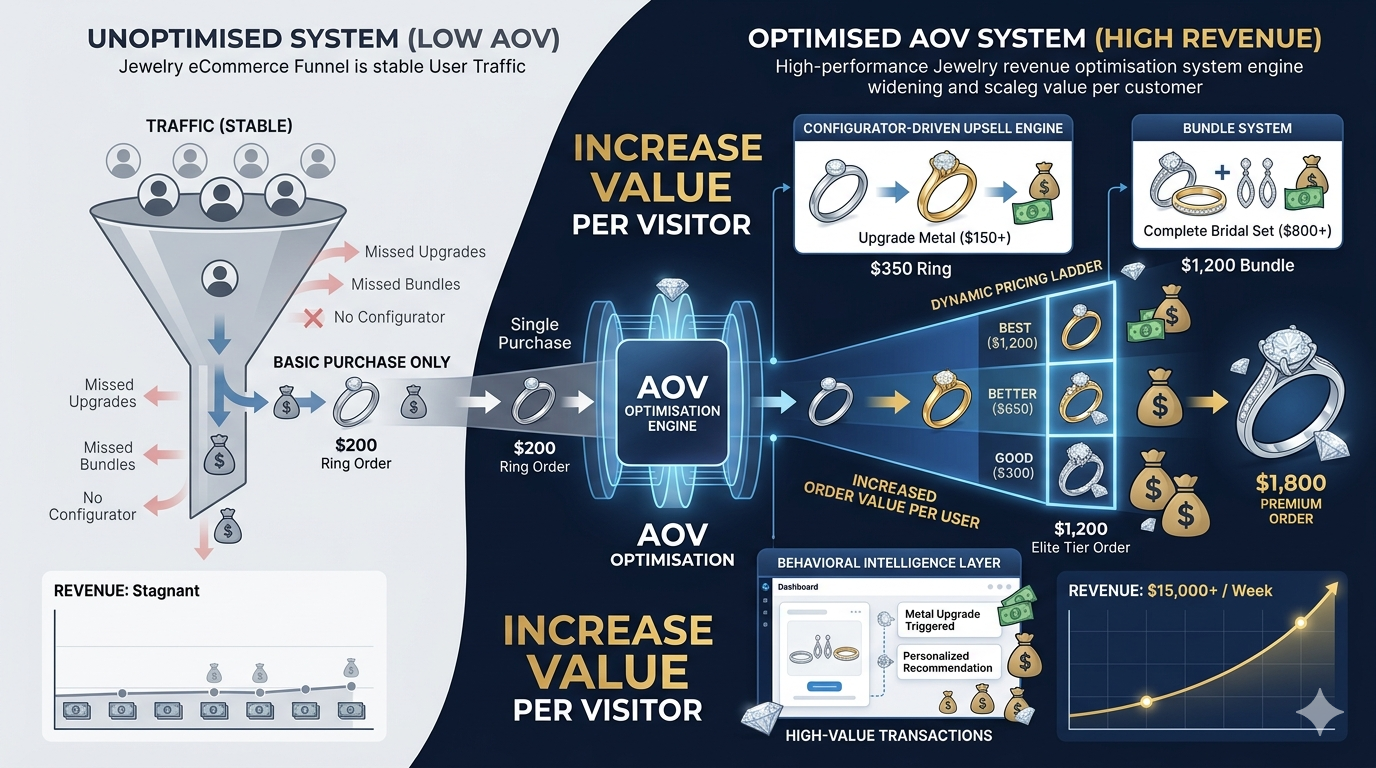
A. Guided upsell decision flows
Instead of random product browsing, users should move through structured value progression:
- basic → premium → signature tiers
- budget-aware upgrades
- guided recommendation paths
This ensures that:
upgrades feel like logical progression, not sales pressure
⸻
B. Configurator-driven value expansion
A properly designed configurator is not just a selection tool.
It is a value engine.
It should:
- suggest higher-quality diamonds dynamically
- show visual improvement in real time
- highlight meaningful upgrades (not just price changes)
Example behaviour:
- increase clarity → visual brilliance improves
- increase carat → emotional impact increases
This links value to perception.
And perception drives AOV.
⸻
C. Bundle-based jewellery architecture
Jewellery purchases are rarely isolated.
But systems often treat them that way.
Instead, structure:
- engagement ring + wedding band combinations
- matching sets
- future lifecycle recommendations
This creates:
natural multi-item purchasing without forcing upsells
⸻
D. Psychological pricing architecture
Pricing is not neutral.
It shapes decision behaviour.
Effective systems use:
- anchoring (premium reference points)
- tiered presentation (good / better / best)
- visual value reinforcement during configuration
This ensures:
users evaluate upgrades relative to higher-value context, not lowest price point
⸻
E. Behaviour-based upselling systems
A mature system responds to behaviour:
- repeated product views → suggest upgrades
- high engagement configurator users → premium prompts
- long decision cycles → bundled recommendations
This is not marketing automation.
It is decision optimisation.
⸻
Why Most Jewellery Businesses Fail to Increase AOV
The failure is structural.
Most businesses:
- treat upselling as a sales tactic
- rely on human persuasion
- depend on staff skill rather than system logic
- fail to integrate configurators with pricing intelligence
So AOV becomes:
inconsistent, manual, and non-scalable
And anything that depends on humans does not scale predictably.
⸻
The Relationship Between AOV, Conversion Rate, and System Maturity
These three metrics are not independent.
They are interconnected outcomes of system design.
⸻
Low-maturity systems:
- weak conversion flows
- low AOV
- high dependency on manual sales
⸻
Medium-maturity systems:
- stable conversion rates
- limited AOV growth
- partial automation
⸻
High-maturity systems:
- structured conversion flow
- increasing AOV over time
- behavioural optimisation
- integrated intelligence layers
Key insight:
AOV only increases sustainably when system maturity increases
⸻
Strategic Insight: Revenue Is a Function of System Design, Not Traffic Volume
Traffic is input.
Conversion is mechanism.
AOV is amplification.
When aligned correctly:
- traffic enters structured system
- conversion processes decision efficiently
- AOV increases value per transaction
When misaligned:
- traffic is wasted
- conversion is inconsistent
- value per user remains capped
This is why two jewellery businesses with the same traffic can have completely different revenue outcomes.
⸻
Conclusion
Most jewellery businesses focus too heavily on acquisition and too little on value extraction.
But in high-ticket eCommerce, growth is not determined by how many users enter the system.
It is determined by:
how much value the system can extract from each decision event
AOV is the most underutilised lever in jewellery eCommerce.
And unlike traffic, it does not require more visitors.
It requires better architecture.
Because in jewellery systems:
revenue does not scale through more attention—it scales through better decision design