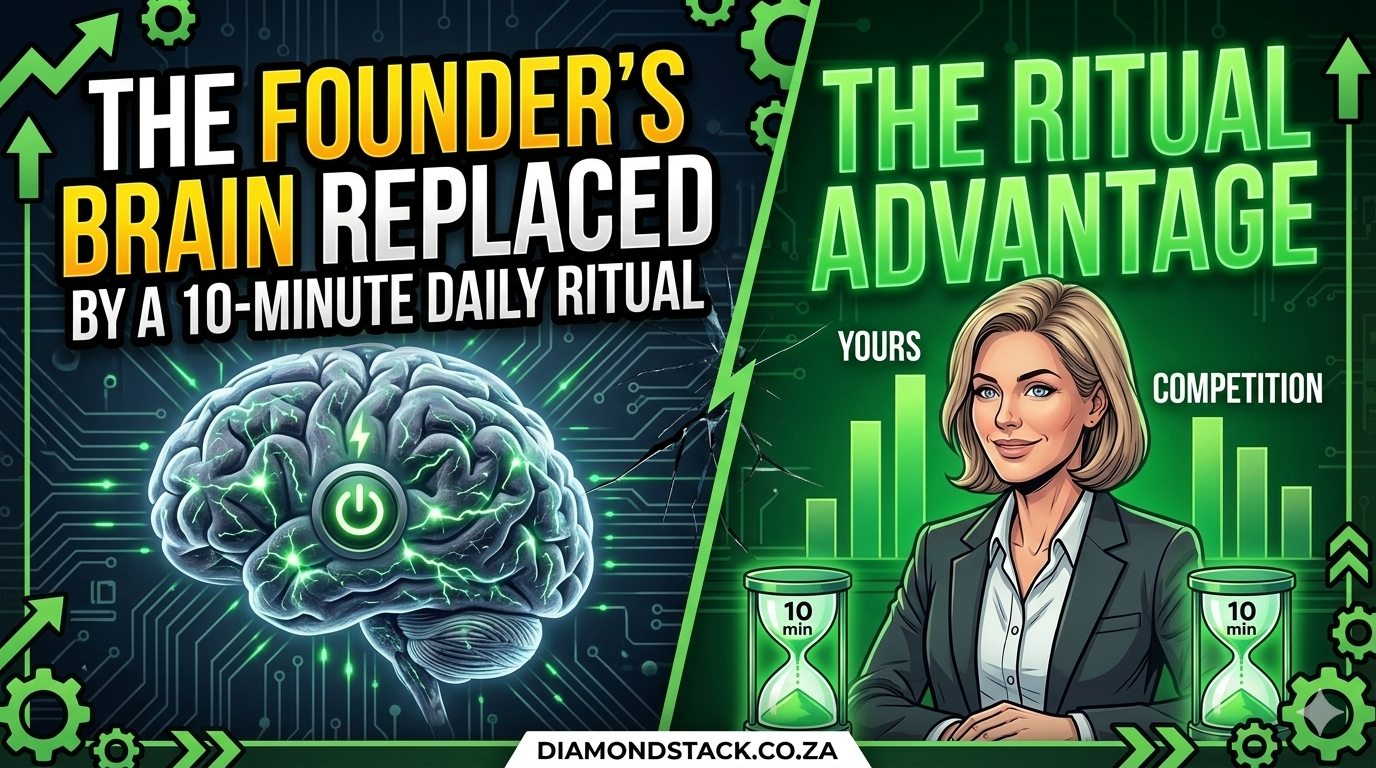
The Daily Ritual That Replaces the Founder’s Brain — How a 10-Minute Habit Becomes Your Competitive Advantage
Erwee Coetzee
Diamond Stack
Cape Town, South Africa
Paul O’Neill was appointed CEO of Alcoa in 1987.
The first thing he did shocked the board. He didn’t talk about profits, efficiency, or market share. He talked about worker safety.
“I want to talk about my personal passion,” he said. “If you want a competitive company, you have to begin with a safe one.”
The board thought he was insane. Alcoa’s lost workdays per 100 workers was already low—1.86 per year. How much better could safety get?
O’Neill introduced a single, non-negotiable ritual. Every accident—no matter how small—had to be reported and analyzed within 24 hours. Not hidden. Not minimized. Not hushed up in a meeting with the floor manager.
Reported. Analyzed. Communicated to the entire company.
This one habit—this daily ritual of reporting and analyzing—became the keystone that transformed everything else.
Within five years, Alcoa’s lost workdays dropped to 0.2 per 100 workers. Profit margins reached record highs. Safety wasn’t a constraint on efficiency—it became the foundation for it.
Duhigg calls this the keystone habit (Duhigg, 2012). One habit that, when established, cascades into systemic change. Like the first domino that topples the rest.
Why the Daily Ritual Matters for Your Atelier
Here’s what you’ve learned so far:
Post 1: Your credibility comes from honesty about uncertainty. Post 2: Your bottleneck is structural, not personal. Post 3: Trying to delegate tacit knowledge destroys your business. Post 4: You can externalise knowledge through a four-step methodology.
But there’s a problem with all of this: it’s abstract. It’s knowledge about what to do. It’s not yet action on what to do.
The gap between knowing and doing is where most frameworks die. People read the post. They nod. They think, “Yes, I should externalise my knowledge.” Then they go back to their day, and they’re making 120 decisions again, and the framework gets buried.
O’Neill solved this at Alcoa with a keystone habit: the daily safety report. It wasn’t complicated. It wasn’t a whole new management system. It was a single, non-negotiable ritual.
And because it was daily, it changed everything else.
You need a keystone habit too. Something so small that it’s non-negotiable. Something that, when you do it daily, forces the entire system to align around it.
The Daily Provenance Log
For your atelier, the keystone habit is what I call the Daily Provenance Log.
Every day, for 10 minutes, you document three things:
1. A decision you made (and why)
Stone selection: “Selected the Mozambique tourmaline over the Zambian—warmer tone, better for this quarter’s collector profile”
Design direction: “Simplified the band—the original design was trying too hard. Collectors want confidence, not complexity.”
Customer conversation: “Client was hesitant about the price. Realized they didn’t understand the stone’s rarity. Spent 15 minutes showing them market comparables. Sale closed.”
2. What happened as a result
Outcome: Customer delighted. Referred two friends. Outcome: Design now in stock. Already had two inquiries. Outcome: Learned that this customer segment needs more education on rarity. 3. What this tells you about your decision-making logic
Pattern: You prioritize collector psychology over technical specs. Pattern: You simplify before you add. Pattern: Price resistance often masks education gaps, not value objection.
That’s it. Ten minutes. Three things. Daily.
Why This Tiny Habit Changes Everything
Gersick and Hackman (1990) discovered something crucial about group routines. They’re not just ways of doing things. They’re the microfoundations—the tiny building blocks—of organisational capability.
When you write down your decision-making logic daily, you’re doing three things simultaneously:
First, you’re externalising your tacit knowledge. Every day, you’re taking something that lives only in your head—your reasoning—and putting it into language. Into words. Into logic.
This is the externalisation from Post 4, but in tiny daily increments.
Second, you’re building a record that your team can learn from. After three months, you have 60 days of examples of how you think. Your stone selection patterns. Your design philosophy. Your customer conversation approach.
This is the observable behaviour that Mthembu needs from Step 1 of the externalisation framework. But instead of him being there for every decision, he’s reading the log. Learning your patterns. Building intuition from your examples.
Third, you’re creating accountability for your own decision-making. Because you have to write it down, you become more intentional about why you’re deciding what you’re deciding.
Studies on habit formation (Duhigg, 2012; also Gersick & Hackman, 1990) show that when a behaviour becomes routine—when it’s habitual—it also becomes more efficient. You spend less cognitive energy deciding whether to do it, so you can spend more cognitive energy on how to do it well.
The Daily Provenance Log becomes the ritual that O’Neill introduced at Alcoa. Non-negotiable. Daily. Small enough that you’ll actually do it.
And because it’s daily, everything aligns around it. Your team starts reading it. They start asking questions. You start explaining your thinking more clearly because you know it’s going into the log. Your decision-making becomes more intentional. Your patterns become visible.
The Cascade
Here’s the beautiful part. When the Daily Provenance Log becomes habitual—when you’ve been doing it for three months without thinking about it—everything else activates:
Month 1: You start the log. It feels forced. You remember it most days. Month 2: You miss a couple days, but you’re catching your reasoning more clearly. Team is starting to read it. Month 3: The log is automatic. You’re noticing patterns in your own thinking. Team is asking questions based on the log. Month 4–6: The externalisation framework from Post 4 starts naturally. Your team is ready to practice because they understand your reasoning. The framework articulation happens organically, not forced.
By month six, you’re not forcing people to learn from you. They’re asking to learn. Because the Daily Provenance Log has made your knowledge visible, learnable, transferable.
This is what Duhigg means by keystone habits. One small ritual. Cascading into systemic change.
How to Start
You don’t need technology. You don’t need a fancy system. A spreadsheet works. A journal works. Google Doc, Notion, Basecamp—pick whatever you’ll actually use.
Tomorrow morning, pick one decision you made today. Write it down. Why did you make it? What happened? What does it tell you about how you think?
Ten minutes. That’s all.
Then do it again tomorrow.
And the day after that.
By week four, you won’t think about it anymore. It’ll be automatic. And your team will already be benefiting from it.
By month three, the externalisation you learned about in Post 4 will start happening naturally. Because you’ve been showing your thinking daily, your team will be ready to articulate frameworks with you. They’ll have enough examples to spot patterns.
What Post 6 Will Show You
Post 5 (this one) is about activating the system through a single habit.
Post 6 will be about how that daily habit feeds into decision frameworks for every area of your business. Once you’ve been logging for three months, you’ll have enough data to articulate frameworks with your team. Not guesses. Actual patterns from your own decision-making.
Posts 7–8 will show you how to build whole-brain cognitive complementarity—teams that combine analytical, operational, interpersonal, and visionary thinking.
Your Reflection for This Week
Before you read the rest, sit with this:
Where will you keep your Daily Provenance Log? And when will you do it—morning, after lunch, end of day?
That’s not a rhetorical question. That’s your actual next step.
Because unlike reading about the framework, unlike understanding why externalisation matters—actually implementing this takes one commitment: ten minutes a day.
Make that decision this week. Pick your tool. Pick your time. And by next Monday, when Post 6 goes live, you’ll have started your keystone habit.
Everything else will follow.
Research & References
Duhigg, C. (2012). The power of habit: Why we do what we do in life and business. Random House.
The foundational work on keystone habits and habit loops. Shows how O’Neill’s safety reporting system at Alcoa cascaded into systemic change. The mechanism: one habitual routine that forces alignment in other systems.
Gersick, C. J. G., & Hackman, J. R. (1990). Habitual routines in task-performing groups. Academy of Management Review, 15(4), 710–720.
On how group routines become the microfoundations of organisational capability. Directly applicable: the Daily Provenance Log is a routine that cascades into capability building across the team.
Weick, K. E. (1984). Small wins: Redefining the scale of social problems. American Psychologist, 39(1), 40–49.
On how small, consistent actions accumulate into large systemic change. The Daily Provenance Log is a small win repeated daily, creating momentum toward the larger goal of distributed leadership.