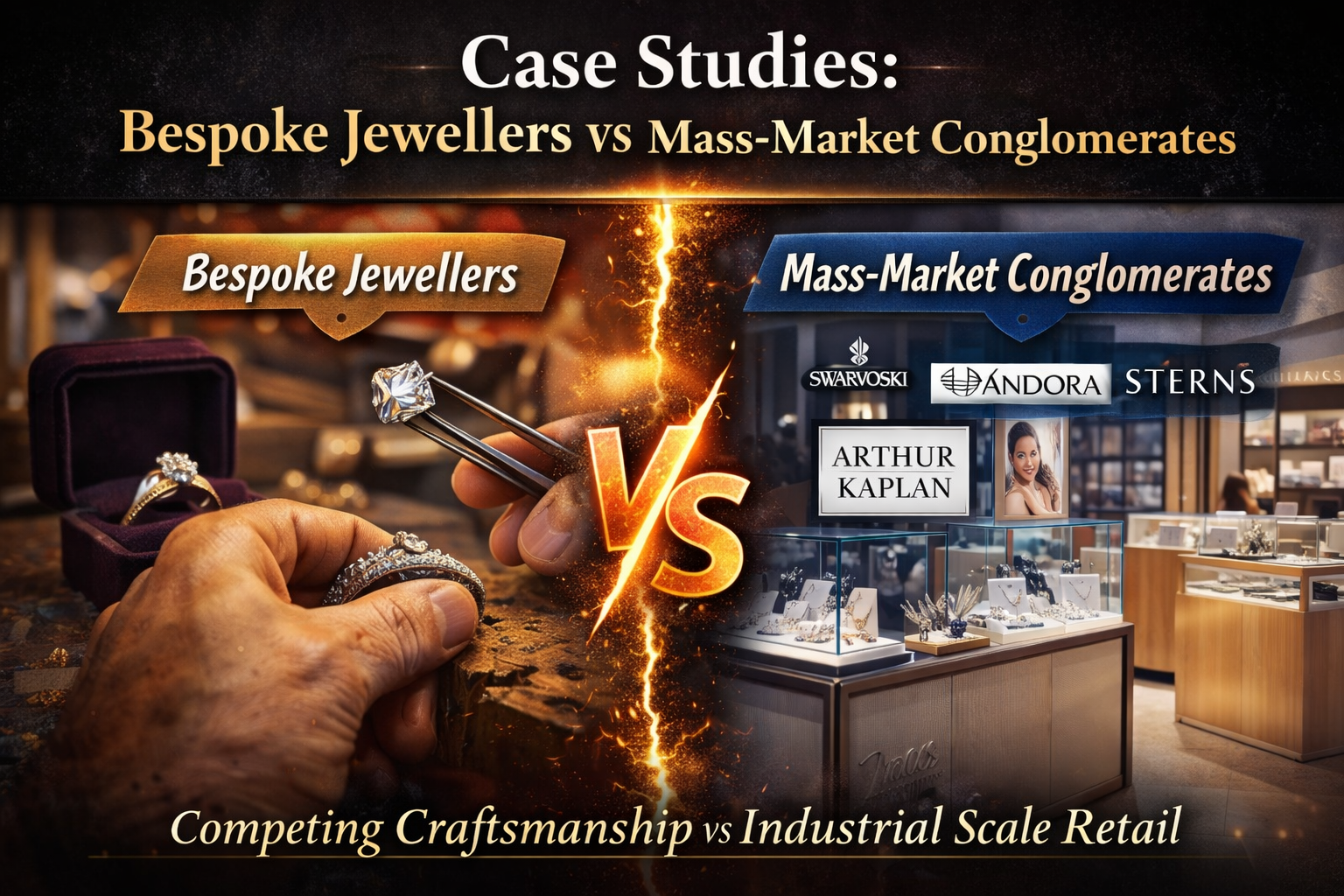
Case Studies: Bespoke Jewellers vs Mass-Market Conglomerates
To understand why the jewellery industry is increasingly splitting into two extremes — artisan bespoke studios and industrial-scale conglomerates — it is helpful to examine how these models operate in practice.
Across South Africa and globally, successful jewellers are no longer competing within the same economic framework. Instead, they operate within two fundamentally different business models:
- Bespoke artisan studios, which focus on craftsmanship, design narrative, and personal client relationships.
- Mass-market retail conglomerates, which rely on scale, distribution networks, and brand visibility.
Each model possesses distinct pricing strategies, margins, customer acquisition channels, and defensive advantages. By comparing real-world examples, the structural pressures reshaping the jewellery market become clear.
What emerges from these case studies is a stark reality: the traditional mid-tier jewellery retailer — neither fully bespoke nor industrially scaled — has very little structural advantage left.
Bespoke South African Jewellers
Independent jewellery studios in South Africa increasingly succeed by focusing on craftsmanship, storytelling, and uniqueness. Rather than competing on price, these businesses position themselves as design houses and creative collaborators.
Their revenue models typically emphasise custom commissions, small-batch production, and high-margin pieces with strong emotional narratives.
Nebü – The Bullion-Based Luxury Model
Founded by designer Helen Viljoen, Nebü represents one of the most distinctive bespoke jewellery models in South Africa.
The studio specialises in pure 24-karat gold jewellery, an unusual choice in a market where most jewellery is produced using 18-karat alloys. Instead of pricing jewellery through traditional retail markups, Nebü adopts a bullion-based pricing model.
Pieces are sold at:
Gold weight value + a flat design fee.
This approach introduces radical transparency into jewellery pricing while preserving healthy margins through the design component. Because the raw gold is priced at its market value, customers perceive the purchase as both luxury consumption and asset ownership.
Typical Nebü pieces range between R30,000 and R150,000 or more, depending on the weight of gold used.
Margins are generated through design fees and craftsmanship rather than traditional retail markups, resulting in estimated gross margins of 40–50%, even while maintaining transparent material pricing.
Customer Acquisition
Nebü attracts clients through:
- digital marketing targeted at high-net-worth buyers
- partnerships with luxury lodges and safari destinations
- international diaspora clients seeking African luxury products
- word-of-mouth referrals among collectors.
Defensive Moats
The Nebü model benefits from several strategic protections:
- use of 100% recycled gold, appealing to sustainability-conscious buyers
- a strong conservation mission, donating 10% of profits to wildlife protection
- transparent pricing tied to bullion value
- distinctive aesthetic rooted in African luxury.
Because the brand integrates ethics, craftsmanship, and transparency, it occupies a unique niche that is extremely difficult for large jewellery retailers to replicate.
Phatsima Jewellery Design – African Luxury Narrative
Founded by designer Nontando Molefe, Phatsima Jewellery Design represents a powerful example of how cultural storytelling can become a luxury moat.
Phatsima produces bespoke pieces and small collections using 18–22 karat gold and gemstones, with strong visual influences drawn from African heritage.
Collections such as the “African Lux” line integrate symbolic motifs that resonate both locally and internationally.
Pricing for Phatsima jewellery typically falls within the R20,000–R60,000 range, though large commissions often exceed these levels.
Because the business focuses heavily on custom work, margins can exceed 50% on material costs, as design value becomes the primary driver of price.
Customer Acquisition
Phatsima built its reputation through a combination of grassroots marketing and strategic exposure:
- an e-commerce website and Instagram storytelling
- participation in design and fashion events
- significant international press coverage.
A major breakthrough occurred when the brand was featured in British Vogue, dramatically raising its global profile.
Today the studio attracts customers from:
- high-income professionals
- celebrity clients
- international collectors interested in African luxury design.
Defensive Moats
Phatsima’s competitive advantages include:
- distinctive African design language
- handcrafted production in South Africa
- strong media recognition
- a lean studio model with minimal overhead.
This combination allows the brand to maintain exclusivity while scaling gradually through reputation rather than mass production.
Kelli Lutrin Personalised Jewellery – The Customer Intimacy Model
Johannesburg-based designer Kelli Lutrin operates a bespoke jewellery studio specialising in personalised bridal and fine jewellery.
The brand’s core strength lies in its ability to transform jewellery into deeply personal artefacts, using engraving and custom design to create pieces that commemorate life events.
Products range widely in price, typically between R5,000 and R50,000, though large bridal commissions often exceed this range.
Because customisation commands a premium, personalised pieces often generate gross margins of approximately 60%, particularly when additional design services are included.
Unlike many bespoke studios, Lutrin leverages existing manufacturing networks to support scaling while maintaining design control.
Customer Acquisition
The brand relies heavily on relationship-based marketing, including:
- bridal exhibitions and wedding industry events
- social media engagement with couples planning weddings
- private consultations for clients and bridal parties.
Lutrin has also begun exploring expansion into the United States market, recognising the strong global demand for personalised jewellery experiences.
Defensive Moats
The brand’s primary defences lie in:
- high-touch customer relationships
- personalised design services
- the founder’s direct involvement in the design process.
Because clients participate directly in the creation of their jewellery, the purchasing experience becomes emotionally embedded — something that mass retailers cannot replicate.
Lilja Hastie Jewellery – The Artistic Collection Model
Designer Lilja Hastie represents another variation of the bespoke jewellery model, blending artistic storytelling with limited-run collections.
Her jewellery often incorporates:
- mythological themes
- hand-applied enamel
- colourful gemstone combinations.
Rather than producing entirely custom pieces, Hastie frequently releases small-batch themed collections, ensuring rarity while allowing some level of production efficiency.
Pricing for these pieces generally begins around R15,000, with complex designs reaching significantly higher levels.
Because the work involves extensive craftsmanship — particularly enamel and multi-stone settings — margins can exceed 60%.
Customer Acquisition
Hastie relies heavily on narrative-driven marketing:
- storytelling on Instagram
- interviews and design features
- appearances at fashion weeks and design fairs.
Her pieces are also stocked by select luxury retailers, including Momento Fine Jewellery, which expands distribution while preserving brand exclusivity.
Defensive Moats
Lilja Hastie’s strategic advantages include:
- distinctive artistic identity
- culturally resonant themes
- limited production runs that maintain exclusivity.
Because each collection is visually distinctive, imitation by competitors is extremely difficult.
Mass-Market Jewellery Conglomerates
While bespoke jewellers focus on craftsmanship and personal relationships, large jewellery retailers operate according to a completely different economic model.
Their success depends on scale, distribution networks, and brand visibility.
These companies rarely rely on custom design. Instead, they maximise revenue through standardised products distributed across hundreds or thousands of retail locations.
The Foschini Group – Retail Scale Dominance
The Foschini Group (TFG) is one of South Africa’s largest retail conglomerates, operating jewellery brands such as:
- Sterns
- American Swiss
- Donna
- Fossil.
These brands are typically embedded within shopping malls, allowing TFG to capture foot traffic from large retail centres.
Jewellery pricing across these stores ranges widely:
- silver jewellery: R200–R2,000
- gold pieces: R3,000–R30,000.
Gross margins typically hover around 50%, driven by fixed markups and high inventory turnover.
Customer Acquisition
TFG relies on:
- a nationwide network of more than 300 retail stores
- its omnichannel platform Bash
- loyalty programmes and store credit facilities.
Promotional events such as Black Friday and clearance sales drive significant seasonal revenue.
Defensive Moats
TFG’s strengths include:
- large-scale purchasing power
- integrated supply chains
- strong brand recognition.
However, this model also exposes the company to risks such as declining mall traffic and consumer credit volatility.
Luxe Holdings – Heritage Luxury Retail
Luxe Holdings Limited owns several high-end jewellery and watch brands in South Africa, including Arthur Kaplan.
These businesses target a more premium customer segment, selling diamond jewellery and luxury watches in major shopping districts.
Products range from R10,000 to several hundred thousand rand, with significant markups on proprietary designs.
Despite strong heritage brands, Luxe Holdings has faced recent financial challenges, reporting losses in recent years as the retail environment becomes more competitive.
Customer Acquisition
The company relies on:
- luxury retail locations
- advertising in premium lifestyle publications
- strong brand recognition associated with Arthur Kaplan.
Defensive Moats
Luxe Holdings benefits from:
- decades of brand heritage
- proprietary product lines
- established relationships with luxury malls.
However, increasing online competition continues to challenge traditional luxury retail formats.
Pandora – Global Scale and Brand Ecosystem
Pandora represents one of the most successful examples of global jewellery branding.
The company built its reputation through charm bracelets and modular jewellery systems, encouraging repeat purchases as customers expand their collections.
Typical Pandora products range from $50 to $150, positioning the brand in the affordable luxury segment.
Because Pandora designs are patented and manufactured at scale, the company achieves gross margins approaching 80%.
Customer Acquisition
Pandora’s global reach includes:
- more than 9,000 branded retail stores
- extensive social media marketing
- loyalty programmes and frequent product launches.
Defensive Moats
The brand benefits from:
- proprietary bracelet systems
- enormous manufacturing scale
- strong brand identity among younger consumers.
However, the brand must constantly innovate to avoid fashion fatigue.
Swarovski – The Affordable Sparkle Strategy
Swarovski occupies a unique position in the jewellery market.
Rather than competing with fine jewellery, the brand focuses on crystal jewellery and accessories, targeting consumers seeking affordable glamour.
Most pieces retail for under $500, with millions of units sold annually.
Customer Acquisition
Swarovski products are sold through:
- branded retail stores
- department stores
- major online marketplaces.
The brand frequently collaborates with fashion designers and influencers to maintain visibility.
Defensive Moats
Swarovski’s primary advantages include:
- its globally recognised crystal brand
- diversified product categories including jewellery, décor, and accessories.
However, the rise of inexpensive fashion jewellery competitors continues to pressure this segment.
Strategic Comparison: Two Diverging Models
These case studies reveal a clear industry divide.
Bespoke jewellers succeed through:
- high margins per piece
- unique craftsmanship
- strong brand narratives
- direct client relationships.
Conglomerates succeed through:
- enormous production scale
- global distribution networks
- heavy marketing investment.
Between these two models lies the traditional mid-tier jewellery retailer — a business increasingly squeezed between price competition and prestige branding.
Without the scale of conglomerates or the uniqueness of bespoke craftsmanship, these retailers struggle to defend their position.
The Strategic Conclusion
The jewellery industry is undergoing the same economic polarisation seen across many consumer markets.
Mass production dominates the low end.
Luxury craftsmanship dominates the high end.
For independent jewellers, the lesson is clear.
Trying to compete with conglomerates on price is nearly impossible.
But by embracing specialisation, craftsmanship, and storytelling, artisan studios can create a defensible niche — one that transforms jewellery from a commodity into a meaningful work of art.
In the emerging landscape of modern jewellery retail, the future belongs not to the middle market.
It belongs to the specialists.