The LLM Vector Trap: Why Keyword-Rich Jewellery Descriptions Fail in Semantic Search
For the last decade, e-commerce SEO in the jewellery sector has been a lexical arms race. The strategy was brutally simple: identify the search volume for “1 carat oval diamond ring cape town,” inject that exact string into the H1, the product description, and the meta tags, and wait for Googlebot to reward the exact-match relevance.
That era is over.
We are no longer optimising for a search engine that counts words. We are structuring data for Large Language Models (LLMs) and AI shopping agents that plot concepts in high-dimensional vector space. If your WooCommerce catalogue is still relying on traditional, keyword-stuffed product descriptions, you have already fallen into the LLM Vector Trap. Your inventory is effectively invisible to the next generation of high-intent buyers.
Here is the technical reality of how semantic search processes your diamond feed, and how to apply the Coetzee Liquidity Protocol (CLP) to ensure your products are retrieved by AI agents.
The Mechanics of the Vector Trap
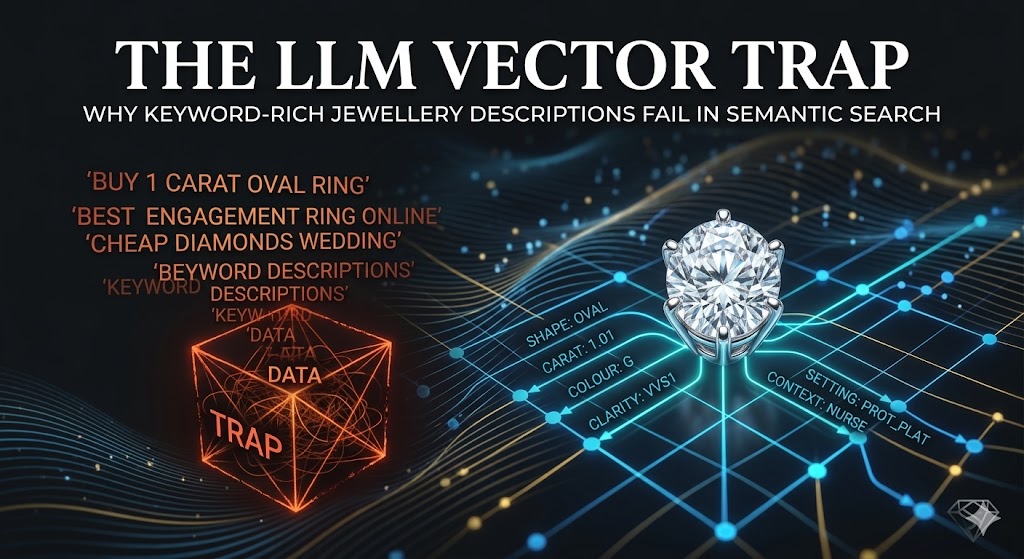
When an LLM or an AI-driven search generative experience (SGE) crawls your product page, it does not read strings of text. It converts your product data into vector embeddings—mathematical representations of meaning mapped across thousands of dimensions.
In vector space, proximity equals relevance. The AI calculates the distance between the user’s query (e.g., “durable engagement ring for a nurse who uses hand sanitiser frequently”) and your product descriptions.
This is where traditional SEO fails catastrophically. A description that reads, “Buy the best 1 carat oval diamond engagement ring online. This cheap 1 carat oval ring is perfect for your wedding,” creates massive semantic noise. In a vector database, this keyword-stuffed paragraph maps closely to “cheap,” “online buying,” and generic “weddings.”
It creates a vast mathematical distance between your product and the user’s actual contextual intent. By trying to rank for everything lexically, you become relevant to nothing semantically. You fall into the trap.
The Ambiguity Penalty in RAG Architecture
Modern AI shopping agents use Retrieval-Augmented Generation (RAG). When a user asks an AI to find a specific type of diamond, the LLM first retrieves facts from a database (your indexed site), then generates a response.
If your WooCommerce product descriptions are filled with marketing fluff and keyword repetition rather than structured, definitive attributes, the RAG system encounters an Ambiguity Penalty.
LLMs hallucinate when they lack concrete data. If a shopping agent cannot definitively parse the exact millimeter dimensions of the band, the setting height, or the specific certification authority from your description, it will not risk recommending your product to a high-net-worth buyer. It will simply bypass your site and pull inventory from a competitor whose data is strictly defined.
Escaping the Trap: The Coetzee Liquidity Protocol
To make your diamond catalogue liquid—meaning it flows seamlessly into AI agent recommendations—you must rewrite your product data for machine readability.
1. Eradicate Lexical Redundancy Strip the exact-match keywords. An AI agent already knows the page is about an engagement ring from the schema and taxonomy. Do not waste token limits telling it what it already knows.
2. Shift from Adjectives to Contextual Entities Instead of calling a ring “beautiful” or “sparkly” (subjective terms that LLMs ignore), use entity-rich context.
- Old: “This beautiful 18k white gold ring…”
- New: “Engineered with an un-plated 18k white gold palladium alloy to prevent rhodium wear…” The latter connects the product to durability and metallurgy entities in the Knowledge Graph.
3. Attribute Certainty is the New Keyword Density Your descriptions must read like technical specifications. State the exact setting profile (e.g., cathedral, bezel, peg head), the exact prong style (e.g., double claw), and the exact band width in millimeters. AI agents route queries based on strict parameters. If your parameter is missing, your product does not exist in the agent’s output.
The Machine-Readable Future
The diamond retailers who dominate the next five years will not be the ones with the most backlinks or the highest keyword density. They will be the ones who structure their WooCommerce databases so cleanly that an AI shopping agent can query their inventory with zero friction.
Stop writing marketing copy for humans who don’t read it. Start structuring entity data for the machines that route the traffic.