E-Commerce SEO for Jewellery: The Complete Technical Playbook for Bespoke Luxury and Moissanite Stores
Author: Erwee Coetzee | Diamond Stack Reading Time: ~22 minutes
Jewellery is one of the most technically demanding verticals in e-commerce SEO. It sits at the intersection of high-consideration purchasing behaviour, visually-led discovery, complex product taxonomy, trust-intensive conversion psychology, and a buyer journey that can stretch from a Google search to a purchase decision over weeks or months.
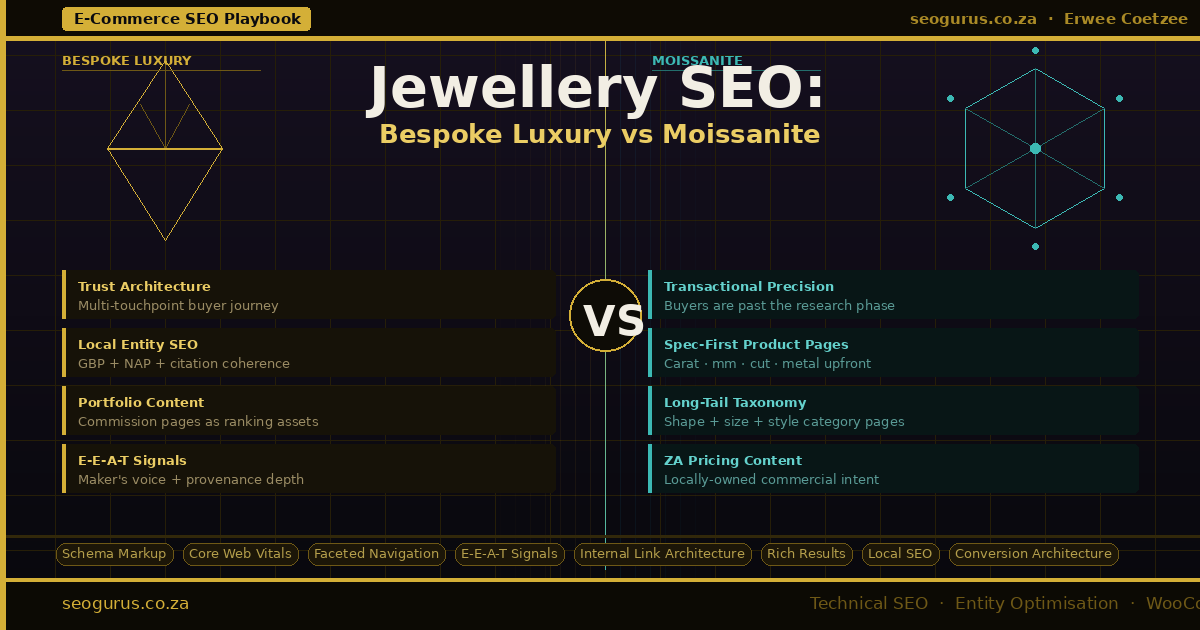
The two ends of the jewellery market — bespoke luxury and moissanite — present what appear on the surface to be opposing SEO problems. One sells to a customer who may spend R 250,000 on a single piece and needs to be persuaded across multiple touchpoints before they pick up the phone. The other sells to a customer who has already done their research, knows exactly what moissanite is, and is looking for the best value, the most credible store, and the fastest path to checkout.
In practice, both require rigorous technical SEO foundations, precisely structured product data, and conversion-aligned content architecture. The strategy diverges at the query intent layer and the trust signal layer — not at the fundamentals. This playbook covers both.
Part One: The Technical Foundation (Non-Negotiable for Both Markets)
Before any market-specific strategy is discussed, the technical substrate has to be correct. Advanced content strategy built on a crawlability problem, a Core Web Vitals failure, or a broken structured data implementation produces nothing.
Crawlability and Index Architecture
The jewellery site crawlability problems that appear most frequently in audits:
Faceted navigation producing infinite URL variations. A WooCommerce jewellery store with filter parameters for metal type, stone type, price range, ring size, and certification lab can produce thousands of parameterised URLs from a catalogue of 200 products. Without explicit canonical tag handling and robots.txt parameter rules, Google’s crawl budget is consumed by filter combinations that carry no independent ranking value — and the category pages that should rank for commercial queries are under-crawled.
The fix is not simply blocking all parameters. The correct architecture distinguishes between:
- Filter combinations that produce unique, rankable content (e.g.,
/engagement-rings/?metal=platinumif platinum engagement rings is a target keyword cluster) — these get canonical tags pointing to themselves and are included in the sitemap - Filter combinations that produce content functionally identical to the base category — these get
noindexor canonical tags pointing to the base category URL - Pagination (page 2, 3, etc.) — these get canonical tags to the first page unless they carry independent content value
Orphaned product pages. In a jewellery catalogue that has grown organically over years, discontinued products are frequently left live as 404s or orphaned pages with no internal links. Google’s crawl history references these URLs; they consume crawl budget and produce coverage errors. A quarterly crawl-and-audit cycle — not an annual one — is the correct maintenance cadence for a jewellery store with an active catalogue.
Thin category pages. The /rings/ category page with twelve products and no editorial content has nothing to recommend it over a hundred competing category pages. Category pages in jewellery need to function as landing pages: a defined keyword target, editorial content that addresses the purchase consideration questions for that category, and structured data appropriate to the content type.
Core Web Vitals in a Visual-Heavy Context
Jewellery is an inherently image-led product category. Lifestyle photography, stone close-ups, 360-degree product views, and video are all commercially justified — but each one is a performance liability if handled without care.
Largest Contentful Paint (LCP) in jewellery is almost always an image. The product hero image or the category banner is invariably the LCP element. The targets:
- LCP below 2.5 seconds on mobile (passing threshold)
- LCP below 1.5 seconds on desktop (competitive in the jewellery vertical)
Achieving this requires: next-gen image formats (WebP with JPEG fallback), responsive srcset with appropriate breakpoints, explicit width and height attributes on all images (prevents layout shift), lazy loading on below-fold images only (loading="eager" on the LCP image, loading="lazy" on everything below it), and a CDN serving images from edge nodes geographically close to your customer base.
Cumulative Layout Shift (CLS) is a particular risk in jewellery stores that use price overlays, promotional banners that load after the page, or dynamic stock/availability badges that inject into the DOM after initial render. Every element that shifts the layout after load contributes to CLS. The fix is reserving space in the layout for dynamic elements — a fixed-height container for the availability badge that shows a placeholder before the dynamic content loads.
Interaction to Next Paint (INP) is the metric most affected by a ring builder or product configurator. Heavy JavaScript on product pages — particularly synchronous JavaScript that blocks the main thread during user interaction — inflates INP. Profile the ring builder’s JavaScript execution cost and move non-critical computation to Web Workers or defer it post-interaction.
Schema Markup: The Jewellery-Specific Implementation
Schema for jewellery is not a checkbox. It is a commercial decision about which features appear in Google’s search results and which ones do not.
Product schema — minimum viable:
{
  "@context": "https://schema.org",
  "@type": "Product",
  "name": "18ct White Gold Round Brilliant Diamond Solitaire Ring",
  "sku": "DS-SOL-18W-RB-100",
  "description": "...",
  "image": ["https://example.com/product-images/solitaire-main.jpg"],
  "brand": {
    "@type": "Brand",
    "name": "Your Store Name"
  },
  "offers": {
    "@type": "Offer",
    "price": "28500",
    "priceCurrency": "ZAR",
    "priceValidUntil": "2026-12-31",
    "availability": "https://schema.org/InStock",
    "url": "https://example.com/product/solitaire-ring/",
    "seller": {
      "@type": "Organization",
      "name": "Your Store Name"
    }
  },
  "aggregateRating": {
    "@type": "AggregateRating",
    "ratingValue": "4.9",
    "reviewCount": "43"
  }
}
What unlocks rich results in jewellery:
aggregateRating— star ratings in SERPs, the single highest click-through-rate improvement available in the jewellery vertical. A listing with 4.8 stars and 40+ reviews consistently outperforms adjacent unrated listings by 15–30% CTR.priceValidUntil— required for price rich results. Without it, Google may suppress the price display in the SERP.availabilitywith a valid schema.org value — required for the “In Stock” label in Shopping results.
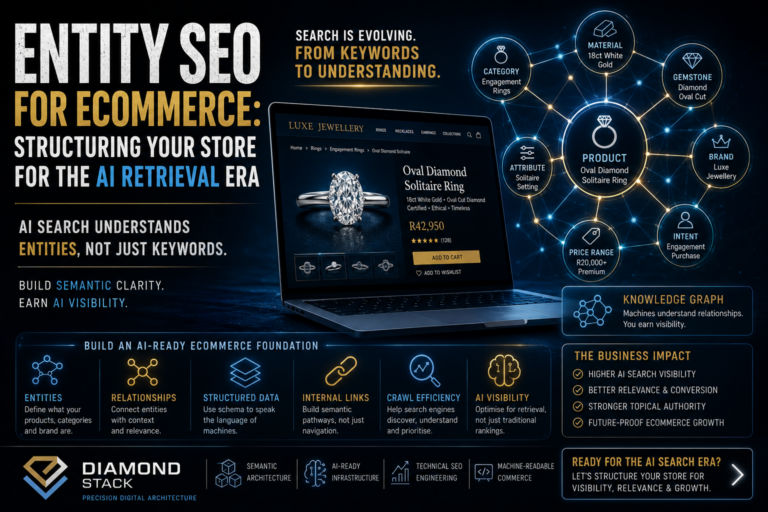
BreadcrumbList schema on every product and category page — this is non-negotiable for jewellery because the category hierarchy is deep (Home > Rings > Engagement Rings > Solitaire Rings > Product) and breadcrumb rich results increase SERP real estate while reinforcing topical depth signals.
FAQPage schema on high-intent category pages and buying guide content. “What is the difference between VS1 and VS2 clarity?” as a structured FAQ answer occupies a featured snippet position and deflects comparison shoppers from navigating away to a competitor’s content.
LocalBusiness or JewelryStore schema on the homepage and contact page — critical for local search visibility. South African jewellery retailers competing for “jeweller near me” and “custom engagement rings [city]” queries live and die by the completeness and consistency of their local entity signals.
Part Two: Bespoke Luxury Jewellery SEO
Bespoke luxury is the most trust-intensive category in e-commerce. The customer is not buying a product — they are commissioning a relationship. The SEO strategy has to reflect this reality at every layer: the keyword architecture, the content structure, the conversion path, and the technical signals that communicate brand authority.
The Bespoke Buyer’s Search Journey
Understanding the query progression of a bespoke luxury buyer is the prerequisite to building a keyword architecture that captures them at each stage.
Stage 1 — Awareness queries (broad, low-intent):
- “custom engagement ring” / “bespoke diamond ring”
- “engagement ring ideas” / “how to design an engagement ring”
- “what is a bespoke ring”
These queries have high volume and low purchase intent. The buyer is in the early research phase. The content target is editorial and educational: buying guides, process explainers, inspiration galleries. The SEO metric is impressions and engagement, not conversion.
Stage 2 — Consideration queries (specific, moderate-intent):
- “bespoke engagement ring [city]” / “custom diamond ring maker [city]”
- “18ct white gold emerald cut engagement ring”
- “custom ring design process”
- “how long does a bespoke ring take”
- “bespoke engagement ring cost”
This is the highest-value cluster for bespoke retailers. The buyer has moved from dreaming to deciding. They are evaluating specific jewellers. Content targets: process pages, portfolio galleries with technical detail, transparent pricing guidance (ranges, not specific prices), timeline explainers, and testimonials with context.
Stage 3 — Decision queries (high-intent, transactional):
- “[jeweller name] reviews”
- “bespoke ring consultation [city]”
- “GIA certified diamond ring custom made”
- Branded queries for the jeweller’s own name
At this stage the buyer has self-qualified. They are looking for confirmation that you are trustworthy. The SEO targets are: review schema, knowledge panel presence, brand query ownership, and a consultation request path that is frictionless.
Bespoke Keyword Architecture: Depth Over Breadth
Bespoke luxury jewellery SEO does not win on volume. A bespoke atelier in Cape Town does not need 10,000 monthly organic visitors — it needs 300 highly qualified visitors who are seriously considering a commission. The keyword architecture should be built around this reality.
Hub-and-spoke content model:
The hub is the core service page: /bespoke-engagement-rings/ or /custom-diamond-jewellery/. This page targets the primary commercial queries, carries the process overview, and links to all spoke content.
Spokes fall into three categories:
Process spokes — each step in the bespoke design process as a dedicated page:
/bespoke-process/initial-consultation//bespoke-process/design-and-cad//bespoke-process/diamond-selection//bespoke-process/casting-and-setting//bespoke-process/finishing-and-delivery/
Each spoke page targets the process-related queries from the consideration stage and signals to Google that this site has comprehensive topical authority on bespoke jewellery creation — not just a landing page using the word “bespoke” once.
Style spokes — dedicated pages for the style categories within the bespoke range:
/bespoke-engagement-rings/solitaire//bespoke-engagement-rings/halo//bespoke-engagement-rings/three-stone//bespoke-engagement-rings/vintage-art-deco/
These pages capture specific style queries and serve the customer who already knows what design direction they want. They also provide internal link paths from the portfolio gallery.
Portfolio spokes — individual commission pages:
/portfolio/1-8ct-cushion-cut-double-halo-platinum//portfolio/art-deco-sapphire-diamond-cluster-18ct-yellow-gold/
Portfolio pages are underused in luxury jewellery SEO. Each completed commission is a keyword targeting opportunity for the specific combination of attributes it represents — and it is a trust signal that generic product pages cannot replicate. A real piece, a real story, a real customer (anonymised if required). This is the content that ranks for long-tail queries like “art deco sapphire engagement ring custom made” and simultaneously operates as social proof.
On-Page Signals for Luxury Authority
In the luxury segment, the on-page content signals that communicate authority are different from commodity e-commerce. Price is not always the conversion trigger — in some cases it is deliberately withheld to qualify buyers. Urgency and scarcity mechanics are counterproductive for a brand positioning around timeless exclusivity.
What luxury buyers respond to on the page:
Provenance and specificity. “GIA-certified 1.84ct D/VVS2 round brilliant” is more convincing than “premium diamond.” The technical specificity signals expertise and respect for the buyer’s intelligence.
The maker’s voice. A bespoke jewellery site where every page sounds like a committee-written press release does not convert. The jeweller’s name, their perspective on craft, their approach to the specific design challenge — these differentiate a bespoke atelier from a generic jewellery retailer in both human and algorithmic terms. Google’s E-E-A-T evaluation is looking for genuine expertise expressed with genuine authority. A jeweller with 20 years of bench experience writing about their craft in specific, technical language is exactly what that signal rewards.
Process photography with technical captions. CAD renders, wax models, casting shots, stone-setting close-ups — these are not nice-to-have content additions. They are the visual evidence that the bespoke process actually happens here, in this studio, by these hands. They also provide rich alt-text opportunities and image search visibility for queries like “custom ring CAD design” and “diamond engagement ring in progress.”
Transparent process timeline. “8–12 weeks from consultation to delivery” answers the consideration-stage question that would otherwise send a buyer to a competitor who does answer it. Every unanswered question on a luxury jewellery page is a conversion leak.
Local SEO for Bespoke Luxury: Entity Coherence Over Volume
Bespoke luxury jewellers are, almost without exception, local businesses with a physically-located studio. The local SEO strategy is not supplementary to the main SEO effort — for most bespoke retailers, local search is the primary discovery channel.
Google Business Profile completeness for a bespoke jeweller requires:
- Category: “Custom Jeweler” as primary, “Jeweler” and “Jewelry Designer” as secondary
- All attributes relevant to the business: “Appointment required,” “By appointment,” custom order availability
- Photos updated monthly — at minimum: exterior, studio interior, bench/tools, portfolio pieces, jeweller at work
- GBP posts used for portfolio updates and process stories (these index in local pack results)
- Q&A section seeded with the questions the consideration-stage buyer actually asks
NAP consistency across every citation, directory, and linked entity. The name, address, and phone number on the GBP must match the LocalBusiness schema on the website exactly — including punctuation, abbreviations, and phone number format. South African directories that matter for a jewellery business: Yellow Pages ZA, SA Business Index, Hotfrog ZA, Brabys, and any industry-specific directories (Jewellery Council of SA, if applicable).
Local link building for bespoke luxury is relationship-driven, not volume-driven. One link from a high-profile Cape Town lifestyle publication carries more local authority than twenty links from generic South African business directories. Target: wedding publications, luxury lifestyle media, bridal stylists with web presence, hotel concierge pages that recommend local artisans, and architecture/interior design publications (for jewellery pieces featured in lifestyle shoots).
Part Three: Moissanite Jewellery SEO
Moissanite is a different beast entirely. The customer is informed, price-conscious, and operating in a category where search intent is highly specific. “Moissanite engagement ring” is not a dreaming query — it is a buying query. Someone searching for moissanite has already made the decision to buy moissanite; they are now evaluating stores.
The competitive landscape is also different. Moissanite is a global market with global competitors — US and UK retailers who have been producing content on the topic for years and dominate many informational queries. South African and regional retailers compete most effectively on the combination of local delivery, local pricing in ZAR, and local customer trust signals.
Moissanite Query Intent: Already Past the Education Phase
The mistake many moissanite retailers make in their SEO is over-investing in educational content (“what is moissanite?”) and under-investing in transactional product content. By 2024, the overwhelming majority of moissanite buyers already know what it is. They found out from YouTube, TikTok, or a bridal forum. They are not landing on your site to be educated — they are landing to be converted.
This shifts the keyword architecture priorities:
High-priority query clusters (transactional):
- “moissanite engagement ring [carat size]” — e.g., “2ct moissanite engagement ring”
- “moissanite ring [shape]” — “oval moissanite ring,” “cushion cut moissanite ring”
- “moissanite [setting style]” — “moissanite halo ring,” “moissanite solitaire”
- “moissanite ring [metal]” — “moissanite white gold ring,” “moissanite rose gold ring”
- “buy moissanite ring South Africa” / “[city] moissanite jewellery”
- “Forever One moissanite” / “Charles and Colvard moissanite” (brand queries for the leading stone supplier)
Medium-priority query clusters (comparative/consideration):
- “moissanite vs diamond engagement ring”
- “moissanite ring price South Africa”
- “is moissanite good quality”
- “moissanite [carat] size comparison”
Lower-priority but useful (awareness):
- “what is moissanite”
- “moissanite pros and cons”
The mistake is building the entire site around the awareness cluster. Target the transactional cluster with product pages, the comparison cluster with a single well-built comparison guide, and let the awareness content exist as supplementary material rather than primary pages.
Product Page Architecture for Moissanite
Moissanite product pages need to work harder than most jewellery product pages because the buyer is making an active comparison between multiple stores. The page that wins the sale is the one that removes the most friction from the decision.
What a high-converting moissanite product page contains:
The title and H1. Include the carat equivalent, cut, metal, and moissanite descriptor:
- “2.5ct Oval Cut Moissanite Engagement Ring — 18ct White Gold Halo Setting”
Not: “Beautiful Moissanite Ring.” Never the vague version. The specific version is both more rankable and more conversion-aligned — a buyer searching for a 2.5ct oval moissanite ring who lands on a page with exactly that in the H1 experiences immediate confirmation that they are in the right place.
Structured specifications visible without scrolling. Moissanite buyers are specification-driven. They want to see: stone grade (D/E/F colourless, G/H near-colourless), cut, carat weight, diameter in mm (critical — helps them visualise on the finger), setting metal and purity, ring size availability, and certification (if applicable). Put these in a <table> with Product schema property markup, not buried in the description text.
Carat-to-mm size guide on every product page. This is the highest-impact conversion element specific to moissanite. The buyer is often coming from a context where they tried on a diamond ring of a specific carat size and are now trying to find the moissanite equivalent. A visual size guide that shows the stone diameter in mm alongside the carat weight, with a hand image for scale, directly reduces size uncertainty — one of the most common moissanite purchase objections.
The “vs diamond” context in the product description. Not as a separate comparison page that the buyer has to navigate to — in the product description itself. “This 2.5ct moissanite measures 8.5mm in diameter, equivalent in size to a 2.5ct diamond. At [price], it represents approximately X% of the cost of a comparable diamond with the same dimensions.” This is not anti-diamond positioning — it is the calculation the buyer is already doing in their head, done for them on the page.
Real customer photography alongside studio shots. The studio shot of the ring is expected. The customer submission of the ring on an actual finger, at an actual engagement, is the trust signal that closes the sale. User-generated content on moissanite product pages converts at a significantly higher rate than studio photography alone.
Technical Schema for Moissanite: Maximising SERP Features
Moissanite is a competitive SERP environment. Schema markup that unlocks additional SERP features provides a meaningful competitive advantage in click-through rates.
Product schema with Material property:
{
  "@type": "Product",
  "name": "2ct Round Brilliant Moissanite Solitaire Ring — 14ct White Gold",
  "material": "Moissanite, 14ct White Gold",
  "offers": {
    "@type": "Offer",
    "price": "8500",
    "priceCurrency": "ZAR",
    "availability": "https://schema.org/InStock",
    "hasMerchantReturnPolicy": {
      "@type": "MerchantReturnPolicy",
      "returnPolicyCategory": "https://schema.org/MerchantReturnFiniteReturnWindow",
      "merchantReturnDays": 30,
      "returnMethod": "https://schema.org/ReturnByMail"
    },
    "shippingDetails": {
      "@type": "OfferShippingDetails",
      "shippingRate": {
        "@type": "MonetaryAmount",
        "value": "0",
        "currency": "ZAR"
      },
      "deliveryTime": {
        "@type": "ShippingDeliveryTime",
        "businessDays": {
          "@type": "OpeningHoursSpecification",
          "dayOfWeek": ["Monday","Tuesday","Wednesday","Thursday","Friday"]
        },
        "cutoffTime": "14:00",
        "handlingTime": {
          "@type": "QuantitativeValue",
          "minValue": 1,
          "maxValue": 2,
          "unitCode": "DAY"
        },
        "transitTime": {
          "@type": "QuantitativeValue",
          "minValue": 2,
          "maxValue": 5,
          "unitCode": "DAY"
        }
      }
    }
  }
}
The hasMerchantReturnPolicy and shippingDetails properties unlock return policy and shipping information in Google Shopping results — features that significantly differentiate a moissanite listing in a competitive SERP where multiple stores are selling comparable products at comparable prices.
Review and AggregateRating — moissanite customers are voracious review readers. Star ratings in the SERP are not optional for a moissanite store competing with established players. Build a post-purchase review request sequence into your order confirmation and fulfilment emails.
The Moissanite Content Strategy: Specificity Wins
In the moissanite content landscape, the comparison articles and “what is moissanite” guides are saturated. Every major retailer and half the bridal publications have published them. Ranking for “moissanite vs diamond” in 2026 requires a genuinely differentiated piece — not a longer version of what already exists.
The content opportunities that are actually winnable:
Carat-specific buying guides: “The Complete Guide to 2ct Moissanite: Sizes, Cuts, Settings and Prices.” There is relatively little content that addresses a specific carat weight in depth, despite the fact that carat-specific queries have meaningful volume and very high purchase intent. A buyer searching “2ct moissanite engagement ring” is ready to buy. A detailed guide that addresses every question specific to that size — how it looks in different cuts, which settings balance it best, how to compare it to a 2ct diamond visually — captures that buyer and builds topical authority around a high-converting query cluster.
Shape-specific guides: “Oval Moissanite: Everything You Need to Know About Cut, Elongation Ratio, and Setting.” Oval is currently the highest-demand moissanite shape. A dedicated guide covering the elongation ratio preference range (1.40–1.50 is the current consensus for a balanced oval), the bow-tie effect and how to assess it, and the metal and prong styles that complement the shape provides genuine value and targets a specific buying query that product pages alone cannot satisfy.
The South African pricing guide. This is the locally-specific content opportunity that global competitors cannot own: “Moissanite Ring Prices in South Africa: What to Expect in 2026.” Exchange rate volatility, VAT, import duties, and the difference between importing directly versus buying locally — these are questions South African moissanite buyers have that US and UK content does not address. A well-built, annually updated pricing guide builds persistent search visibility for South African commercial queries.
Moissanite Category Page SEO: The Long-Tail Taxonomy
Moissanite product taxonomy should be built to capture every commercially-significant query combination, not just the broad category pages. The winning architecture creates dedicated category pages for the query clusters that have purchase intent:
/moissanite-rings/oval/— “oval moissanite ring”/moissanite-rings/cushion-cut/— “cushion cut moissanite ring”/moissanite-rings/halo/— “moissanite halo ring”/moissanite-rings/2-carat/— “2ct moissanite ring” / “2 carat moissanite ring”/moissanite-rings/white-gold/— “moissanite white gold ring”/moissanite-rings/rose-gold/— “moissanite rose gold ring”/moissanite-earrings/— dedicated category/moissanite-bracelets/— dedicated category
Each of these pages needs editorial content above the product grid: 150–300 words addressing the specific buyer considerations for that shape, size, or style. Not filler text — content that actually helps the buyer decide whether this shape or this setting is right for them.
The breadcrumbList schema on these pages signals to Google the hierarchical relationship between categories and helps the site rank for increasingly specific query combinations.
Part Four: Internal Linking Architecture for Jewellery Sites
Internal linking in jewellery is a commercial decision, not a navigational afterthought. The internal link graph determines how PageRank flows through the site and which pages accumulate enough authority to rank for competitive queries.
The rule of internal linking for jewellery: link toward money pages. Your highest-commercial-value pages — /bespoke-engagement-rings/, /moissanite-rings/, /custom-ring-builder/ — should receive the most internal links from the widest variety of site pages. Every blog post, every buying guide, every portfolio page should have at least one contextual link to a commercial page using relevant anchor text.
The anchor text conventions that matter:
- Exact match: “bespoke engagement rings” linking to
/bespoke-engagement-rings/— use sparingly, high impact - Partial match: “custom diamond ring design” linking to the bespoke service page — use freely
- Descriptive: “our ring builder” linking to the ring builder — natural, low risk
- Avoid: “click here,” “learn more,” “this page” — wasted anchor text equity
Siloing for topical authority. Bespoke luxury content and moissanite content should link primarily within their own content clusters and only secondarily across clusters. Google’s topical authority assessment is cluster-aware: a site where every bespoke article links to every moissanite article and vice versa presents a confused topical profile. A site where bespoke content links to other bespoke content, and moissanite content links to other moissanite content, with the homepage as the bridge between clusters, presents a clear authority signal for each topic independently.
Part Five: Conversion Rate Optimisation as an SEO Signal
In 2024 and beyond, Google’s ranking signals include user behaviour metrics — click-through rate, dwell time, pogo-sticking (returning immediately to the SERP after landing). These are signals that make conversion rate optimisation inseparable from SEO for any competitive jewellery category.
A page that ranks number three, gets a 4% CTR from the SERP, and has a 70% bounce rate is performing worse in Google’s evaluation than a page ranking number five with a 7% CTR and a 40% bounce rate. The latter is being tested upward; the former is being tested downward.
CTR optimisation for jewellery SERPs:
Title tag conventions that outperform in jewellery:
- Lead with the product attribute most relevant to the query intent
- Include price signals where competitive: “From R 4,500” in the meta description
- Include trust signals where relevant: “GIA Certified” or “30-Day Returns”
- Keep title tags at 55–60 characters — truncated titles lose CTR
Meta description conventions:
- Answer the implicit question in the query (“Custom engagement rings in Cape Town. Consult with our designer from R 2,500. Ready in 8–12 weeks.”)
- Call to action that matches the buyer’s stage: “Book a Consultation” for bespoke, “Shop Now” for moissanite
- Include differentiators that competitors’ descriptions do not: free resizing, lifetime warranty, certification included
Dwell time in jewellery: Buyers spend time on jewellery pages. A product page with high-quality photography, video, and detailed specifications will naturally accumulate dwell time. The pages that lose dwell time prematurely are the ones with slow image loading (LCP failures), poor mobile layout, or a confusing conversion path (where is the “buy” button?). Technical performance and conversion design are, at the competitive end of jewellery SEO, the same problem.
Closing: The Strategic Separation
The difference between bespoke luxury SEO and moissanite SEO is ultimately a question of where in the buyer journey you are earning the right to convert.
Bespoke luxury earns that right through accumulated trust signals: the depth of portfolio content, the specificity of the jeweller’s voice, the completeness of the process explanation, the local authority signals that confirm the jeweller is real, established, and reputable. The SEO strategy is designed to be present at every stage of a long consideration journey and to build the authority that, when the buyer is finally ready to commit to a consultation, makes the choice feel obvious.
Moissanite earns that right through transactional precision: the product page that answers every specification question without requiring navigation, the price that is clear and competitive, the social proof that is immediate and credible, and the checkout path that has no friction. The SEO strategy is designed to capture buyers who are already decided and remove every reason not to convert.
Both require flawless technical execution. Both require schema markup that expands SERP real estate. Both require internal linking that concentrates authority on the pages that generate revenue. The strategy diverges at the content layer — not at the foundation.
Build the foundation right. Then build the strategy on top of it.