Zero Effect: What a 1997 Steel Mill Study Tells You About Every Management Course You Have Ever Attended
You have done this before. You attended the seminar, paid the facilitator, and came back with a folder full of frameworks. You sat your team down on a Monday morning and explained that things were going to be different. For approximately three weeks, they were. Then the bench returned to its rhythms, the folder gathered dust on the shelf above the safe, and the studio hummed along exactly as it had before you spent R18,000 on two days in a conference room in Sandton.
Or perhaps it was not a seminar. Perhaps it was a new inventory system — one of the good ones, cloud-based, with a dashboard. You spent four months getting the data clean and the staff trained. The dashboard was beautiful. It told you things you already knew. It did not tell you why your most talented bench jeweller still waited three days before touching a job that needed to be done on Tuesday. It did not tell you why the same arguments about prioritisation kept surfacing at the same point in every busy season. The system was technically correct and operationally irrelevant.
Or perhaps it was a leadership course. Or a new commission structure. Or a conversation about values at the annual year-end function. Each of these things was, in isolation, the right thing to do. And each of them, in isolation, produced roughly the same result: a temporary disturbance in the studio’s equilibrium, followed by a return to the prior state.
This is not a failure of effort. It is a failure of architecture. And it was documented — in precise econometric terms — in a steel mill in Pittsburgh in 1997.
The Steel Mill Discovery
In 1997, three economists — Casey Ichniowski, Kathryn Shaw, and Giovanna Prennushi — published a study in the American Economic Review that would become one of the most replicated findings in management science. They had spent years collecting detailed data from 36 steel finishing lines owned by 17 companies. The question they were trying to answer was straightforward: do human resource practices actually affect productivity?
The answer was more complicated than they expected, and it is worth reading slowly.
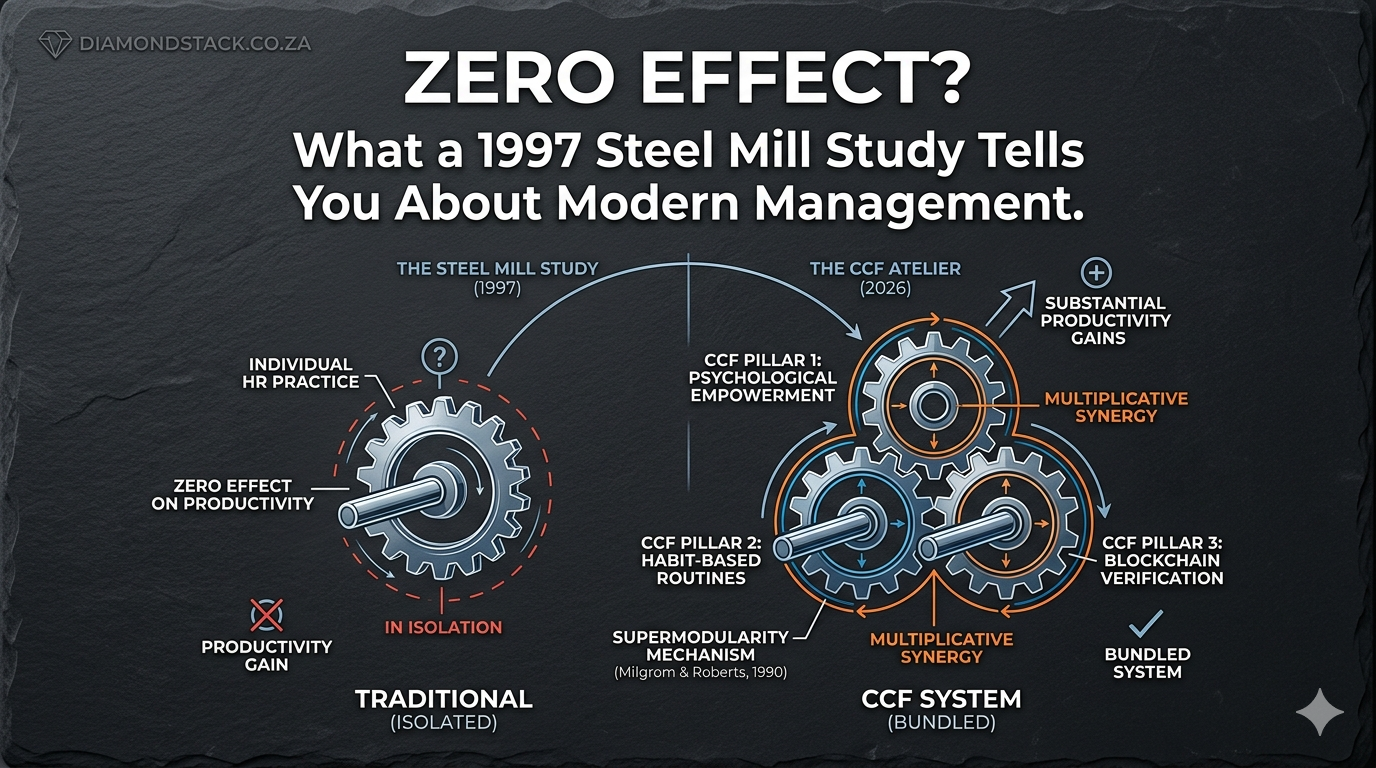
Ichniowski, Shaw, and Prennushi found that steel lines using a system of innovative HR practices — including incentive pay, teamwork, flexible job assignments, employment security, and training — achieved substantially higher productivity than lines using traditional approaches. This was not surprising. What was surprising was the finding about individual practices deployed in isolation. When a steel line introduced only one component of the bundle — teams without flexible job assignments, or training without incentive alignment — the effect on productivity was statistically indistinguishable from zero (Ichniowski et al., 1997).
Not small. Not modest. Zero.
Two years later, Ichniowski and Shaw (1999) replicated the finding by comparing US and Japanese steel production lines. Japanese lines, which almost universally operate as integrated systems, substantially outperformed US lines using traditional isolated practices. US lines that adopted the full Japanese-style bundle matched Japanese productivity levels. The researchers’ conclusion was unambiguous: the system, not the national culture, was driving the effect.
The finding has been confirmed at scale. Subramony (2009) conducted a meta-analysis of 65 studies and found that HR bundles consistently produce larger performance effects than individual practices across varying firm sizes. Combs et al. (2006), in what remains one of the most-cited meta-analyses in the field — 92 studies, cited over 4,500 times — found that systems of HR practices correlate with performance at r = 0.28, while individual practices in isolation correlate at r = 0.14. The bundle effect is not merely additive. It is qualitatively different.
Combs et al. do introduce an important qualification that honest reporting requires. Individual practices are not entirely inert — the r = 0.14 correlation is statistically significant. The more precise claim is not that isolated practices do nothing, but that their effect is roughly half that of the bundled system, and that the gap widens in complex, implementation-dependent environments. A jewellery atelier, with its tacit knowledge dependencies, craft precision requirements, and founder-proximity dynamics, is precisely the kind of environment where the gap between isolated and systemic intervention is most pronounced.
Why Your Atelier Is More Like a Steel Mill Than You Think
The analogy resists itself, and that resistance is worth examining. A steel finishing line is a volume production environment operating on fixed-specification outputs. A jewellery atelier produces bespoke, high-craft objects whose value proposition is precisely their un-systematised idiosyncrasy. The master’s eye, the bench decision that cannot be written into a procedure, the aesthetic judgment that distinguishes a R45,000 commission from a R12,000 one — none of these are variables in a steel mill productivity regression.
And yet the structural conditions that make the Ichniowski finding relevant are present in your studio in a form the steel researchers would recognise immediately.
Consider the components of the Ichniowski bundle. Incentive pay in a steel mill is the equivalent of commission structures and recognition systems in an atelier — mechanisms that align individual effort with collective output. Teamwork in a steel mill is the coordination between polishing, setting, and casting that determines whether a job moves cleanly through the bench or waits three days at each handoff point. Flexible job assignments are the cross-training and multi-skilling that allow a studio to absorb a sick-leave gap without a production crisis. Employment security is the psychological foundation on which artisans take creative risks rather than executing to the minimum safe specification. Training is the systematic transfer of the master’s tacit knowledge to the next generation of bench jewellers before it retires with the founder.
The components are structurally identical. The craft context changes their expression, not their logic.
Lor and Hassan (2017), in a study of jewellery artisans in Malaysia, found that transformational and supportive leadership had a positive, significant impact on employee performance — while transactional leadership was statistically insignificant. This is the jewellery-specific confirmation of the broader bundle logic: the practices that treat the artisan as an integrated human being, rather than a production unit to be monitored, produce the measurable performance effects. The practices that treat the bench as a machine to be managed do not.
The Mathematics of More
In 1990, economists Paul Milgrom and John Roberts published a paper in the American Economic Review that gave the Ichniowski finding its theoretical spine. The paper formalised the concept of supermodularity — a mathematical property of systems in which the marginal return of each component increases when the other components are present (Milgrom & Roberts, 1990).
The concept does not require equations to understand. Consider a lock, a key, and a door. Each of these objects has some standalone utility. A lock without a key is a paperweight. A key without a lock is a piece of metal. A door without either is just a plank. But when all three are present and aligned, they produce something qualitatively new — security, privacy, the ability to separate what is inside from what is outside. The value of the combination exceeds the sum of the individual components not because they are added together, but because each one changes what the others can do.
This is supermodularity. In organisational terms: the marginal return of empowering your bench jeweller increases substantially when you also have structured routines that give them a clear operational context to exercise that empowerment within, and a verification system that makes their expertise visible and meaningful to both themselves and the market they serve.
Milgrom and Roberts (1995) extended their theoretical work with a practical warning that every studio owner considering a partial implementation should read carefully. When there are strong complementarities among practices within a system, adopting only one component — or a small subset — is likely to reduce overall performance relative to the prior state. The firm incurs the cost and disruption of the new practice without triggering the synergistic returns that only materialise at full system integration.
They described this as the valley between performance peaks. The traditional system occupies one peak — it is suboptimal compared to the integrated bundle, but it is internally consistent. The integrated bundle occupies a higher peak. The valley between them is the transition zone, in which the old system has been disrupted but the new system has not yet cohered. Firms that attempt the transition by adopting one component at a time spend extended periods in this valley, bearing costs without benefits, and often conclude that the new system does not work — when in fact they never reached the altitude at which the system’s returns become visible.
Patel et al. (2013) provided the closest empirical confirmation of this three-way complementarity in an SME context. Their study explicitly tested and measured the supermodularity of empowerment-based HR systems, operational routines, and transparency systems — finding that the marginal return of each component was significantly higher in the presence of the others. This is not a metaphor. It is a measured interaction effect in firms of the size and complexity range that characterises a South African jewellery atelier.
The Binding Constraint: Why Ability Is Not Your Problem
The AMO framework — developed by Appelbaum et al. (2000) and subsequently one of the most widely used models in strategic HR research — proposes that employee performance is a function of three conditions: Ability (the skill and knowledge to perform), Motivation (the willingness to apply that skill), and Opportunity (the structural context that allows performance to occur). All three must be present for performance to materialise. But the framework also implies something that the practitioner literature rarely makes explicit: in any given environment, one of the three is the binding constraint — the rate-limiting factor that determines the ceiling on the other two.
In a jewellery atelier, the binding constraint is almost never Ability. You selected your bench jewellers on the basis of demonstrated craft. Your polisher has 14 years of experience. Your setter handles stones that would terrify a less skilled technician. The Ability constraint was addressed at the point of hire, and it is continuously addressed through the informal apprenticeship structures that characterise the craft. Prenen et al. (2015) note that in high-craft industries, Ability does remain a moving target as techniques evolve — the introduction of CAD/CAM, laser welding, and new alloy chemistries creates genuine skill gaps that training must address. But this is a maintenance problem, not a structural constraint.
Nor is Opportunity typically the primary constraint in a well-established studio. Your artisans have access to tools, materials, and workspace. They have the physical and procedural opportunity to perform. Bos-Nehles et al. (2013) found that even when Motivation and Ability are high, Opportunity-enhancing practices act as a gatekeeper — without structured routines, motivated artisans cannot convert that motivation into consistent output. But the gatekeeper function of Opportunity means it is a necessary condition, not the binding one.
Ehrnrooth and Björkman (2012) provide the clearest articulation of the motivation constraint in high-skill environments. In contexts where Ability is a baseline — where workers were selected for demonstrated competence — the primary driver of performance variance is not whether they can perform, but whether they are in a psychological state that allows them to apply their tacit knowledge to non-routine problems. This is the distinction between executing a familiar task competently and bringing genuine creative investment to a challenging commission. The former is Ability. The latter is what Ehrnrooth and Björkman call “integrated regulation” — a form of intrinsic motivation in which the work itself is experienced as meaningful, and in which the worker applies discretionary effort not because they are monitored, but because the work matters to them.
Argote and Ingram (2000), in a paper cited over 6,500 times, provide the mechanism that makes this binding constraint so consequential for craft businesses specifically. In low-volume, high-skill production environments, knowledge is embedded in people — in the artisan’s hands, eyes, and accumulated judgment. This tacit knowledge cannot be extracted by documentation procedures or encoded in manuals. It transfers only through relationship, observation, and motivated collaboration. When motivation is low — when the artisan is going through the motions rather than fully present at the bench — the tacit knowledge remains trapped in the individual. It does not flow to apprentices. It does not surface in the quality conversations that improve the studio’s collective capability. It does not manifest in the extra care that distinguishes a R50,000 piece from one that merely meets specification.
The Ability is there. The Opportunity is there. The tacit knowledge is there. What is missing is the motivational architecture that converts latent craft excellence into organisational performance.
Three Pillars as an AMO System
The Coetzee Convergence Framework maps directly onto the AMO structure — not as a post-hoc rationalisation, but as the reason the three pillars were selected and sequenced as they were.
Pillar 1, Psychological Empowerment, addresses the Motivation constraint. Spreitzer (1995) defined psychological empowerment as a cognitive state comprising four dimensions: meaning (the work matters), competence (the worker is capable), self-determination (the worker has genuine discretion), and impact (the worker’s actions make a difference to outcomes). Seibert, Wang, and Courtright (2011), in a meta-analysis of 142 independent samples, found a corrected correlation of ρ = .44 between psychological empowerment and task performance. Translated into variance explained: empowerment interventions account for approximately 19.4% of task performance variance when implemented as a standalone construct. This is the ceiling on Pillar 1 alone. It is not trivial — it is a substantial effect by the standards of organisational psychology. But it is well below the threshold at which complementarity effects become visible.
Pillar 2, Habit-Based Externalisation, addresses the Opportunity constraint. Gersick and Hackman (1990) established that groups develop stable behavioural routines — habitual patterns of task execution — that both enable performance and resist change. Feldman and Pentland (2003) distinguished between the ostensive aspect of routines (the abstract idea of how things should be done) and the performative aspect (what actually happens at the bench). The CCF’s habit-based routines work at the performative level: they create the structured operational context in which empowered artisans can exercise their motivation consistently, without each job requiring a fresh negotiation of how work is organised. Duhigg’s (2012) popular articulation of habit loop theory — cue, routine, reward — is the practitioner-accessible translation of this academic foundation, though Wood and Neal (2007) and Lally et al. (2010) provide the peer-reviewed habit formation evidence that anchors the claims scientifically.
Pillar 3, the Diamond Stack Digital Passport, operates at both the Ability and the Motivation layers simultaneously — and this dual function is what makes it the catalytic component of the CCF’s supermodularity. At the Ability layer, the Digital Passport creates a verified record of the artisan’s demonstrated competence: the service history, provenance documentation, and material traceability that constitute objective proof of craft capability. This is the signalling function Spence (1973) described — a costly, verifiable signal that reduces the information asymmetry Akerlof (1970) identified as the structural problem in markets for experience goods like jewellery.
At the Motivation layer, Jiang and Cheng (2025) provide the critical finding: digital tracking and verification systems increase work engagement when they activate the meaning dimension of psychological empowerment. When the digital record is experienced as an objective validation of the artisan’s skill — as a permanent, portable record of craft excellence — it increases the psychological meaningfulness of the work. When it is experienced as a monitoring tool in the founder’s hands, the effect reverses. This is the design condition on which the entire third pillar depends, and it is examined in detail in the sections on Transparency Equity below.
The supermodularity operates through specific mutual reinforcement mechanisms. Empowerment increases the value of the blockchain layer: high-trust, psychologically safe environments reduce the incentive to falsify records, increasing the integrity of the provenance data and therefore its market value. Habit routines increase the value of empowerment: structured operational contexts free cognitive bandwidth that would otherwise be consumed by coordination friction, leaving more capacity for the creative problem-solving that empowered artisans perform. The Digital Passport increases the value of habit routines: permanent documentation of service records creates accountability loops that reinforce habit consistency — the artisan’s work is no longer ephemeral, but accumulated into a record that builds over time.
Each pillar increases the marginal return of the others. This is what Milgrom and Roberts (1990) meant by supermodularity. This is what Patel et al. (2013) measured in SME contexts. And this is why partial adoption is not a conservative strategy — it is an expensive one.
The Valley of Death
Michael Fullan (2001), in a work cited over 18,000 times across education and organisational change research, named something that every studio owner who has attempted a serious operational transformation will recognise: the Implementation Dip. It is a literal, measurable decline in proficiency and confidence that occurs when a new system is introduced, before the new habits have automated and the new routines have become second nature. Fullan’s contribution was not to identify it — practitioners had known about it for decades — but to name it and normalise it. The Implementation Dip is not evidence that the system is wrong. It is evidence that deep learning is occurring.
For a jewellery atelier implementing the CCF, the dip is predictable in its mechanism and bounded in its duration. CIPD (2024/2025) research on SME HR system implementations indicates that the active phase of the transition — from initial deployment to stabilisation — typically lasts between five weeks and six months, with the most acute disruption concentrated in the first eight to twelve weeks. Evidence from SME digital transformation projects suggests that productivity declines during this period typically range between 10% and 15% in well-managed transitions, with the magnitude increasing where implementation is poorly sequenced or inadequately communicated to the artisan team.
Milgrom and Roberts (1995) are precise about the mechanism. The firm that partially adopts the new system incurs the costs of reconfiguration — the time, cognitive load, and procedural friction of the new practices — without triggering the synergistic returns that only materialise when all three components are operational. The studio that installs the Digital Passport without the empowerment architecture will find that artisans experience the documentation requirements as administrative burden rather than meaningful record-keeping. The studio that introduces psychological empowerment frameworks without structured habit routines will find that motivated artisans channel their discretionary effort in directions that feel personally meaningful but do not align with studio priorities. The studio that implements habit routines without the motivational underpinning will find that artisans comply with procedures in the letter while withdrawing in spirit.
The most dangerous moment in any CCF implementation is approximately week five. This is where Repenning and Sterman (2002), in a paper published in Administrative Science Quarterly and cited nearly 1,800 times, identified what they called the Capability Trap — a self-reinforcing failure dynamic in which the time and cognitive load imposed by the new system reduces short-term output, the founder interprets this reduction as evidence that the system is not working, the system is abandoned or scaled back, and the studio returns to its prior equilibrium, now with the additional disadvantage of a demoralised team that has been asked to change and then been told the change was not worth the effort.
The Capability Trap is not a theoretical risk. Jensen et al. (2013) documented that HPWS bundles can increase employee anxiety and role overload, particularly in high-pressure environments where the new system’s demands stack on top of existing production pressures. In a busy season — the period when the CCF’s operational improvements would be most valuable — the implementation demands are most likely to feel unmanageable. The founder who has not been briefed on the Implementation Dip will almost certainly misread this as evidence of system failure. The founder who has been briefed will recognise it as the valley that must be crossed to reach the higher performance peak on the other side.
The determinant of whether a studio crosses the valley or retreats from it is the founder’s psychological commitment during weeks five to twelve. Not their intellectual conviction — their emotional capacity to hold nerve through a period when the metrics look worse than they did before the intervention began. This is documented. Lindholm (2025) identifies founder commitment during the acute dip phase as the primary determinant of successful SME system transitions. The research from implementation science in Swiss healthcare contexts (2020) adds a second determinant: early involvement of the artisans themselves in the design of the system, which reduces the magnitude of the dip by ensuring the new routines account for tacit knowledge requirements that an outside designer would not anticipate.
The Three Failure Modes — Named Before They Are Answered
Intellectual honesty requires that the CCF’s documented failure modes be stated before the survival strategies are offered. A framework that presents only its supporting evidence is marketing copy. A framework that presents its failure modes alongside its architecture is a tool.
The first failure mode is what Nyamubarwa (2016), writing in the SA Journal of Human Resource Management, identified as the one-size-fits-all problem in micro-enterprise HR. Full HPWS bundle implementation rates in firms under 25 staff are documented at below 20%, because the administrative overhead of maintaining the bundle — documentation, formal routines, system maintenance — outweighs the productivity gains in contexts where resource buffers are thin and informality is a genuine competitive advantage. The “eclectic nature” of small firm HR, as Nyamubarwa frames it, is not a deficiency to be corrected. It is a functional adaptation to resource constraints that a corporate HR framework, exported unchanged, will disrupt rather than enhance.
The CCF’s response to this failure mode is not a defence of corporate HR — it is an explicit rejection of it. The CCF is not a large-firm HPWS in miniature. It is a ruggedised SME framework designed for the specific constraints of the 8–25 person atelier. The Digital Passport does not add a bureaucratic documentation layer to the studio’s existing workload. It replaces the existing chaos of scattered invoices, WhatsApp photographs, and verbal service histories with a structured record that takes less time to maintain than the current disorganisation costs. The habit routines do not impose a new procedural architecture on top of existing workflows. They externalise the procedural knowledge that is currently trapped in the founder’s head and therefore only accessible when the founder is physically present in the studio.
The second failure mode is what Roy and Sarkar (2024), in the Strategic Entrepreneurship Journal, describe as the Craft-Standardisation Paradox. Drawing on Bernstein’s concept of “framing relations,” they argue that standardisation — the strong framing required by HPWS routines — can stunt the development of the artisan’s internalised competence. High-craft environments require what Bernstein called “weak framing”: sufficient procedural looseness that the apprentice develops their own work rhythms, their own aesthetic instincts, their own relationship with material. When the habit loop governs how the diamond is cut, the system destroys the very idiosyncrasy that justifies the R50,000 price tag.
The CCF’s response to this failure mode is Minimum Viable Standardisation — the principle that the framework systematises the operational shell while protecting the tacit core. The habit routines govern how a job enters the studio, how service records are maintained, how work-in-progress is communicated, and how completed work is documented. They do not govern how the stone is set. They do not govern the aesthetic conversation with the client. They do not govern the bench decision that distinguishes a master jeweller’s work from a technically competent but soulless execution. The Digital Passport records that the diamond was set with excellence. It does not dictate what excellence looks like. The master’s eye is not a variable in the habit loop.
The third failure mode is the most geographically specific and therefore the most directly relevant for South African studios. Feng (2025), writing in the SA Journal of Business Management, found that digital transformation initiatives in South African manufacturing contexts — firms of comparable size and structural characteristics to the jewellery atelier — can trigger what the organisational psychology literature calls unethical pro-self behaviours: system gaming, selective compliance, and the performance of procedure rather than its execution. The mechanism is technostress compounded by job insecurity. When workers believe that the digital verification system is a precursor to automation, performance benchmarking, or disciplinary action, they do not engage with it as a tool of craft record-keeping. They manage it as a performance signal — entering data that makes them look compliant rather than data that accurately reflects their work.
The CCF’s response to this failure mode is Transparency Equity, which is examined in the next section. But the foundational point must be stated clearly: the Digital Passport fails as a surveillance tool. It only functions as a complementarity amplifier — as the component that increases the marginal return of empowerment and habit routines — when the artisan experiences it as their record, not the founder’s.
Minimum Viable Standardisation
The CCF’s approach to Pillar 2 is governed by a distinction that Adler and Borys (1996) formalised in one of the most-cited papers in organisational sociology: the difference between enabling and coercive formalisation. Published in Administrative Science Quarterly and cited over 4,800 times, the paper argues that formalisation — the codification of work into documented procedures and routines — is not inherently empowering or constraining. The effect depends entirely on the design intent and implementation framing of the formal system.
Coercive formalisation is designed to monitor and constrain worker behaviour. The procedure exists to prevent deviation. Compliance is the goal. The worker’s relationship to the procedure is adversarial: the procedure represents the organisation’s distrust of the worker’s judgment, and the worker responds by doing exactly what the procedure requires — and nothing more. The discretionary effort that Argote and Ingram (2000) identified as the vehicle for tacit knowledge transfer is precisely the effort that coercive formalisation extinguishes.
Enabling formalisation is designed to support and amplify worker judgment. The procedure exists to reduce friction, not to replace expertise. The routine handles the aspects of work that do not require craft judgment, freeing the artisan’s cognitive resources for the aspects that do. Adler and Borys (1996) found that workers in enabling formalisation environments experience a qualitatively different relationship with their procedures: they understand why the routine exists, they can see how it connects to the broader system, and they have sufficient transparency into the whole process to exercise informed discretion when the procedure meets an edge case the designer did not anticipate.
Transparency is the mechanism that converts a routine from coercive to enabling. When the artisan can see how their work-in-progress record connects to the client relationship, the provenance chain, and the studio’s reputational capital, the routine acquires meaning. It is no longer a compliance requirement. It is a contribution to a system the artisan understands and benefits from.
Sprigg et al. (2007) confirmed the interaction empirically: empowerment only scales — only produces the full effect predicted by Seibert et al.’s (2011) meta-analysis — when the technical systems and routines are aligned to handle the operational variability of the work context. In a jewellery studio, this means the habit routines must be calibrated to the actual complexity of commission work, not borrowed from a retail environment where standardisation is genuinely possible across the full range of work. A routine that works for repair jobs may need adaptation for bespoke commissions. Minimum Viable Standardisation means finding the threshold at which the operational benefits of the routine justify the constraint it imposes — and not crossing it.
Levinthal (1997), in a paper on adaptive landscapes cited over 5,200 times, provides the theoretical caution that Minimum Viable Standardisation must answer. In complex systems with many interacting elements, the search for an optimal configuration is constrained by what Levinthal calls “rugged fitness landscapes” — terrain in which the optimal combination is surrounded by local optima that look attractive from close proximity but represent a ceiling rather than a summit. For a small firm attempting a three-way complementarity, the risk of getting trapped on a local peak — a partially functional system that is better than the prior state but well below the potential of the full bundle — is genuine. The CCF’s phased deployment protocol is the structural response: each pillar is introduced in sequence, with the empowerment architecture established before the habit routines are formalised, and the habit routines functional before the Digital Passport is deployed. The sequence matters because it determines which components the artisan experiences as tools they chose versus systems imposed on them.
Transparency Equity
Jiang and Cheng (2025) published what may be the most directly applicable finding for the Diamond Stack Digital Passport’s empowerment mechanism. Their study examined how algorithmic tracking and digital verification systems affect work engagement in knowledge-intensive and craft-proximate environments. The finding was nuanced in a way that the practitioner literature on blockchain provenance rarely acknowledges: digital systems increase work engagement specifically when they activate the meaning dimension of psychological empowerment. When the digital record is experienced as an objective, permanent validation of the worker’s skill — as proof of craft excellence that belongs to the artisan as much as to the organisation — engagement increases. When the same system is experienced as a monitoring tool that serves the employer’s interest in oversight, the effect reverses.
The design intent of the system is the switch between these two outcomes. Not the technology — the intent, the framing, and the governance of who benefits from the data.
Frey and Jegen (2001), in a paper on motivation crowding theory cited over 4,500 times, established the theoretical mechanism. External verification systems — whether financial incentives, monitoring technologies, or documented accountability structures — crowd out intrinsic motivation when they are perceived as controlling. The artisan who was previously motivated by the intrinsic satisfaction of excellent craft work begins to experience their motivation as contingent on the external system. Remove the system, and the motivation collapses. Maintain the system, and the motivation remains, but it has been converted from an internal resource the artisan owns to an external dependency the organisation controls. The net effect on discretionary effort is negative.
Van Esch et al. (2021) documented this effect specifically in digital HR tool contexts: systems perceived as workforce surveillance trigger what they call acceptance failure — a pattern in which workers technically comply with the system’s requirements while psychologically withdrawing from its intent. Zhang and Hao (2022), writing in the SA Journal of Business Management, found that digital transformation initiatives in manufacturing contexts must be “people-centric” — a phrase that sounds like management consulting language but has a precise operational meaning: the data generated by the system must produce visible benefits for the worker, not merely for the organisation.
The CCF’s Transparency Equity principle operationalises this requirement in three specific design commitments for the Diamond Stack Digital Passport.
First, the artisan’s service record is their portable professional reputation. The Digital Passport is not a studio asset that disappears when the artisan moves on. It is a documented record of demonstrated craft capability that the artisan carries with them — the equivalent of a surgeon’s operating record or an engineer’s project portfolio. This framing changes the artisan’s relationship to the documentation requirement from compliance to investment. They are building their own professional record, not completing the founder’s administrative procedure.
Second, the data accessible to the artisan must be equivalent to the data accessible to the founder and the market. If the founder can see a complete service history and the artisan cannot see their own record, the system is structurally coercive regardless of the stated intent. Transparency is not selective. An asymmetric information architecture produces exactly the Frey and Jegen (2001) crowding-out effect it is designed to avoid.
Third, the meaning dimension identified by Jiang and Cheng (2025) must be designed in at the point of deployment — not retrofitted when engagement problems surface. This means the introduction of the Digital Passport must include an explicit conversation with the artisan team about what the record means for their professional identity and market visibility, not merely a technical briefing on how to use the system. Adler and Borys (1996) established that workers who understand why a system exists — who can see the whole process and their role in it — maintain enabling rather than coercive experiences of formalisation. The Digital Passport introduction is a meaning-making event, not a software deployment.
The Honest Summary
The CCF is not the easiest path. The research is unambiguous on this point, and presenting it otherwise would be precisely the kind of information asymmetry that the framework is designed to solve in the jewellery market itself.
What the evidence supports — across 30 years of management science, six rounds of structured devil’s advocate interrogation, and a literature spanning steel mills in Pittsburgh, craft sectors in Malaysia, and digital transformation contexts in South Africa — is a qualified and specific claim. Three pillars, deployed as an integrated system rather than as sequential modules, produce supermodular performance gains that no single pillar produces in isolation. The mathematical mechanism was formalised by Milgrom and Roberts (1990, 1995). The empirical precedent was established by Ichniowski, Shaw, and Prennushi (1997) and subsequently replicated across firm sizes and geographies. The SME-specific confirmation was provided by Patel et al. (2013). The AMO binding constraint that makes Pillar 1 the primary lever was documented by Ehrnrooth and Björkman (2012) and Argote and Ingram (2000). The enabling design condition for Pillar 3 was identified by Jiang and Cheng (2025) and theorised by Adler and Borys (1996).
The qualification is equally important to state. The system requires a founder willing to hold nerve through an Implementation Dip of approximately 10–15% productivity decline over eight to twelve weeks, without misreading the dip as system failure. It requires a commitment to Minimum Viable Standardisation — the discipline to systematise only what the craft can absorb without losing the idiosyncrasy that justifies its price. And it requires genuine Transparency Equity — a design commitment to the artisan’s ownership of their own record that cannot be simulated by good intentions and must be built into the system architecture from the beginning.
Gerhart (2007) raises the most intellectually serious challenge to the supermodularity claim: the empirical evidence for true multiplicative synergy, as opposed to the additive effects of several good practices deployed simultaneously, is methodologically difficult to disentangle. This is an honest limitation that the CCF’s framework acknowledges. The claim being made is not that the pillars multiply each other in a mathematically precise sense, but that they are Edgeworth complements — that each one increases the marginal return of the others, such that the total effect of the system substantially exceeds the sum of what each pillar produces in isolation. This is measurable. It has been measured. And it is the only documented path from craft excellence — which your studio already possesses in abundance — to the organisational performance that determines whether that craft excellence survives the next decade.
The folder on the shelf above the safe did not fail because it contained bad ideas. It failed because good ideas, deployed in isolation, produce effects that are roughly half the magnitude of the same ideas deployed as a system — and that is on a good day, in a forgiving environment, with a patient founder. The steel mill proved it. The meta-analyses confirmed it. And 27 years of management science have not found a more reliable path to the performance that isolated interventions have been promising and not delivering.
Frequently Asked Questions
1. My studio is six people, not 25. Is this framework relevant at our scale?
The CCF was designed for the 8–25 person range, but the supermodularity logic applies at smaller scales with appropriate calibration. The critical threshold is not headcount — it is whether the founder can personally oversee every bench decision without a system. At six people, that may still be possible. The question is whether it is sustainable as the studio grows, and whether the tacit knowledge currently residing in the founder will survive a succession event or a period of illness without a structured transfer mechanism. Nyamubarwa (2016) documents that full HPWS bundle implementation rates below 20% in micro-enterprises are primarily driven by administrative overhead concerns. The CCF’s Minimum Viable Standardisation principle is designed to address exactly this constraint: start with the lightest viable version of each pillar and add complexity only as the studio demonstrates capacity to absorb it.
2. We already have strong routines and good communication. Do we need all three pillars?
This is the most important question to answer carefully, because it is where the Milgrom and Roberts (1995) valley-of-death warning is most relevant. Strong routines and good communication are the Opportunity component of the AMO system. If your Motivation architecture — the psychological empowerment conditions under which your artisans experience their work as meaningful — is not equally developed, the routines are producing roughly half their potential effect. And if neither the routines nor the empowerment are connected to a verification layer that makes the studio’s craft excellence visible to the market, the system has no external amplifier. The question to ask is not whether you have some version of each pillar, but whether the three are working together as a coherent system or operating as independent, unconnected practices.
3. The blockchain documentation requirement sounds time-consuming. How does it not just create more admin?
This is the Nyamubarwa (2016) failure mode stated as a practical concern, and it deserves a direct answer. The Digital Passport replaces existing documentation practices — it does not add to them. Most studios currently maintain some combination of job cards, WhatsApp message threads, photographed stones, client emails, and verbal service histories. The total time currently spent on this fragmented documentation is almost always greater than the time required to maintain a structured Digital Passport, because fragmented documentation requires repeated reconstruction every time a client asks a question, a stone is queried, or a service history needs to be traced. The question is not whether the documentation overhead increases — it typically decreases — but whether the implementation transition costs during the eight to twelve week dip phase are worth the long-term efficiency gain. The evidence suggests they are, provided the transition is properly managed and the founder does not abandon the system during the acute disruption phase.
4. My best jeweller has been with me for 18 years. Won’t formalising routines feel like I don’t trust them?
This concern identifies exactly the risk that Adler and Borys (1996) theorised and that Frey and Jegen (2001) confirmed empirically. Coercive formalisation — routines designed to monitor and constrain — will indeed be experienced as distrust by a skilled artisan with 18 years of demonstrated capability. But this is precisely why the CCF’s enabling formalisation approach matters. The conversation with your senior artisan is not “I am introducing procedures because I do not trust your judgment.” It is “I am building systems to ensure that what you know is not lost if you are sick for three weeks, and to ensure that the market can verify what you already know about the quality of this studio’s work.” Those are categorically different framings, and the research is clear on which one maintains discretionary effort and which one extinguishes it. The system is not a replacement for 18 years of accumulated expertise. It is the mechanism by which that expertise becomes organisationally durable rather than personally contingent.
5. What does success look like at 12 months, and how would I measure it?
The Seibert et al. (2011) meta-analysis provides the benchmark for Pillar 1: a well-implemented psychological empowerment intervention explains approximately 19.4% of task performance variance. This is not a revenue number — it is a process metric. At 12 months, you should be measuring the four Spreitzer (1995) dimensions — meaning, competence, self-determination, and impact — through a structured instrument, not through the founder’s subjective impression of team morale. For Pillar 2, habit routine compliance rates and handoff timing consistency are the leading indicators, with job throughput time and rework rates as the lagging performance outcomes. For Pillar 3, the Digital Passport’s success at 12 months is measured not by the completeness of the records — that is a compliance metric — but by whether artisans are referencing their own records voluntarily, which is the behavioural indicator of the meaning activation that Jiang and Cheng (2025) identified as the system’s empowerment mechanism. When an artisan shows a client their service record not because the protocol requires it but because they are proud of what it documents, the Transparency Equity condition has been met.
References
Adler, P. S., & Borys, B. (1996). Two types of bureaucracy: Enabling and coercive. Administrative Science Quarterly, 41(1), 61–89.
Akerlof, G. A. (1970). The market for “lemons”: Quality uncertainty and the market mechanism. Quarterly Journal of Economics, 84(3), 488–500.
Appelbaum, E., Bailey, T., Berg, P., & Kalleberg, A. L. (2000). Manufacturing advantage: Why high-performance work systems pay off. Cornell University Press.
Argote, L., & Ingram, P. (2000). Knowledge transfer: A basis for competitive advantage in firms. Organizational Behavior and Human Decision Processes, 82(1), 150–169.
Bos-Nehles, A. C., Van Riemsdijk, M. J., & Kees Looise, J. (2013). Employee perceptions of line management performance: Applying the AMO theory to explain the effectiveness of line managers’ HRM implementation. Human Resource Management, 52(6), 861–877.
CIPD. (2024/2025). Operating efficiently: Implementing HR information systems in SMEs. Chartered Institute of Personnel and Development.
Combs, J., Liu, Y., Hall, A., & Ketchen, D. (2006). How much do high-performance work practices matter? A meta-analysis of their effects on organizational performance. Personnel Psychology, 59(3), 501–528.
Duhigg, C. (2012). The power of habit: Why we do what we do in life and business. Random House.
Ehrnrooth, M., & Björkman, I. (2012). An integrative HRM process theorization: Beyond signalling effects and mutual gains. Journal of Management Studies, 49(6), 1109–1135.
Feldman, M. S., & Pentland, B. T. (2003). Reconceptualizing organizational routines as a source of flexibility and change. Administrative Science Quarterly, 48(1), 94–118.
Feng, Y. (2025). Digital transformation and employees’ unethical pro-self behaviours: Evidence from South African manufacturing. SA Journal of Business Management.
Frey, B. S., & Jegen, R. (2001). Motivation crowding theory. Journal of Economic Surveys, 15(5), 589–611.
Fullan, M. (2001). The new meaning of educational change (3rd ed.). Teachers College Press.
Gerhart, B. (2007). Modeling HRM and performance linkages. In P. Boxall, J. Purcell, & P. Wright (Eds.), Oxford handbook of human resource management (pp. 552–580). Oxford University Press.
Gersick, C. J. G., & Hackman, J. R. (1990). Habitual routines in task-performing groups. Organizational Behavior and Human Decision Processes, 47(1), 65–97.
Ichniowski, C., & Shaw, K. (1999). The effects of human resource management systems on economic performance: An international comparison of US and Japanese plants. Journal of the Japanese and International Economies, 13(4), 294–328.
Ichniowski, C., Shaw, K., & Prennushi, G. (1997). The effects of human resource management practices on productivity: A study of steel finishing lines. American Economic Review, 87(3), 291–313.
Jensen, J. M., Patel, P. C., & Messersmith, J. G. (2013). High-performance work systems and job control: Consequences for anxiety, role overload, and turnover intentions. Journal of Management, 39(6), 1699–1724.
Jiang, H., & Cheng, X. (2025). Perceived algorithmic control and gig workers’ work engagement: Assessing the mediating role of psychological empowerment. Frontiers in Psychology. PMC.
Lally, P., van Jaarsveld, C. H. M., Potts, H. W. W., & Wardle, J. (2010). How are habits formed: Modelling habit formation in the real world. European Journal of Social Psychology, 40(6), 998–1009.
Levinthal, D. A. (1997). Adaptation on rugged landscapes. Management Science, 43(7), 934–950.
Lor, W., & Hassan, S. (2017). The influence of leadership styles on employees’ job satisfaction in the jewellery industry. International Review of Management and Marketing, 7(2), 15–20.
Milgrom, P., & Roberts, J. (1990). The economics of modern manufacturing: Technology, strategy, and organization. American Economic Review, 80(3), 511–528.
Milgrom, P., & Roberts, J. (1995). Complementarities and fit: Strategy, structure, and organizational change in manufacturing. Journal of Accounting and Economics, 19(2–3), 179–208.
Nyamubarwa, W. (2016). Debunking the one-size-fits-all approach to HRM: A review of HR practices in SME firms. SA Journal of Human Resource Management, 14(1), 1–9.
Patel, P. C., Messersmith, J. G., & Lepak, D. P. (2013). Walking the tightrope: An assessment of the relationship between high-performance work systems and organizational ambidexterity. Academy of Management Journal, 56(5), 1420–1442.
Prenen, R., Van Ruysseveldt, J., & Van Dam, K. (2015). Ability, motivation and opportunity to continue working. Human Resource Management Journal, 25(4), 569–583.
Repenning, N. P., & Sterman, J. D. (2002). Capability traps and self-confirming attribution errors in the dynamics of process improvement. Administrative Science Quarterly, 47(2), 265–295.
Roy, M., & Sarkar, A. (2024). Craft approach to work: A humanist model of work in organizations. Small Business Economics.
Seibert, S. E., Wang, G., & Courtright, S. H. (2011). Antecedents and consequences of psychological and team empowerment in organizations: A meta-analytic review. Journal of Applied Psychology, 96(5), 981–1003.
Spence, M. (1973). Job market signaling. Quarterly Journal of Economics, 87(3), 355–374.
Spreitzer, G. M. (1995). Psychological empowerment in the workplace: Dimensions, measurement, and validation. Academy of Management Journal, 38(5), 1442–1465.
Sprigg, C. A., Stride, C. B., Wall, T. D., Holman, D. J., & Smith, P. R. (2007). Work characteristics, musculoskeletal disorders, and the mediating role of psychological strain: A study of call centre employees. Journal of Applied Psychology, 92(5), 1456–1466.
Subramony, M. (2009). A meta-analytic investigation of the relationship between HRM bundles and firm performance. Human Resource Management, 48(5), 745–768.
Van Esch, P., Black, J. S., & Arli, D. (2021). Job candidates’ reactions to AI-enabled job application processes. AI and Ethics, 1, 119–130.
Wood, W., & Neal, D. T. (2007). A new look at habits and the habit-goal interface. Psychological Review, 114(4), 843–863.
Zhang, J., & Hao, Y. (2022). Empowering employees for digital transformation in manufacturing enterprises. SA Journal of Business Management, 53(1), 1–12.