
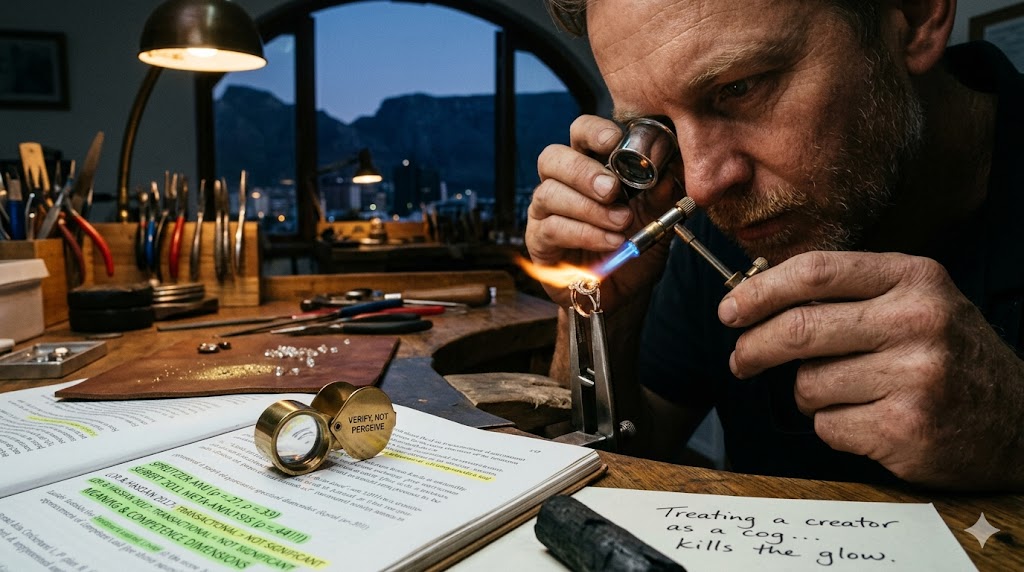
The View from the Bench: Why Artisans Hate “Transactional” Bosses
There is a fundamental misunderstanding in the way many jewellery businesses are managed. It usually stems from a place of stress—the founder, feeling the weight of the overhead, tries to drive production through “transactional” leadership. It’s the classic carrot-and-stick: “Finish these ten settings by Friday, and there’s a bonus. Fail, and we need to have a talk.”
To a factory manager, this makes sense. To an artisan, it’s a slow-acting poison for creativity.
The Science of the Artisan Mind
In 2017, researchers Lor and Hassan conducted a study specifically focused on jewellery artisans. They wanted to see which leadership styles actually moved the needle on performance. Their findings were a wakeup call for the “boss” mentality: Transactional leadership (reward-and-punishment) was not significant. It didn’t work. Not because the artisans were lazy, but because the incentive didn’t match the “Meaning” of the work.
When I look at this through the lens of Gretchen Spreitzer’s dimensions of empowerment, the pattern becomes clear. A master goldsmith isn’t motivated by a transactional “unit price.” They are driven by Competence (the mastery of a difficult curve or a flawless grain setting) and Meaning (the knowledge that they are creating an heirloom that will outlast them).
A Goldsmith is Not a Factory Worker
If you treat a creator like a cog in a machine, they will eventually start acting like one. They stop volunteering ideas. They stop spotting the “two-degree” adjustment that would have made a stone pop. They wait for instructions because the environment has told them that their “Meaning” doesn’t matter—only their output does.
This is the ultimate “Diminisher” trap. By trying to control the production, the founder accidentally suppresses the very thing they are paying for: the artisan’s soul.
Creating a Multiplier Environment
Rapport in a studio isn’t built on bonuses alone; it’s built on Stewardship.
An artisan needs a “Multiplier” environment where their expertise is respected, not just managed. When you shift from “checking up on them” to “removing obstacles for them,” you align with the science of human motivation. You stop being the person holding the stick and start being the person holding the vision.
My work in technical SEO and digital strategy always comes back to this human bedrock. You can have the best website in South Africa, but if the energy at the bench is transactional, the product will eventually lose its “glow.”
We don’t just build digital stacks; we build environments where creators can do their best work. Because in this industry, the “Meaning” is the only thing that actually scales.