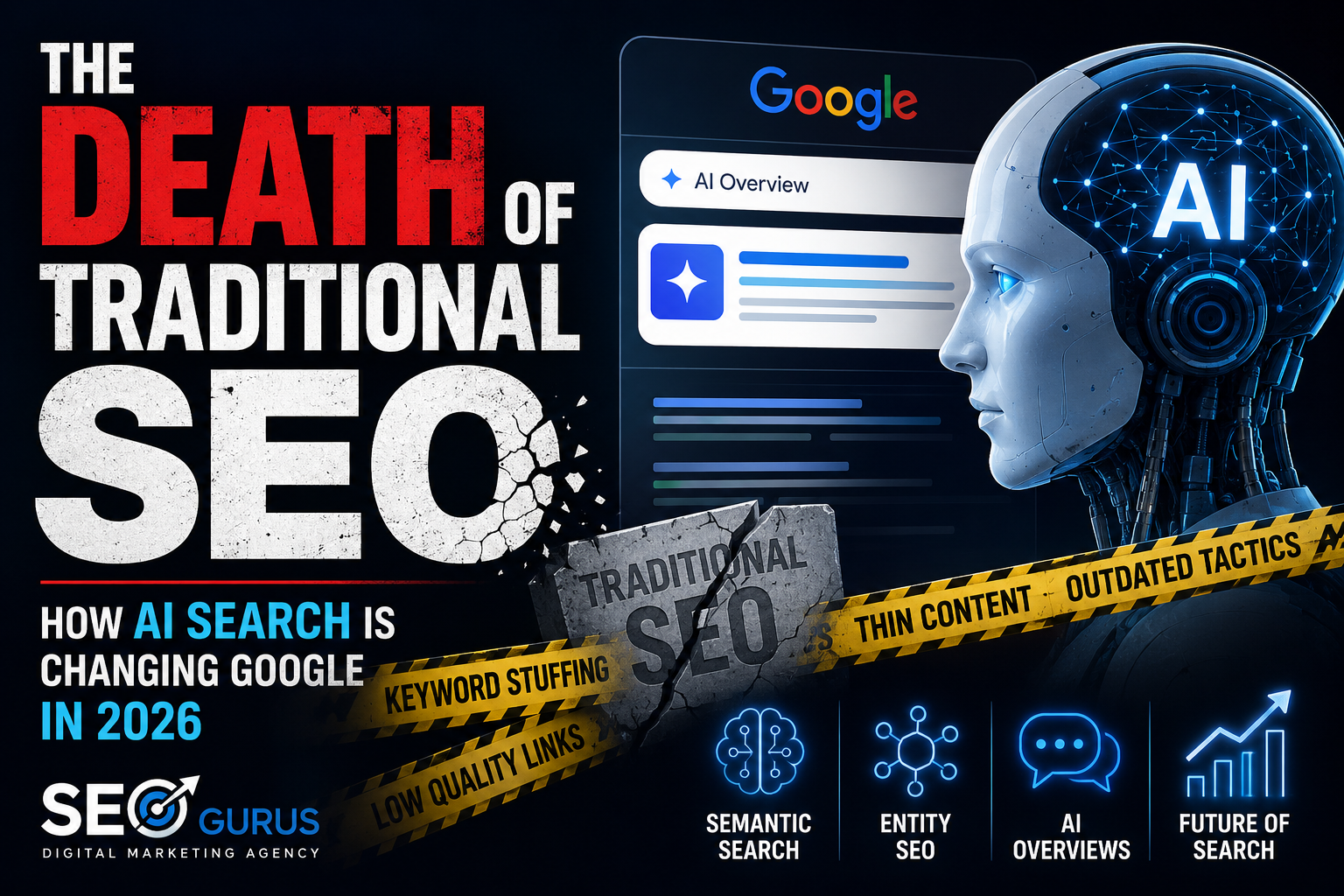
The Death of Traditional SEO: How AI Search Is Changing Google in 2026
For more than two decades, businesses approached Google with a relatively simple formula: target keywords, build backlinks, publish content, and climb the rankings. That model is collapsing.
Search is no longer just a list of blue links. Google has evolved into an AI-driven answer engine powered by semantic understanding, contextual retrieval systems, predictive intent modelling, and machine-generated summaries. The rise of Google AI Overviews, conversational search interfaces, multimodal indexing, and generative search experiences is fundamentally changing how users discover information online.
The consequences are already visible. Organic click-through rates are declining across informational queries as AI-generated answers increasingly satisfy users directly within search results. Businesses relying on outdated SEO tactics are watching impressions rise while actual website traffic stagnates. Traditional ranking strategies built around keyword density and generic blog content are rapidly losing effectiveness.
This is not a temporary algorithm update.
It is a structural transformation of search itself.
The future belongs to businesses that understand AI SEO, semantic search architecture, entity optimisation, and machine-readable trust signals. Companies that fail to adapt risk becoming invisible in an AI-first search ecosystem where visibility is determined not only by rankings, but by whether AI systems trust, understand, and reference your brand.
At SEO Gurus, we believe the next era of SEO belongs to technically sophisticated brands that treat search visibility as a data architecture problem rather than a content volume game. SEO in 2026 is no longer about simply ranking pages. It is about becoming the most contextually authoritative source within an AI-driven search environment.
Why Traditional SEO Is Dying
Traditional SEO was built for a different version of Google.
In the early years of search optimisation, Google relied heavily on relatively simplistic signals:
- exact-match keywords
- backlink volume
- anchor text manipulation
- static content relevance
- page-level optimisation
This created an entire industry built around predictable formulas. Agencies sold ranking packages based on directory links, spun articles, blog networks, and aggressive keyword targeting. For a while, these tactics worked.
Today, many of them actively harm search performance.
Keyword Stuffing No Longer Works
Google’s natural language processing systems have become significantly more advanced. Modern search algorithms no longer rely on exact keyword repetition to understand content relevance. Instead, they interpret:
- semantic meaning
- contextual relationships
- topic coverage
- entity associations
- search intent alignment
A page repeating “AI SEO” fifty times without meaningful expertise is now less valuable than a deeply authoritative article that comprehensively addresses semantic relationships surrounding AI search optimisation.
Google understands concepts, not just strings of text.
Low-Quality Content Is Being Filtered Aggressively
The rise of AI-generated content farms created an explosion of shallow, repetitive articles across the internet. In response, Google increasingly prioritises:
- information gain
- originality
- first-hand expertise
- topical depth
- authoritative insights
Generic content written purely to target keywords is becoming algorithmically disposable.
Search engines now evaluate whether a page genuinely contributes new value to the search ecosystem or merely rephrases existing information.
Backlink Manipulation Is Losing Influence
Backlinks still matter, but their role has changed dramatically.
Traditional SEO agencies often pursued:
- directory spam
- private blog networks
- irrelevant guest posts
- low-quality outreach campaigns
Modern AI-driven search systems increasingly analyse:
- topical relevance
- entity relationships
- brand authority
- contextual citations
- trust ecosystems
A mention from a highly trusted industry source can now outweigh hundreds of low-quality backlinks.
Template SEO Has Become Commoditised
Most SEO agencies still operate using outdated templates:
- basic keyword research
- generic monthly blogs
- superficial optimisation checklists
- vanity ranking reports
The problem is that modern search systems evaluate complex relationships between:
- site architecture
- semantic coverage
- technical performance
- user interaction signals
- entity trust
- contextual authority
SEO has evolved from keyword optimisation into search intelligence engineering.
Businesses still relying on 2018 SEO strategies are effectively competing in a search environment that no longer exists.
The Rise of AI Search
Google is no longer simply indexing websites.
It is generating answers.
This shift changes everything.
Google AI Overviews
Google AI Overviews represent one of the most disruptive developments in search history. Instead of presenting users with ten blue links, Google increasingly synthesises information into AI-generated summaries that directly answer queries within search results.
This reduces the need for users to click through to websites.
For businesses, this creates a new challenge:
ranking alone is no longer enough.
You must become a trusted source referenced by AI systems themselves.
Conversational Search Is Changing Query Behaviour
Users are increasingly searching using natural language:
- “What’s the best AI SEO strategy for eCommerce brands?”
- “Why are my Google rankings dropping after AI Overviews?”
- “How does entity SEO work?”
These conversational queries require search systems to interpret:
- intent
- context
- nuance
- relationships between concepts
Traditional keyword targeting struggles in this environment because conversational queries rarely follow rigid keyword structures.
Multimodal Search Is Expanding
Search is no longer limited to text.
Google now processes:
- images
- video
- audio
- visual search patterns
- contextual media relationships
AI-powered search engines increasingly understand information across multiple formats simultaneously.
Businesses optimising only written content are missing major visibility opportunities.
Predictive Search Experiences
Modern search engines anticipate user intent before users fully articulate it.
AI systems analyse:
- behavioural patterns
- historical search journeys
- contextual relevance
- semantic proximity
- engagement signals
Search results are becoming personalised, predictive, and dynamically generated.
This means static SEO strategies are becoming increasingly ineffective.
How Google Understands Meaning Instead of Keywords
One of the biggest misconceptions in modern SEO is that Google primarily ranks pages based on keyword usage.
That model is outdated.
Google increasingly understands meaning through semantic relationships.
Semantic Search
Semantic search focuses on understanding:
- concepts
- context
- relationships
- intent
- topical relevance
For example, Google understands that:
- “AI SEO”
- “AI search optimisation”
- “Generative Engine Optimisation”
- “semantic search visibility”
are contextually related concepts.
Modern AI SEO requires building semantic depth rather than repeating isolated keywords.
Natural Language Processing
Google’s NLP systems interpret:
- sentence structure
- entity relationships
- topical hierarchy
- contextual signals
- linguistic nuance
This allows Google to evaluate whether content demonstrates genuine expertise or merely attempts optimisation manipulation.
Vector Search and Embeddings
Modern search engines increasingly rely on vector embeddings to understand similarity between ideas and concepts.
Rather than indexing pages purely through keywords, AI systems map information into multidimensional semantic spaces where concepts relate contextually.
This means Google can understand:
- topical proximity
- expertise depth
- conceptual coverage
- semantic completeness
Pages with shallow semantic coverage struggle in AI-driven retrieval systems.
Search Intent Modelling
Search engines increasingly evaluate:
- informational intent
- transactional intent
- navigational intent
- commercial investigation intent
Google does not simply rank the most optimised page.
It ranks the page most likely to satisfy the user’s underlying intent.
This is why modern AI SEO strategies require deep behavioural understanding rather than simplistic keyword targeting.
What Is Generative Engine Optimisation (GEO)?
Generative Engine Optimisation represents the next evolution of SEO.
Instead of optimising purely for rankings, GEO focuses on increasing the likelihood that AI systems:
- reference your content
- cite your brand
- trust your information
- surface your expertise within generated answers
This fundamentally changes optimisation priorities.
Optimisation for AI-Generated Answers
AI systems prefer content that is:
- structured clearly
- contextually authoritative
- semantically comprehensive
- factually consistent
- easy to interpret programmatically
This creates demand for:
- machine-readable structure
- semantic clarity
- entity reinforcement
- information hierarchy
Content Chunking
AI retrieval systems increasingly process information in fragments rather than entire pages.
This means content must be structured into:
- logically grouped sections
- highly focused topical clusters
- semantically distinct content blocks
Well-structured content increases citation probability within AI-generated summaries.
Citation Probability
Future SEO success may depend less on ranking positions and more on whether AI systems:
- trust your brand
- retrieve your information
- reference your expertise
- include your content in generated answers
Businesses must optimise for AI citation ecosystems rather than traditional click-through dynamics alone.
Information Architecture Matters More Than Ever
AI systems evaluate:
- internal linking
- topical clustering
- semantic consistency
- structured data
- contextual hierarchy
Modern SEO increasingly resembles knowledge engineering.
Entity SEO and the Future of Brand Visibility
One of the most important developments in AI SEO is the rise of entity-based search.
Google increasingly understands brands, people, organisations, products, and concepts as entities connected through relationships.
What Is an Entity?
An entity is something uniquely identifiable.
Examples include:
- brands
- people
- companies
- locations
- products
- technologies
Google maps relationships between entities within its Knowledge Graph.
Why Entity SEO Matters
Traditional SEO focused on pages.
Modern AI SEO focuses on brands and contextual authority.
Google increasingly evaluates:
- who is publishing the information
- how trusted the entity is
- what relationships exist between entities
- whether the entity demonstrates expertise
This is why brand authority matters more than ever.
E-E-A-T and Trust Signals
Google’s evaluation systems increasingly prioritise:
- Experience
- Expertise
- Authoritativeness
- Trustworthiness
AI systems seek trusted sources capable of delivering reliable information.
Entity SEO strengthens:
- digital credibility
- brand recognition
- semantic trust
- contextual authority
Structured Data and Schema Markup
Structured data helps AI systems interpret:
- business details
- products
- services
- reviews
- authorship
- FAQs
- content relationships
Schema markup acts as machine-readable context for search engines.
Businesses without structured data increasingly struggle within AI-driven search environments.
Why Topical Authority Matters More Than Ever
Publishing isolated articles is no longer enough.
Modern search visibility requires topical ecosystems.
Content Ecosystems
Google increasingly rewards websites demonstrating:
- comprehensive expertise
- semantic breadth
- contextual depth
- interconnected knowledge
This means successful AI SEO strategies require:
- topic clusters
- pillar content
- semantic support pages
- contextual linking
Information Gain
Search engines increasingly prioritise content that contributes new insights.
Generic articles repeating common advice provide little informational value.
Strong AI SEO content introduces:
- unique perspectives
- original frameworks
- technical depth
- advanced analysis
- strategic insight
Internal Linking Architecture
Internal links help search engines understand:
- topical relationships
- hierarchy
- semantic relevance
- contextual authority
Well-designed internal linking systems strengthen crawl efficiency and topical clarity.
Semantic Depth
Top-performing websites increasingly cover entire conceptual ecosystems rather than isolated keywords.
For example, a strong AI SEO content cluster may include:
- semantic SEO
- entity optimisation
- structured data
- AI retrieval systems
- vector search
- content architecture
- knowledge graphs
- conversational search
This creates contextual authority that AI systems recognise.
The SEO Strategies That Still Work in 2026
Despite massive industry changes, several core principles remain highly effective.
Technical SEO
Technical SEO remains foundational.
AI systems still rely on:
- crawlability
- rendering efficiency
- site performance
- structured architecture
- indexation quality
Technical weaknesses reduce visibility regardless of content quality.
Site Architecture
Well-organised websites improve:
- crawl efficiency
- semantic clarity
- contextual hierarchy
- user experience
AI search systems increasingly reward logically structured information environments.
Schema Markup
Structured data improves machine interpretability.
Critical schema types include:
- Organisation schema
- FAQ schema
- Article schema
- Product schema
- LocalBusiness schema
- Breadcrumb schema
Schema strengthens AI understanding of entity relationships and contextual meaning.
High-Authority Content
Quality now outweighs quantity.
High-performing content demonstrates:
- expertise
- originality
- semantic depth
- contextual coverage
- practical value
Thin AI-generated content increasingly fails to achieve sustainable visibility.
UX Signals and Page Experience
Google increasingly evaluates behavioural signals such as:
- engagement
- bounce patterns
- interaction quality
- page responsiveness
- mobile usability
AI SEO is deeply connected to user experience optimisation.
Branded Search Demand
Strong brands generate:
- direct searches
- trust signals
- contextual authority
- citation opportunities
Brand-building is increasingly inseparable from SEO performance.
Why Most SEO Agencies Are Not Prepared for AI Search
A major problem within the SEO industry is that many agencies are still selling obsolete methodologies.
Outdated SEO Tactics
Many agencies still prioritise:
- mass-produced blogs
- low-quality backlinks
- keyword repetition
- superficial optimisation
These tactics deliver diminishing returns in AI-driven search environments.
Automated Content Farms
The rise of AI writing tools created an explosion of generic content.
Unfortunately, many agencies mistake content volume for authority.
Modern search systems increasingly filter:
- repetitive content
- low-information pages
- shallow topical coverage
- synthetic expertise
Vanity Metrics
Many SEO reports focus on:
- isolated rankings
- traffic spikes
- keyword counts
These metrics often ignore:
- conversion quality
- entity authority
- AI visibility
- semantic trust
- search ecosystem positioning
Lack of Technical Understanding
Modern SEO requires understanding:
- retrieval systems
- semantic modelling
- structured data
- crawl architecture
- machine-readable signals
- contextual indexing
Many agencies simply lack the technical depth required for AI-era search optimisation.
How SEO Gurus Future-Proofs Businesses for AI Search
At SEO Gurus, we approach SEO differently.
We do not view search optimisation as a checklist of outdated ranking tricks.
We view it as an evolving intelligence system.
Semantic Search Strategy
Our AI SEO frameworks focus on:
- topical authority
- semantic relevance
- contextual depth
- entity reinforcement
- machine-readable optimisation
We build search ecosystems designed for modern AI retrieval systems.
Technical Precision
Our strategies include:
- advanced technical SEO
- structured data implementation
- crawl optimisation
- semantic site architecture
- performance engineering
Technical excellence remains essential within AI search environments.
Entity Optimisation
We help businesses strengthen:
- brand authority
- digital trust signals
- Knowledge Graph presence
- semantic relationships
- citation consistency
Entity SEO is becoming one of the most important ranking factors in AI-powered search.
AI-Era Content Strategy
We create content designed for:
- semantic relevance
- AI citation probability
- topical authority
- contextual completeness
- search intent alignment
The goal is not simply traffic.
The goal is trusted visibility within intelligent search systems.
Frequently Asked Questions About AI SEO
What is AI SEO?
AI SEO refers to optimisation strategies designed for AI-driven search systems, including semantic search, AI-generated answers, conversational search interfaces, and machine-learning retrieval models.
What is Generative Engine Optimisation?
Generative Engine Optimisation focuses on improving visibility within AI-generated answers by increasing the likelihood that AI systems reference and trust your content.
Is traditional SEO dead?
Traditional keyword-focused SEO is rapidly losing effectiveness. Modern SEO requires semantic optimisation, entity authority, technical architecture, and AI visibility strategies.
How do Google AI Overviews affect SEO?
AI Overviews reduce organic click-through rates by answering queries directly within search results. Businesses must optimise content to become trusted AI citation sources.
What is entity SEO?
Entity SEO focuses on strengthening how search engines understand and trust brands, organisations, products, and people within semantic search systems.
Why is topical authority important?
Topical authority helps search engines recognise comprehensive expertise across an entire subject area, improving trust, relevance, and AI retrieval probability.
Can AI-generated content rank in Google?
AI-generated content can rank if it demonstrates originality, expertise, semantic depth, and contextual value. Generic automated content increasingly struggles to perform well.
The Future of SEO Belongs to Search Intelligence
The era of simplistic SEO tactics is ending.
Search engines are evolving into intelligent systems capable of understanding:
- meaning
- trust
- context
- relationships
- expertise
- behavioural intent
Businesses that continue relying on outdated SEO strategies will struggle as AI-driven search reshapes online visibility.
The future belongs to brands capable of building:
- semantic authority
- machine-readable trust
- contextual relevance
- intelligent content ecosystems
AI SEO is not a trend.
It is the next evolutionary phase of search itself.
At SEO Gurus, we help businesses adapt to this new reality through advanced AI SEO strategies, semantic search optimisation, entity engineering, technical SEO consulting, and future-proof visibility frameworks built specifically for modern search ecosystems.
If your business is ready to compete in the AI era of Google, now is the time to rethink how search visibility actually works.