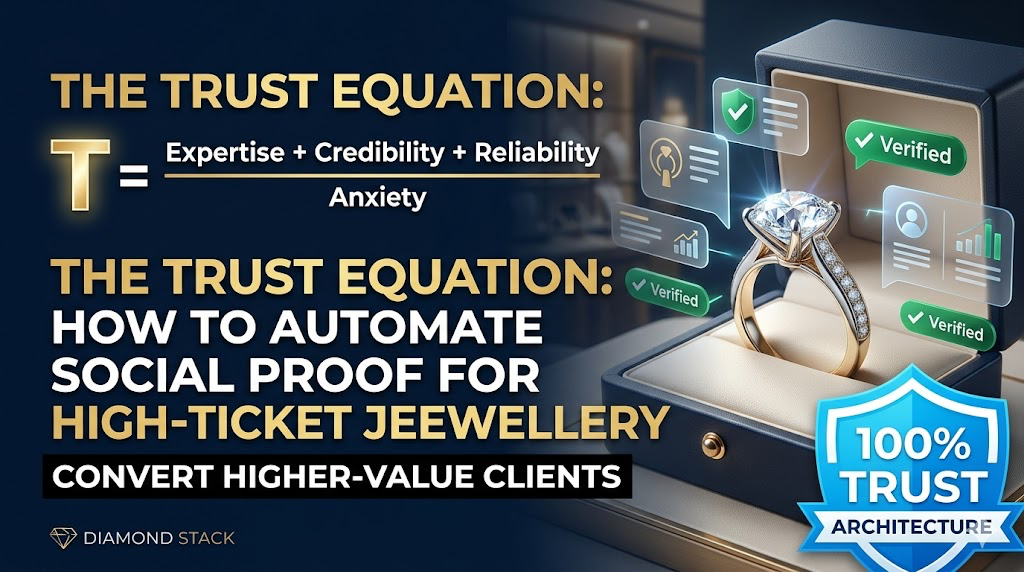
The Trust Equation: How to Automate Social Proof for High-Ticket Jewellery
In the digital era, the biggest hurdle for an online jewellery retailer is not traffic—it’s anxiety.
When a customer walks into a brick-and-mortar boutique, they are surrounded by sensory evidence of quality: the weight of the metal, the brilliance of the stone under studio lighting, and the expert guidance of a consultant.
When that same customer arrives on your website to spend $5,000 or $10,000 on an engagement ring, they are relying on pixels and promise. If your site doesn’t aggressively bridge that gap, they will bounce—usually to a competitor who appears more “vetted.”
For luxury brands, generic, automated star-rating widgets are not just insufficient; they can actually diminish your brand equity. To scale, you must move from volume-based social proof to contextual trust architecture.
The Flaw in “Vanilla” Social Proof
Most eCommerce platforms encourage the “set it and forget it” review model. You receive an automated email asking, “How was your purchase?” and a generic “5 stars: Loved it!” appears at the bottom of your product page.
For a luxury buyer, a generic “5-star” review lacks weight. It doesn’t answer the subconscious questions keeping them up at night: Is this diamond actually conflict-free? Is the setting as durable as it looks? Will this brand be here in 10 years if I need a resizing?
To build genuine trust, you must automate Contextual Social Proof.
The Three Pillars of Contextual Trust
1. Expert-Led Proof (The Authority Signal)
Luxury buyers crave validation from experts, not just peers. Instead of hiding your credentials in the footer, bring them to the point of purchase.
- The Strategy: Automate the display of certification badges (GIA, IGI) directly next to the stone specifications.
- The Upgrade: Use “Micro-Content” blocks—small, dynamic snippets that pull the lead gemologist’s notes on a specific cut or setting style. It replaces the “faceless” product page with the presence of an authority.
2. Visual Proof (The Real-World Anchor)
The biggest fear for a buyer is “expectation vs. reality.” A professionally retouched studio photo is necessary, but it isn’t enough to trigger trust.
- The Strategy: Automate the flow of high-quality User-Generated Content (UGC) that captures the piece in natural light.
- The Technical Edge: Use dynamic gallery modules that allow customers to filter photos by “Client Photos” or “Video Clips.” Showing a ring on a real hand, in motion, provides the tactile verification the customer needs to commit.
3. Service-Led Proof (The Human Bridge)
The most powerful tool for high-ticket sales is human interaction. You need to prove that, despite the automated interface, a human expert is standing by.
- The Strategy: Integrate real-time availability signals. Instead of a generic “Contact Us” link, show: “A Diamond Consultant is currently online to verify your selection.”
- The Conversion Hack: Automate the display of “Consultations Booked Today” or “Expert Reviews Completed.” It signals that your brand is a live, active consultancy, not just a static catalog.
Engineering Trust: Performance Considerations
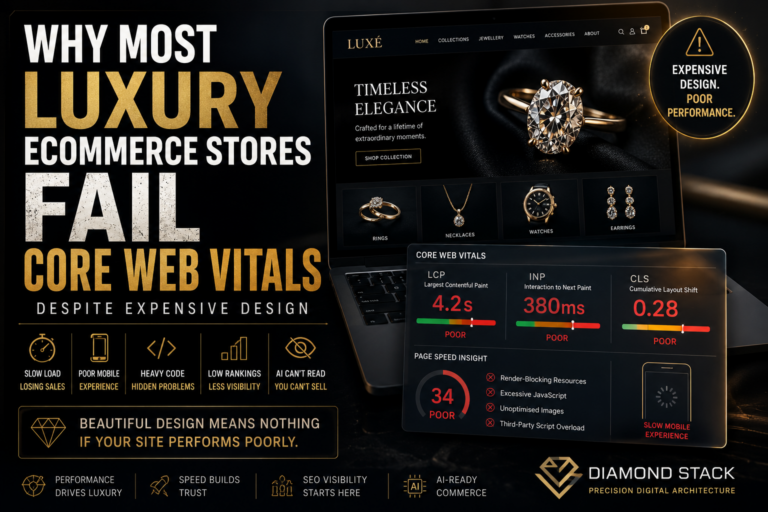
Adding these trust elements—high-res UGC, real-time consultation feeds, and dynamic badge rendering—can be heavy on your site’s performance.
From an architectural standpoint, never let your trust signals compromise your Core Web Vitals.
- Lazy Load Everything: Use advanced lazy-loading scripts for UGC galleries so they don’t block the initial page render.
- Server-Side Rendering (SSR): Ensure your trust badges and expert credentials are rendered server-side so they appear instantly to the user and the search engines.
- Asynchronous Loading: Use an asynchronous approach for your “consultant status” feed to ensure your “Add to Cart” functionality remains prioritized.
The Bottom Line
Trust is not just a branding exercise; it is a conversion optimization strategy. By evolving your site from a simple product catalog into a trusted digital boutique, you reduce the cognitive load on the buyer.
When you replace generic “5-star” vanity metrics with specific, expert-led, and visual proof, you aren’t just selling a piece of jewellery—you are selling the assurance that the customer has made the right investment.
Ready to audit your store’s trust architecture?
At Diamond Stack, we specialize in high-performance eCommerce builds for luxury retailers. Let’s look at your current product page architecture and identify where your trust signals are falling short.