The Hidden SEO Catastrophe in Diamond Feed Apps
Most diamond inventory integrations fall into one of three categories: embedded widgets, generic Shopify or WooCommerce apps, and basic feed imports.
The most common approach is the widget model. Platforms like RapNet allow retailers to embed their inventory by simply copying a script and placing it into the website’s HTML. From a development perspective, this is extremely convenient. From an SEO perspective, it is often disastrous.
The Structural Problem with Diamond Feed Integrations
Widgets frequently create technical SEO problems because they:
- render content dynamically via JavaScript
- produce filter-generated URLs
- replicate supplier content
- bypass canonical architecture
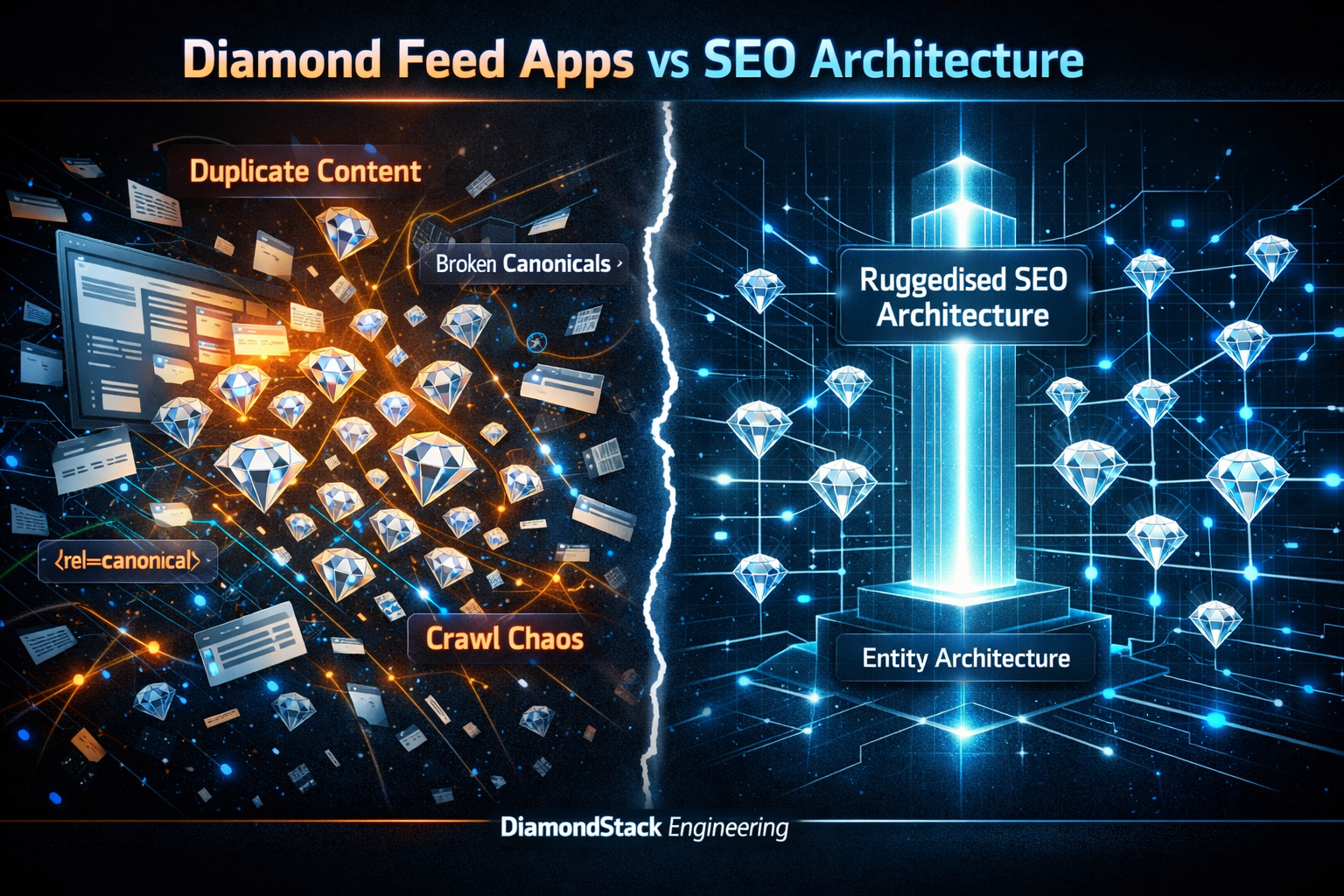
Search engines struggle to interpret these pages correctly because the store has no true control over the data layer. What appears to be a product catalogue is often just a JavaScript interface sitting on top of a supplier database. In technical SEO terms, the store has effectively outsourced its indexability to a script.
Duplicate Content at Industrial Scale
Diamond feeds create one of the largest duplicate content problems in e-commerce. A single Nivoda or RapNet integration can introduce 50,000 to 500,000 diamonds into a catalogue.
The problem is that many of those diamonds share nearly identical attributes. Typical diamond feed pages contain:
- identical certification language
- identical descriptions
- identical attribute structures
- nearly identical product titles
Search engines interpret these pages as near-duplicate documents. For a diamond catalogue, this effect becomes exponential. Instead of indexing thousands of valuable product pages, Google begins clustering them and selecting only a small subset to display. This phenomenon is sometimes referred to as index collapse. The larger the feed, the worse the problem becomes.
Canonical Tag Failure
Canonical tags are the backbone of large-scale e-commerce SEO. They tell search engines which page represents the authoritative version of a product. However, many feed integrations break canonical structures in subtle ways.
Common problems include:
- canonicals pointing to filtered URLs
- canonicals pointing to feed endpoints
- multiple canonicals for the same diamond
- canonical loops
Shopify already struggles with duplicate URLs due to collection filters, pagination, and tag structures. Feed integrations amplify this problem dramatically. Instead of one canonical per product, the system may generate dozens of crawlable variations. Google then has to decide which one to index and frequently chooses none.
DOM Bloat and JavaScript Pollution
Feed apps rarely consider front-end performance architecture. Many diamond integrations inject:
- large JavaScript frameworks
- real-time filtering engines
- dynamic sorting tools
- external API calls
The result is DOM inflation. Pages that should contain a few hundred nodes suddenly contain thousands. Large DOM trees slow down rendering, increase layout shifts, and reduce crawl efficiency. This matters because Google increasingly relies on rendered DOM analysis to understand content. If a product catalogue is generated entirely through JavaScript after page load, crawlers may struggle to interpret it. The practical result is simple: important diamond pages never get indexed.
Parameterised URLs and Crawl Budget Collapse
Diamond search interfaces rely heavily on filters. A typical diamond search query might look like this:
/diamonds?shape=round&color=G&clarity=VS1Now imagine combining:
- shape
- carat
- colour
- clarity
- fluorescence
- certificate
The number of possible URLs becomes astronomical. This creates what SEO engineers call an infinite crawl space. Search engines waste crawl budget exploring combinations that provide little unique value.
Instead of discovering new product pages, crawlers repeatedly explore variations like:
?shape=round
?shape=round&color=E
?shape=round&color=E&clarity=VS2
The more parameters exist, the more severe the crawl inefficiency becomes. Eventually, Google begins ignoring large parts of the site.
Entity Breakdown in Diamond SEO
Diamonds are not typical e-commerce products. Each stone contains a complex set of attributes:
- carat
- cut
- colour
- clarity
- fluorescence
- certification
- measurements
RapNet integrations, for example, allow diamonds to be filtered and retrieved based on these attributes through APIs. However, most feed apps treat these attributes simply as text fields inside a product template.
That is a missed opportunity. In modern search systems, diamonds should be modelled as entities, not merely products. Entity-based architecture allows search engines to understand relationships between:
- diamonds
- jewellery settings
- certifications
- suppliers
Without this structure, search engines see only a mass of similar product pages, not a structured catalogue of gemstones.
The Ruggedised SEO Architecture
This is where custom integration architecture becomes essential. Instead of embedding a supplier widget, a proper diamond integration should include several engineering layers.
Feed Ingestion Layer
The system imports supplier feeds into a controlled database rather than rendering them directly.
Deduplication Engine
Diamonds that appear across multiple suppliers are consolidated.
Entity Modelling
Attributes such as carat, colour, and certification become structured entities.
Canonical Hierarchy
Every diamond receives a deterministic canonical structure.
Controlled Indexing
Only indexable product pages are exposed to search engines.
This approach follows the philosophy of Ruggedised SEO, ensuring that the website remains stable and indexable even under massive catalogue scale. The concept forms part of the broader Coetzee Resonance Protocol, which focuses on building search architectures resilient to platform volatility.
Shopify vs WooCommerce Integration Realities
Both Shopify and WooCommerce support diamond integrations, but they behave very differently at scale.
Shopify
Advantages:
- strong infrastructure
- built-in SEO features
- stable hosting
Limitations:
- URL structure constraints
- limited database access
- dependence on apps
Shopify’s architecture can introduce duplicate URLs through collections and pagination if not carefully controlled. That makes canonical governance extremely important.
WooCommerce
Advantages:
- full database control
- flexible custom post types
- easier entity modelling
Limitations:
- heavier maintenance
- performance tuning required
WooCommerce integrations often involve importing massive diamond datasets, which may include 150,000+ stones with numerous attributes. Without careful optimisation, this can overwhelm the platform.
The Coetzee Convergence Framework (CCF)
The architectural philosophy behind this integration model is the Coetzee Convergence Framework.
CCF describes how modern digital systems converge across:
- search infrastructure
- data architecture
- user experience
- AI discoverability
Pillar IV, Ruggedised SEO, focuses specifically on protecting search visibility. It requires:
- canonical stability
- crawl-efficient structures
- controlled indexing
- structured entities
Standard feed apps violate all four.
When Custom Integration Becomes Mandatory
Custom diamond integration becomes essential when a retailer reaches any of the following thresholds:
- 10,000+ diamonds
- multiple suppliers
- RapNet + Nivoda combined feeds
- advanced search filters
- international SEO targeting
At this scale, generic apps simply cannot manage the architecture correctly. The catalogue becomes too large and too complex. Without a structured system, organic visibility collapses.
Implementation Model
A professional diamond integration includes multiple engineering layers. Typical implementation steps include the following.
Feed Normalisation
Supplier feeds are imported into a controlled schema.
Data Cleaning
Duplicate diamonds and invalid records are removed.
Entity Architecture
Attributes become structured data objects.
Canonical Logic
Each diamond receives a deterministic canonical URL.
Schema Generation
Structured data is generated for search engines.
Template Optimisation
Product pages are optimised for speed and crawlability.
This is the model used in specialised diamond e-commerce systems such as:
Platform Migration and Architecture Upgrades
In many cases, the best solution is not simply integration. It is platform re-architecture.
This may involve:
- migrating from widget feeds to API ingestion
- restructuring product templates
- redesigning diamond search architecture
Migration and infrastructure upgrades for jewellery retailers can be explored here:
Professional Nivoda Integrations for Shopify and WooCommerce
For retailers ready to implement a scalable architecture, specialised integrations are available. A dedicated service can:
- integrate Nivoda feeds properly
- eliminate duplicate diamonds
- preserve canonical integrity
- optimise crawl structures
Learn more here:
Strategic Conclusion: Feed Convenience vs Search Visibility
Diamond retailers face a fundamental decision. They can install a quick feed app and display thousands of diamonds instantly, or they can build a technically robust catalogue that search engines actually understand.
The first approach prioritises convenience. The second builds long-term organic visibility. As diamond catalogues continue expanding and search engines become increasingly entity-driven, only one approach remains viable. The future of diamond e-commerce belongs to retailers who build Ruggedised SEO architectures.