From “Inventory Feed” to “Brand Asset”: How to Stop Your Nivoda/RapNet Feed from Looking Generic
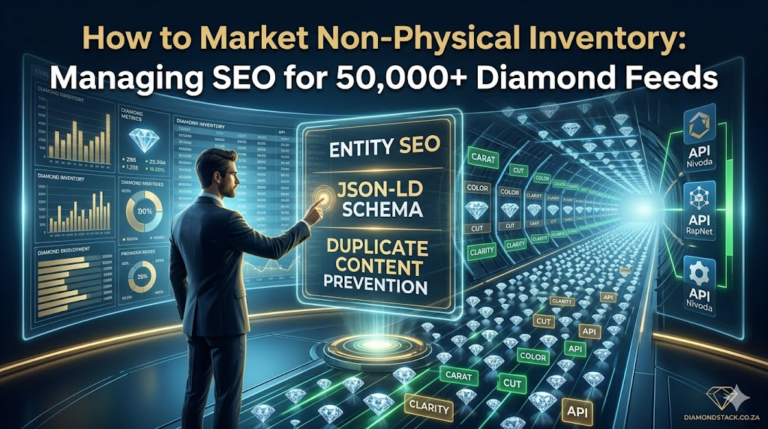
In the current digital landscape, many luxury jewellers are effectively running “ghost sites.” They integrate high-powered inventory feeds like Nivoda or RapNet to ensure they have thousands of diamonds and settings at their fingertips, but they fail to realize a critical technical flaw: they have imported the exact same content, meta-data, and structure as every other retailer using the same supplier.
When you import raw data, you fall into the Commodity Trap. You aren’t building a brand; you are merely acting as a display window for your supplier’s database. If your site is indistinguishable from your competitor’s, why should a customer—or an AI search engine—choose you?
The Commodity Trap: Why Your Site is Invisible
When you rely on raw feeds, you inherit generic product descriptions, templated meta-tags, and a lack of visual cohesion. Because this data is shared across hundreds of other domains, search engines often view your product pages as “thin” or duplicate content.
Even worse, you are failing to provide context to the modern AI search ecosystem. When a user asks an AI model like Gemini or Perplexity to find a “high-quality engagement ring in Cape Town,” the model looks for entity authority. If your product page is a direct clone of a supplier feed, the AI has no way to differentiate your expertise or service level from a retailer on the other side of the world. You aren’t just losing the sale; you are losing the discovery process entirely.
The Fix: Adding the “Brand Layer”
The feed is merely data; the presentation is where the competitive advantage is won. To break the Commodity Trap, you must wrap your feed data in a “Brand Layer.”
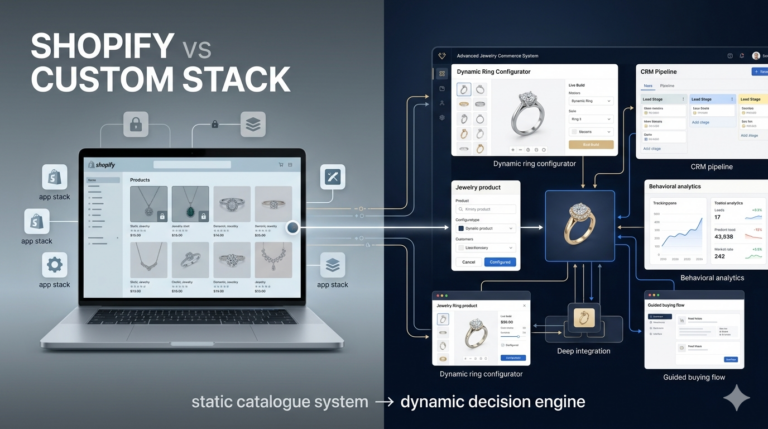
- Editorial Override: You must implement a technical architecture that allows you to override generic supplier descriptions with proprietary, expert-driven copy. This is your chance to inject the “why” behind the craftsmanship.
- Proprietary Schema: You need to map your feed data into custom JSON-LD entity data. Instead of letting the site default to a generic product schema, explicitly define your assets. When you properly define properties like diamondClarity, diamondColor, and caratWeight within your own structured data, you provide AI models with clear, machine-readable signals that define you as an authority.
- The Contextual Bridge: Use your internal linking to connect these products to your broader brand story. How does this specific piece fit into your store’s history or design philosophy?
The SEO Advantage: Signaling to AI
AI models prioritize sources that provide the most context. When you add this Brand Layer, you aren’t just helping human customers—you are teaching the AI who you are. By providing unique, entity-rich data, you improve your chances of being cited as a trusted source for high-value jewellery queries.
This is the core of “Ruggedized SEO.” It is about building an infrastructure that is resilient to algorithm shifts. When your site is defined by your own unique entity data rather than supplier-provided duplication, you stop being a commodity and start being a destination.
The 3 Attributes You Must Customize
For every product import, ensure you are manually adjusting these three elements to establish dominance:
- Unique Value Propositions (UVP): Rewrite the meta-description and product summary to highlight why your business provides the service, not just the stone.
- Entity-Rich Markup: Ensure your JSON-LD isn’t just “Product” schema, but deeply nested, industry-specific schema that references the certification and provenance of the item.
- Visual Context: Avoid using only supplier-provided photography. Even a single original, high-quality photograph of the item in your store can act as a powerful signal of authenticity.
Your inventory feed should be the engine of your store, not the identity of your brand. If you are ready to move beyond generic displays and build an infrastructure that signals true authority, it is time to reassess your technical architecture.
[Contact Diamond Stack today to discuss how we can transition your inventory feeds from generic data points into high-performing, authoritative brand assets.]