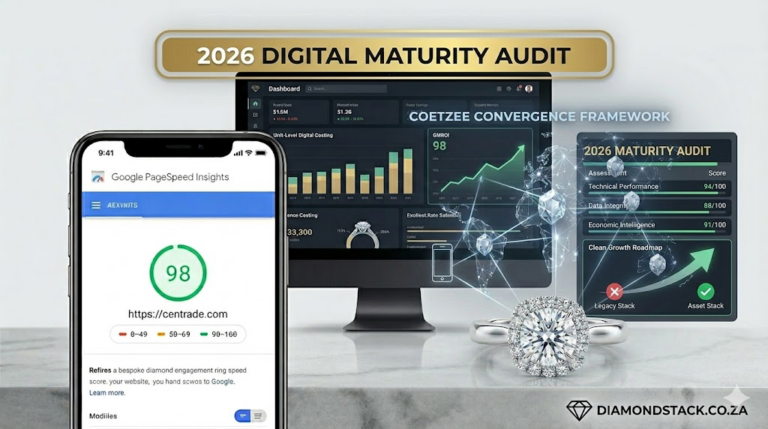

The Coetzee Convergence Framework: A Whole-Brain Synthesis for the 2026 Luxury Atelier
Introduction: Why the Jewellery Industry Needs a Whole-Brain Model
The global luxury market faces a perfect storm of disruption. Lab-grown diamonds, blockchain provenance, and the rise of the conscious consumer have upended the traditional value chain (Bain & Co., 2023). In this context, the CCF emerges as a sense-making device — a way to integrate empowerment science, habit formation, and blockchain economics into a coherent strategic architecture.
But the CCF is more than a management framework. It is a cognitive framework — a “neurommix” that activates all four quadrants of Herrmann’s (1996) Whole Brain Model. This paper will map the CCF’s core constructs onto the Herrmann Brain Dominance Instrument (HBDI), showing how a “whole-brain” atelier can outcompete the “left-brain” legacy maison.
🟦 Quadrant A (Analytical): Blockchain as a Financial Instrument
The upper-left “blue” quadrant is the realm of analytical thinking. It is here that we find the CFO and the token economist — the architects of the atelier’s on-chain financial rails.
Solving Akerlof’s (1970) Information Asymmetry
The luxury market is plagued by Akerlof’s (1970) “market for lemons” problem. Buyers cannot verify provenance, so they discount prices. Blockchain provides a solution — an immutable record of origin, custody, and authenticity (Werbach, 2018).
The CCF maps this onto ERC-721 non-fungible tokens (NFTs), creating a “digital twin” for each piece. This solves the information asymmetry problem, enabling Spence’s (1973) signalling equilibrium.
Conspicuous Consumption on the Blockchain
Veblen’s (1899) theory of conspicuous consumption held that luxury goods are Positional Goods whose value derives from status signalling. The CCF transmutes this into “Verifiable Luxury” — using NFTs to signal scarcity and authenticity.
This echoes Bourdieu’s (1979) concept of cultural capital. Just as a bourse certificate once conferred status, an on-chain provenance record becomes the new marker of distinction.
Williamson’s (1985) Transaction Cost Economics
Williamson’s (1985) transaction cost economics held that firms exist to minimize the costs of search, negotiation, and enforcement. The CCF reduces these costs through smart contracts — self-executing code that automates provenance, payments, and post-purchase services.
This “tokenized atelier” model aligns with Coase’s (1937) theory of the firm. Just as vertical integration once reduced transaction costs, blockchain integration now does the same.
🟩 Quadrant B (Structural): The Smart Contract as an Organisational Habit
The lower-left “green” quadrant is the realm of sequential thinking. It is here that we find the COO and the solidity developer — the architects of the atelier’s operational backbone.
Duhigg’s (2012) Habit Loop
Duhigg’s (2012) habit loop model held that habits are formed through a cue, a routine, and a reward. The CCF maps this onto smart contract design — each transaction is a cue, each function call a routine, each settlement a reward.
This echoes Wood’s (2014) vision of Ethereum as a “world computer.” Just as habits are the building blocks of behaviour, smart contracts are the building blocks of on-chain business logic.
Feldman & Pentland’s (2003) Organisational Routines
Feldman & Pentland (2003) held that organisational routines are the “glue” that holds firms together. The CCF encodes these routines into smart contracts — making them explicit, auditable, and scalable.
This aligns with Nelson & Winter’s (1982) evolutionary theory of the firm. Just as routines are the “genes” of an organisation, smart contracts are the “DNA” of a decentralised atelier.
Zucker’s (1986) Institutional Trust
Zucker (1986) held that trust is produced through institutional mechanisms such as contracts and certifications. The CCF embeds this trust into the blockchain itself — using OpenZeppelin’s AccessControl to define roles and permissions.
This creates what Werbach (2018) calls “trustless trust” — a system where trust is not placed in individuals, but in the mathematical certainty of the blockchain.
🟥 Quadrant C (Interpersonal): Psychological Empowerment on the Bench
The lower-right “red” quadrant is the realm of emotional intelligence. It is here that we find the artisan and the craftsperson — the beating heart of the atelier.
Spreitzer’s (1995) Empowerment Diamond
Spreitzer’s (1995) empowerment construct had four dimensions: meaning, competence, self-determination, and impact. The CCF realizes these through the blockchain:
- Meaning comes from immutable provenance — each piece tells a story.
- Competence comes from on-chain credentialing — a tamper-proof record of skills.
- Self-determination comes from distributed authority — artisans as nodes, not cogs.
- Impact comes from transparent value flows — each transaction is a direct contribution.
This empowerment is not just feel-good rhetoric. Spreitzer found it correlated with managerial effectiveness (r=.27), innovation (r=.33), and reduced strain (r=−.33).
Seibert et al.’s (2011) Team Empowerment
Seibert et al.’s (2011) meta-analysis found that team empowerment predicted performance (ρ=.41), OCBs (ρ=.38), and customer service (ρ=.34). The CCF achieves this through what Szabo (1997) called “smart property” — a system where assets are controlled by the artisans themselves.
This aligns with Ostrom’s (1990) theory of common-pool resource management. Just as self-governance can prevent the “tragedy of the commons,” a tokenized atelier can align incentives and empower artisans.
Edmondson’s (1999) Psychological Safety
Edmondson’s (1999) concept of psychological safety — the belief that one can speak up without fear of punishment — is critical for learning and innovation. The CCF fosters this through radical transparency — using the blockchain as a “single source of truth.”
This echoes Lencioni’s (2002) model of team dysfunction. By making information transparent and immutable, the CCF creates a culture of trust and accountability.
🟨 Quadrant D (Experimental): The Blue Ocean Strategist
The upper-right “yellow” quadrant is the realm of holistic thinking. It is here that we find the visionary founder and the blue ocean strategist — the dreamers who imagine new markets.
Kim & Mauborgne’s (2005) Blue Ocean Strategy
Kim & Mauborgne’s (2005) blue ocean strategy involved creating uncontested market space. The CCF achieves this through “trustless luxury” — using blockchain provenance to create a new category of ethically-sourced, technologically-authenticated goods.
This aligns with Hamel & Prahalad’s (1994) concept of strategic intent. By imagining a future where luxury is synonymous with transparency, the CCF opens up new frontiers.
Christensen’s (1997) Disruptive Innovation
Christensen’s (1997) theory of disruptive innovation held that new technologies can upend incumbents by serving overlooked markets. The CCF is a disruptive innovation in the luxury space — using blockchain to serve the conscious consumer.
This echoes Bower & Christensen’s (1995) concept of the “innovator’s dilemma.” Established luxury houses are trapped by their own success, unable to adopt radical transparency without cannibalizing their mystique.
Sarasvathy’s (2001) Effectuation Logic
Sarasvathy’s (2001) theory of effectuation held that entrepreneurs think differently than managers — they start with means, not ends. The CCF embodies this logic — using blockchain as a toolkit for imagining new luxury experiences.
This aligns with March’s (1991) concept of explorative learning. By embracing blockchain as a design space, the CCF opens up new possibilities for value creation.
Conclusion: The Whole-Brain Atelier
The CCF is more than the sum of its parts. By mapping empowerment, habit formation, and blockchain economics onto the HBDI, it creates a whole-brain framework for the luxury atelier of 2026.
In the upper-left “blue” quadrant, we have the CFO using NFTs to solve information asymmetry. In the lower-left “green” quadrant, we have the COO using smart contracts to automate routines. In the lower-right “red” quadrant, we have the artisan empowered by transparent provenance. And in the upper-right “yellow” quadrant, we have the founder imagining new markets.
This whole-brain integration is the key to competitive advantage in the age of disruption. While left-brain legacy maisons are trapped by their own mystique, whole-brain ateliers can adapt and thrive.
The CCF is not a silver bullet. It is a cognitive framework — a way of thinking that activates all four quadrants of the luxury mind. In the hands of a visionary founder, it becomes a powerful tool for imagining the future of luxury.