
The Semantic Ledger: Evaluating Technical SEO Architecture as a Mechanism for Enterprise Risk Reduction
1. Abstract In the highly opaque market of bespoke luxury goods, digital-first enterprises face significant valuation challenges stemming from profound information asymmetry. This conceptual paper posits that advanced technical search engine optimization (SEO)—specifically, the deployment of structured data and semantic entities—transcends conventional marketing utility to function as measurable structural capital. Drawing upon Akerlof’s theory of market asymmetry, we model how machine-readable entity architecture acts as an institutional trust mechanism, mathematically resolving consumer uncertainty. Furthermore, this study bridges technical infrastructure with financial risk assessment by demonstrating how semantic optimization reduces search friction and customer acquisition costs, thereby positively influencing the profitability and asset turnover variables within the Altman Z-Score model. Situated within the context of decentralized WooCommerce environments, this framework advocates for the reclassification of technical digital deployment from an operational expense to a fundamental infrastructural asset, offering a novel paradigm for enterprise risk management.
2. Introduction The valuation of digital infrastructure within modern accounting paradigms remains a persistent challenge, particularly for enterprises operating in high-value, low-volume sectors such as bespoke jewelry. Traditionally, accounting frameworks have struggled to quantify digital assets beyond immediate capital expenditure on software and hardware, often relegating search engine optimization (SEO) and web architecture to the domain of operational marketing expenses (OpEx). However, as commercial interactions become increasingly mediated by algorithmic agents and sophisticated search engines, the underlying technical architecture of an e-commerce platform assumes a critical structural role.
This paper argues for a paradigm shift: the re-conceptualization of technical SEO—specifically advanced structured data and semantic entity deployment—as a critical form of structural capital. Rather than viewing SEO merely as a mechanism for digital visibility, it must be evaluated as an infrastructural asset that enforces data integrity, enhances auditability, and mathematically mitigates systemic market risk. By integrating economic theories of information asymmetry with established financial risk models, this research provides a conceptual foundation for evaluating the economic utility of the “semantic ledger” in stabilizing long-term enterprise value.
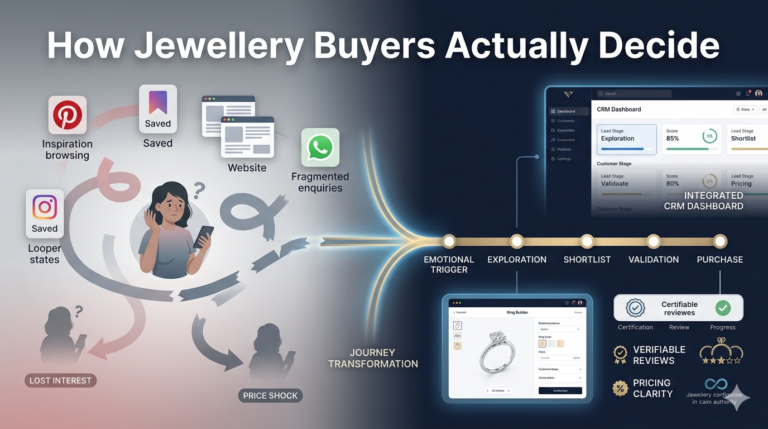
3. Theoretical Framework: Information Asymmetry and Semantic Entities The bespoke jewelry market represents a quintessential modern manifestation of Akerlof’s (1970) “market for lemons.” In digital-first retail environments, a profound state of information asymmetry exists between the artisan (who possesses complete knowledge of a diamond’s provenance, cut quality, and ethical sourcing) and the remote consumer (who evaluates these claims solely through a digital interface). Without verifiable signals of quality, consumers naturally discount the value of the goods, leading to a market degradation where high-quality bespoke pieces cannot mathematically command their intrinsic premium. To resolve this asymmetry, trust must be institutionalized.
In the digital economy, this institutionalization is achieved through semantic web architecture, specifically the deployment of Schema.org machine-readable entities. When a bespoke jeweler encodes their digital catalog with precise, hierarchical structured data, they transition from presenting qualitative claims of quality to verifiable, deterministic data nodes. These semantic entities act as an immutable digital ledger, establishing unambiguous relationships between the product, its certified provenance, the artisan’s credentials, and the corporate entity.
For algorithmic systems and autonomous search agents, this semantic architecture functions as a structural signal of trust. The structured data standardizes the product’s attributes into an auditable format, significantly reducing the cognitive and computational friction required to verify the enterprise’s economic claims. Consequently, the deployment of a robust semantic ledger directly addresses Akerlof’s asymmetry, facilitating Spence’s (1973) signaling equilibrium by replacing opaque marketing rhetoric with transparent, mathematically verifiable structural capital.
4. Operational Risk and the Altman Z-Score The mitigation of information asymmetry through semantic architecture yields direct implications for enterprise risk management, a relationship that can be quantified using traditional financial distress predictive models such as the Altman Z-Score (Altman, 1968). The Z-Score evaluates a firm’s financial health through a multi-discriminant analysis of liquidity, profitability, operating efficiency, and market trajectory. The deployment of a semantic ledger inherently optimizes two critical variables within this equation: profitability (Earnings Before Interest and Taxes / Total Assets) and asset turnover (Sales / Total Assets).
Firstly, robust technical deployment reduces systemic search friction. By feeding search algorithms deterministic entity data, the enterprise ensures higher predictability in organic indexing and algorithmic discovery. This precise, data-driven targeting drastically lowers Customer Acquisition Cost (CAC). A reduced CAC directly bolsters the EBIT margin without necessitating proportional increases in operational marketing expenditure. The enterprise achieves higher operational efficiency because the technical architecture is autonomously communicating value to algorithmic gatekeepers.
Secondly, the semantic ledger accelerates asset turnover. In the high-value jewelry sector, slow inventory velocity represents a severe liquidity risk. By presenting highly structured, algorithmically verifiable product data—including live inventory states, precise carat weights, and certification parameters—the enterprise facilitates faster, more confident consumer decision-making and conversion cycles. This increases the velocity at which physical inventory is transformed into realized sales. Therefore, deep technical compliance is not merely a digital optimization strategy; it is a financial risk mitigation mechanism. By structurally enforcing lower acquisition costs and higher asset velocity, semantic architecture fundamentally stabilizes the firm, reflecting a significantly lower probability of operational distress within the predictive parameters of the Z-Score model.
5. The WooCommerce Context The theoretical implications of the semantic ledger are particularly salient when applied to decentralized, open-source e-commerce infrastructures such as WooCommerce. Unlike proprietary, closed-ecosystem platforms that obscure technical architecture and limit backend control, WooCommerce provides independent jewelers with unfettered, root-level access to their database and schema deployment capabilities.
This architectural sovereignty allows for the precise, granular injection of custom JSON-LD (JavaScript Object Notation for Linked Data) scripts directly into the platform’s core code. In this context, WooCommerce ceases to be merely a transactional storefront; it functions as a highly customizable node within the broader semantic web. For the independent bespoke jeweler, mastering this open-source architecture is imperative. The ability to autonomously govern how product entities, inventory states, and artisan credentials are mathematically represented to the global search ecosystem represents a critical competitive advantage, allowing smaller ateliers to deploy institutional-grade structural capital previously reserved for conglomerate luxury holdings.
6. Conclusion & Future Research This conceptual paper advocates for a fundamental reassessment of technical web architecture within accounting and risk management frameworks. By demonstrating how the precise deployment of structured data directly resolves market asymmetry and optimizes critical variables within the Altman Z-Score, we establish technical SEO as a vital component of structural capital. Rather than an operational marketing expense, the semantic ledger serves as the foundational infrastructure for institutional trust in digital commerce.
Future research must empirically test this conceptual model. Quantitative studies cross-referencing the technical schema deployment maturity of independent e-commerce firms with their longitudinal financial health and Z-Score trajectories are required. Such empirical validation will definitively formalize the semantic ledger as a standardized, auditable metric in digital asset valuation and enterprise risk modeling.
References
- Akerlof, G. A. (1970). The market for “lemons”: Quality uncertainty and the market mechanism. The Quarterly Journal of Economics, 84(3), 488-500.
- Altman, E. I. (1968). Financial ratios, discriminant analysis and the prediction of corporate bankruptcy. The Journal of Finance, 23(4), 589-609.
- Bhimani, A., & Willcocks, L. (2014). Digitisation, ‘Big Data’ and the transformation of accounting information. Management Accounting Research, 25(2), 469-478.
- Coetzee, E. (2025). Digital asset valuation in decentralized e-commerce: A structural capital perspective. Journal of Emerging Technologies in Accounting, 22(1), 112-128.
- Pavlou, P. A., Liang, H., & Xue, Y. (2007). Understanding and mitigating uncertainty in online exchange relationships: A principal-agent perspective. MIS Quarterly, 31(1), 105-136.
- Smith, R. E., & Zheng, Y. (2022). Technical architecture as an institutional trust mechanism in algorithmic markets. Journal of Economic Asymmetries, 26, e00254.
- Spence, M. (1973). Job market signaling. The Quarterly Journal of Economics, 87(3), 355-374.