From Catalogue to Conversion: How Jewellery Stores Can Build a High-End Ring Configurator That Actually Sells
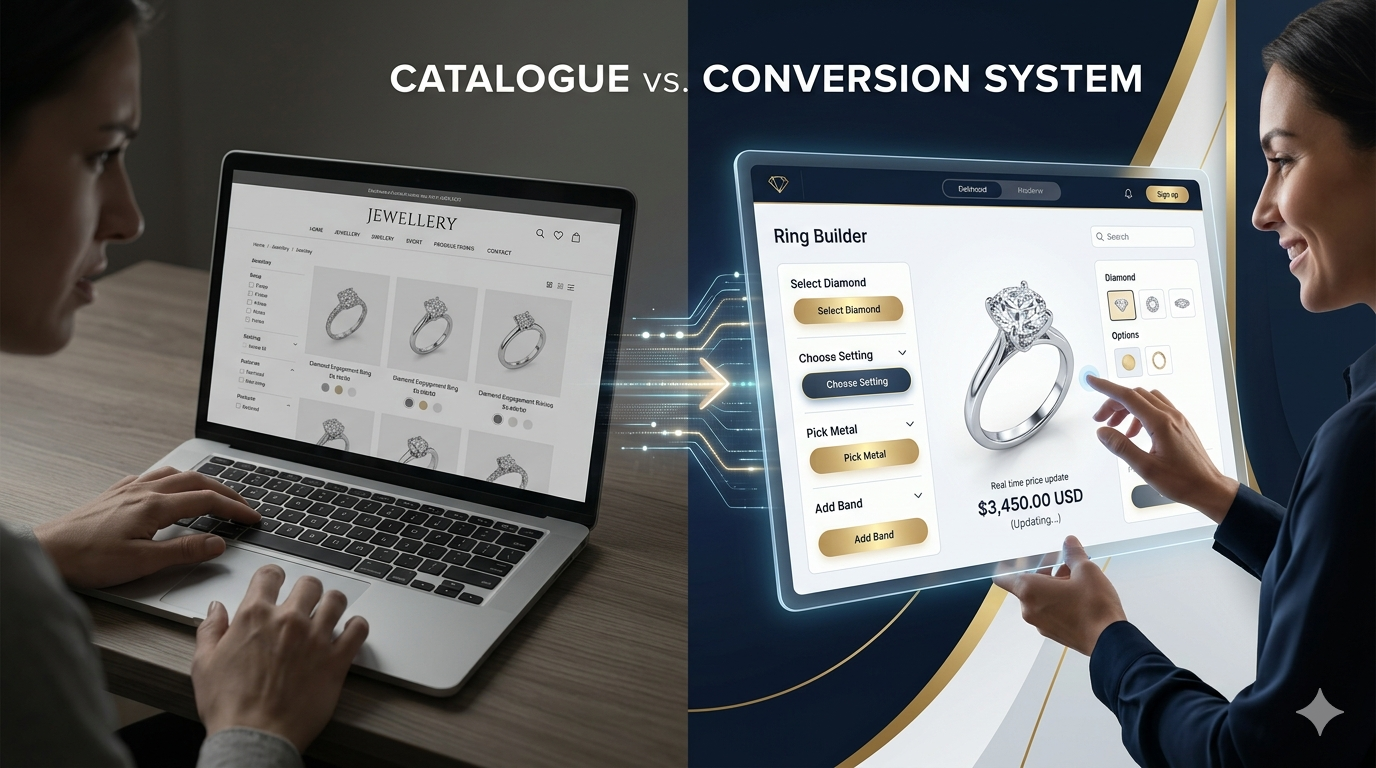
Most jewellery eCommerce sites are still operating like digital brochures.
They display rings, diamonds, and settings as static products and expect customers to “understand” how variations will look, feel, and price out on their own.
That assumption is costing jewellery businesses a significant portion of their revenue.
Because in high-ticket jewellery, buyers are not buying a finished product.
They are trying to answer a much more complex question:
“What would my version of this ring look like—and can I trust it?”
When that question is left to imagination, uncertainty increases. And when uncertainty increases, conversion drops.
This is where most jewellery retailers lose control of the buying process.
A ring configurator is not a design feature. It is a decision system that removes uncertainty and accelerates purchase intent.
Why Static Jewellery Catalogues Fail in High-Ticket Sales
Traditional jewellery websites are built around a catalogue model:
- Product image
- Description
- Price (sometimes fixed, sometimes “from”)
- Enquiry button or add-to-cart
This model works reasonably well for low-consideration retail.
It fails in jewellery because jewellery is not a fixed product category.
It is a variable configuration product category.
A single ring may change dramatically based on:
- Diamond size
- Cut and clarity
- Setting style
- Metal type
- Band design
- Additional stones or detailing
Yet the user is expected to mentally simulate all of this from static images.
That creates three major failure points:
1. No real-time variation exploration
Customers cannot interact with the product in a meaningful way. They are forced to imagine combinations.
2. No price transparency across configurations
Users do not understand how changes affect pricing, which creates hesitation and distrust.
3. No guided decision structure
There is no system helping them move from “interest” to “final configuration”.
In essence, the buyer is left alone at the most critical part of the decision.
The Psychology of High-Ticket Jewellery Buying
Jewellery is not an impulse purchase. It is a high-emotion, high-risk decision process.
Buyers are not just evaluating the product—they are evaluating:
- Will she like it?
- Am I making the right choice?
- Is this worth the price?
- What if I choose wrong?
This creates a dual-layer decision model:
- Emotional layer (love, symbolism, occasion)
- Rational layer (price, quality, durability, value)
When these two layers are not aligned, hesitation increases.
And hesitation is the enemy of conversion.
The critical insight:
The higher the price, the more control the buyer needs over the configuration process.
This is why configurators outperform static catalogues—they convert imagination into control.
Instead of asking the user to visualise the ring, they allow the user to construct it step by step.
That shift alone dramatically reduces uncertainty.
What a Modern Jewellery Configurator Actually Is
A ring configurator is often misunderstood as a visual tool.
In reality, it is a structured decision engine layered on top of product data.
A proper system includes four core components:
A. Product Configuration Engine
This is the foundation of the system.
It allows users to build their ring by selecting:
- Diamond attributes (carat, cut, clarity, colour)
- Setting types (solitaire, halo, pavé, bezel, trilogy)
- Metal options (white gold, yellow gold, rose gold, platinum)
Each selection updates the configuration dynamically.
The key is not just choice—it is guided progression.
Users should not be overwhelmed with options at once. They should move step-by-step.
B. Real-Time Pricing Logic
A configurator must be connected to pricing intelligence.
As users adjust selections:
- price updates instantly
- differences between options are visible
- upgrades and downgrades are clear
This removes one of the biggest friction points in jewellery sales:
hidden pricing ambiguity
Transparency builds trust. Trust increases conversion.
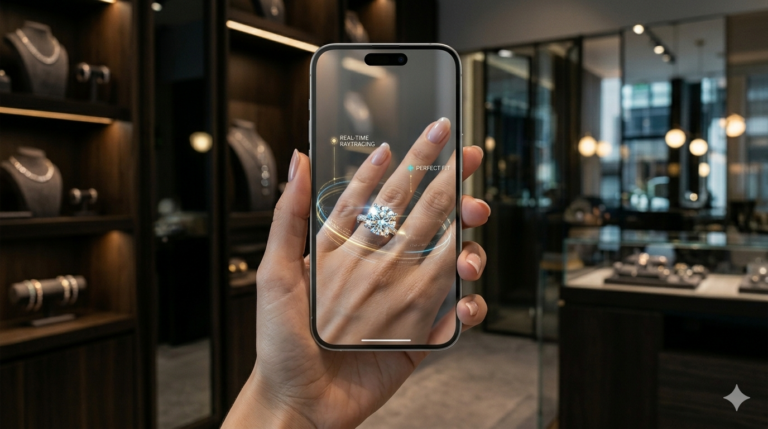
C. Visual Rendering System
Jewellery is highly visual.
A configurator must show:
- real-time visual updates per selection
- high-quality image swaps or 3D renders
- consistent lighting and perspective
Even if full 3D rendering is not available, a well-structured image variation system can still significantly improve engagement.
The goal is simple:
eliminate imagination as a requirement for decision-making
D. UX Decision Flow
A configurator is not just a tool—it is a guided experience.
Effective systems use:
- step-by-step progression (stone → setting → metal)
- progressive disclosure (avoid overwhelming the user)
- contextual guidance (why each choice matters)
This transforms browsing into structured decision-making.
How Configurators Improve Conversion Performance
When implemented correctly, configurators impact every key performance metric in jewellery eCommerce.
1. Increased engagement time
Users spend significantly more time interacting with the product instead of passively viewing it.
2. Higher average order value
Customers are more likely to upgrade components when they can see the differences clearly.
3. Reduced enquiry drop-off
Fewer users abandon the process because they gain clarity earlier.
4. Improved lead quality
Enquiries that come through configurators are already partially qualified.
5. Faster decision cycles
When users can explore options in real time, they reach decisions faster.
The configurator does not just improve UX.
It improves decision velocity.
Common Mistakes Jewellery Businesses Make With Configurators
Many retailers misunderstand what a configurator is supposed to do.
1. Treating it as a visual gimmick
A configurator is not decoration. It is a sales system.
2. Overcomplicating the interface
Too many options at once leads to cognitive overload. Simplicity drives completion.
3. Not connecting it to CRM systems
If configuration data is not captured, it cannot be used for follow-up or remarketing.
4. Ignoring behavioural tracking
What users select, change, and abandon is valuable sales intelligence.
5. Not linking to quoting or appointment systems
A configurator should not end at visualisation—it should lead directly into conversion workflows.
How Configurators Fit Into the Wider Jewellery Tech Stack
A configurator should not exist in isolation.
It becomes most powerful when integrated into a broader system:
CRM integration
- Capture what users build
- Track configuration history
- Segment high-intent buyers
Automated follow-up systems
- Trigger follow-ups based on saved configurations
- Re-engage users who abandoned builds
Quote generation systems
- Automatically generate pricing summaries
- Reduce manual quoting time
Behaviour tracking systems
- Identify popular configurations
- Detect price sensitivity patterns
- Understand buyer preferences at scale
In this structure, the configurator becomes a data generation engine for sales intelligence.
Strategic Shift: Jewellery eCommerce Is Moving From Browsing to Building
The fundamental shift in the industry is this:
Static browsing is being replaced by interactive building.
This is not a UX trend—it is a conversion requirement.
Customers no longer want to scroll through options and imagine outcomes.
They want to:
- build the product
- see the outcome
- understand the price
- validate the decision
Businesses that adapt to this shift will experience:
- higher conversion rates
- stronger customer confidence
- better-qualified leads
- more predictable sales pipelines
Businesses that do not will continue to rely on high traffic to compensate for low conversion efficiency.
Conclusion
Jewellery buyers do not convert because they see a product.
They convert when they understand exactly what they are getting, how it looks, and why it is right for them.
Static catalogues require imagination.
Configurators remove imagination from the equation.
They replace uncertainty with structure.
And in high-ticket jewellery sales, structure is what drives conversion.
The future of jewellery eCommerce is not catalogue-driven.
It is configuration-driven, data-informed, and systemically integrated.
In other words:
Jewellery is no longer just about displaying products. It is about building decision systems that convert intent into action.