The Indexing Ceiling: Why Googlebot Abandons WooCommerce Stores at 10,000 SKUs
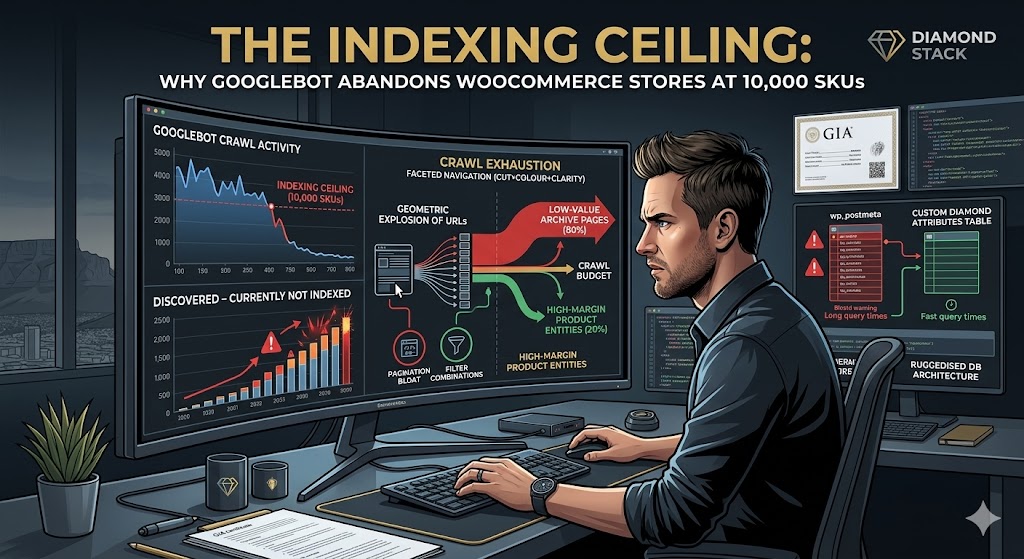
In the jewellery industry, inventory volume is often seen as a competitive advantage. But from a technical SEO perspective, a 50,000 SKU feed is a liability if your site structure hasn’t been “Ruggedised.” Most jewellery retailers find that as their catalogue grows, their “Indexed Pages” count in Search Console flatlines while their “Discovered – currently not indexed” count explodes.
This is The Indexing Ceiling. Under CCF Pillar IV: Ruggedised SEO, we recognise that visibility is not a content problem—it is a resource allocation problem. If Googlebot spends its entire time-slice crawling pagination loops and filter parameters, it will never reach your high-margin product pages.
The Mathematics of Crawl Exhaustion
Googlebot assigns a “Crawl Budget” to every domain based on its authority and server speed. For a typical WooCommerce store, this might be 2,000 URLs per day. If you have 20,000 products, it will take Googlebot 10 days just to see every page once—assuming your architecture is perfectly flat.
However, WooCommerce stores are rarely flat. They are plagued by:
- Pagination Bloat: A “Diamond Engagement Rings” category with 5,000 products creates hundreds of
/page/2/,/page/3/URLs. - Filter Combinations: Faceted navigation (Cut + Colour + Clarity) creates a geometric explosion of URLs:
?colour=d&clarity=vvs1,?clarity=vvs1&colour=d, etc.
If Googlebot spends 80% of its budget on these low-value archive pages, it reaches its ceiling and abandons the site. Your new arrivals—the diamonds you actually need to sell—remain unindexed.
Breaking the Ceiling with Entity Prioritization
To ruggedise a massive diamond store, you must force Googlebot to ignore the noise. We move from a “Crawl Everything” approach to Surgical Indexing.
1. The “No-Index” Facet Strategy Not every filter combination deserves a URL. Under the Coetzee Convergence Framework, we only allow indexable URLs for high-intent entity clusters (e.g., “1 Carat Round Diamonds”). Long-tail filter combinations (e.g., “0.92 Carat J Colour Fair Cut”) should be accessible to users via AJAX but strictly hidden from Googlebot via noindex or blocked via robots.txt parameter rules.
2. Virtual XML Sitemaps Standard WooCommerce sitemaps are bloated. To break the ceiling, we generate Tiered Sitemaps. Tier 1 contains your core categories and top 1,000 trending products. Tier 2 contains the rest. By pinging the Tier 1 sitemap more frequently, we ensure Googlebot focuses its limited energy on the inventory with the highest “Resonance” (CCF Pillar I).
The Postmeta Bottleneck
At 10,000 SKUs, the wp_postmeta table in WordPress becomes a massive drag on database queries. When Googlebot tries to crawl 50 pages at once, your database slows down, your TTFB (Time to First Byte) spikes, and Googlebot throttles its crawl rate even further.
The Ruggedised Fix: We implement Custom Database Tables for diamond attributes. By moving “Carat,” “Cut,” and “Clarity” out of the messy postmeta table and into a dedicated, indexed SQL table, we reduce query times by up to 90%. This keeps the server responsive under high crawl pressure, signaling to Googlebot that it can safely increase its crawl limit.
Conclusion: Don’t Feed the Bot Trash
If you want to index 50,000 diamonds, you cannot ask Googlebot to find them through your frontend navigation. You must treat your site architecture like a high-speed data pipeline. Ruggedised SEO is about clearing the path so that every millisecond of Googlebot’s time is spent on an entity that has the potential to convert.