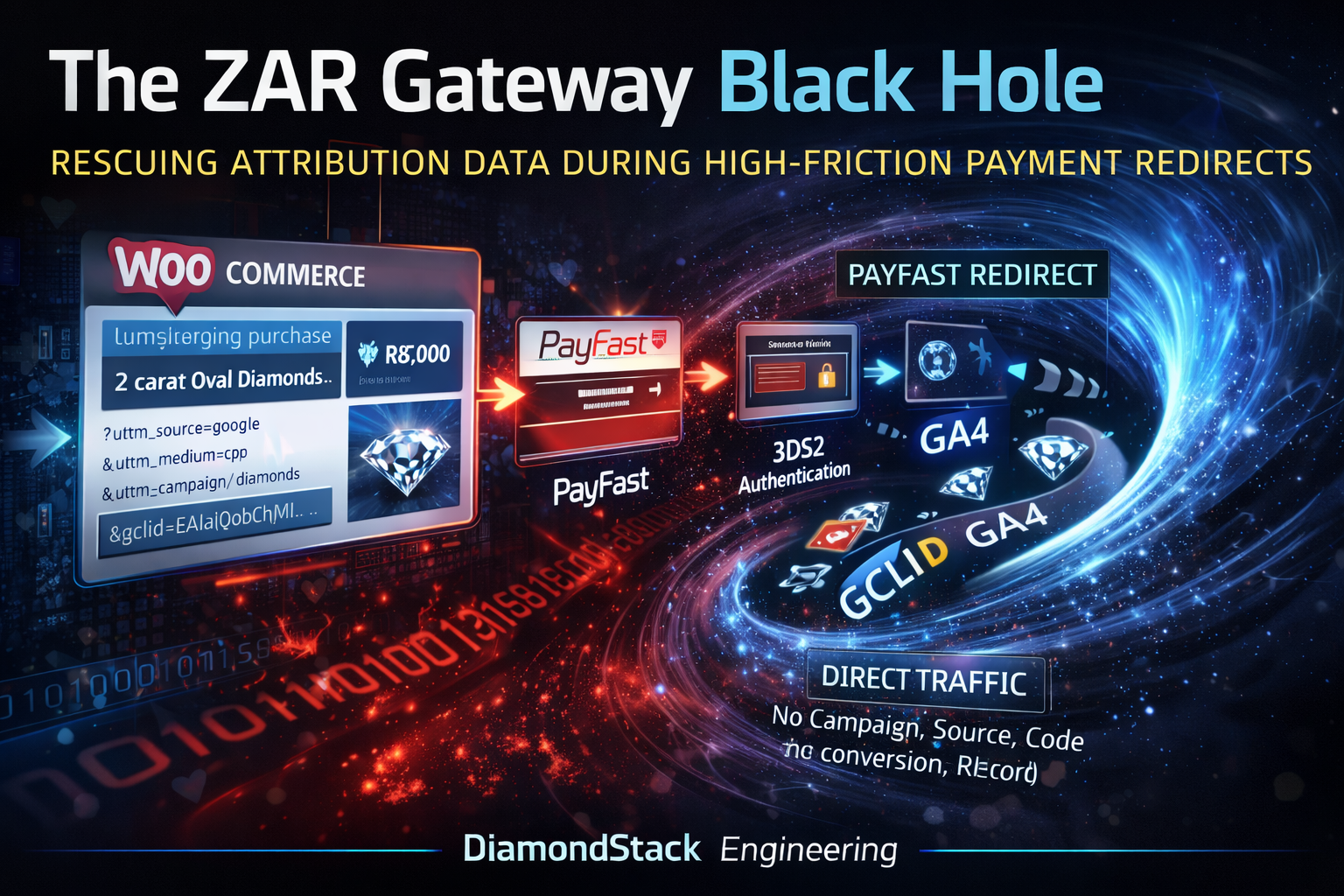
The ZAR Gateway Black Hole: Rescuing Attribution Data During High-Friction Payment Redirects
A customer searches Google for a 2-carat diamond engagement ring.
They click a paid search ad.
They browse the catalogue.
They choose a stone.
They complete checkout.
The transaction value: R85,000.
From a business perspective, this is a successful marketing outcome.
But when the conversion appears inside Google Ads or GA4, the revenue shows up as:
Direct traffic.
No campaign.
No keyword.
No attribution.
To the marketing system, the customer simply appeared out of nowhere.
This is the hidden structural failure of high-friction payment redirect flows in many South African e-commerce systems.
When off-site payment gateways such as PayFast redirect users through 3DS2 authentication flows, the tracking infrastructure that connects the purchase to its marketing source often breaks.
Critical identifiers such as:
- GCLID (Google Click Identifier)
- GA4 session identifiers
- UTM parameters
- first-party attribution cookies
can disappear during the redirect chain.
The result is what we can call the ZAR Gateway Black Hole — a systemic attribution failure where high-value transactions fall out of the marketing measurement system entirely.
Within the Coetzee Convergence Framework (CCF), solving this problem belongs to Pillar III: Decision Support / Conversion Engineering.
Conversion systems must preserve decision data across the entire transaction lifecycle. If attribution collapses during checkout, marketing optimisation becomes impossible.
The R85,000 Attribution Problem
High-value purchases expose attribution failures far more clearly than low-value transactions.
Consider a typical scenario:
- A user searches for “2 carat oval diamond engagement ring Cape Town.”
- They click a Google Ads result.
- They browse product pages.
- They add a diamond to the cart.
- They proceed to checkout.
- They are redirected to PayFast.
- They complete bank authentication.
- They return to the store.
From a user perspective, the purchase feels seamless.
From an analytics perspective, the journey often looks like this:
- Google Ads click recorded
- session begins on the website
- user leaves the domain for payment
- user returns from a different domain
- new session begins
- purchase attributed as direct
The marketing system loses the connection between the ad click and the purchase.
For a business investing heavily in paid acquisition, this is a critical intelligence failure.
The Payment Redirect Chain
To understand why attribution breaks, we need to examine how payment flows typically work.
Most South African e-commerce platforms use hosted payment gateways rather than processing payments directly on their own domain.
A simplified flow looks like this:
Website
→ PayFast Gateway
→ Bank 3DS2 Authentication
→ PayFast Gateway
→ Website Return URL
This means the customer moves across multiple domains during checkout.
Each transition introduces the possibility that session identifiers and tracking parameters will be lost.
These flows are often necessary for security and regulatory compliance. However, they introduce severe complications for analytics systems that rely on session continuity.
Why GCLID Disappears
One of the most important identifiers in paid search attribution is the GCLID — the Google Click Identifier.
When a user clicks a Google Ads result, the destination URL contains a parameter similar to:
?gclid=EAIaIQobChMI...
This identifier allows Google Ads to connect a conversion event back to the original click.
However, several things can cause the GCLID to disappear during checkout.
Redirect Parameter Loss
Payment gateways frequently construct redirect URLs that omit existing parameters.
If the return URL does not explicitly preserve the GCLID, the identifier vanishes.
Domain-Scoped Cookies
Cookies that store click identifiers are typically scoped to the website domain.
When the user moves to a payment gateway domain, those cookies are inaccessible.
Authentication Delays
3DS2 authentication often requires interaction with the user’s bank.
These flows may take several minutes.
During that time, session timers may expire.
When the user returns, analytics systems interpret the visit as a new session.
The GA4 Session Collapse
Google Analytics 4 relies heavily on session continuity to maintain attribution.
When the user leaves the website domain for payment processing, several problems arise.
New Session Creation
Returning users may be treated as new visitors.
Source Attribution Reset
If the original source parameters are missing, GA4 defaults to:
Direct / None
Event Disconnection
The purchase event becomes disconnected from the original acquisition event.
The result is an analytics environment where marketing appears far less effective than it actually is.
Paid campaigns may appear to underperform, leading to misguided optimisation decisions.
The ZAR Gateway Black Hole
In South African e-commerce environments, this attribution failure is particularly common due to the widespread use of off-site payment gateways combined with bank-level authentication systems.
These infrastructures are designed for security and regulatory compliance — not marketing analytics.
The combination of:
- multiple domain redirects
- bank authentication flows
- delayed user interactions
- parameter stripping
creates a systemic attribution gap.
This gap becomes a black hole for marketing data.
Transactions occur.
Revenue is generated.
But the systems responsible for measuring marketing performance lose the signal.
Cross-Domain Tracking Architecture
Rescuing attribution data requires engineering solutions rather than simple analytics configuration.
The goal is to maintain a continuous data thread across all stages of the transaction journey.
Several architectural strategies can achieve this.
Persistent Click Identifier Storage
When a user first lands on the site, identifiers such as the GCLID should be stored server-side.
Possible storage locations include:
- database session tables
- order metadata
- first-party cookies with extended lifetime
This ensures the identifier survives even if the browser session breaks.
Redirect Parameter Preservation
Checkout systems should append critical tracking parameters to the return URL.
This allows the site to restore attribution when the user returns from the gateway.
Server-Side Conversion Tracking
Instead of relying solely on client-side tracking, the server can send conversion data directly to platforms such as Google Ads.
Because the server retains order data and click identifiers, it can reconnect the attribution chain even if the browser session fails.
Session Stitching
When the user returns from the payment gateway, the system can attempt to reconnect the new session to the original session using stored identifiers.
This restores attribution continuity.
Conversion Engineering Under the Coetzee Convergence Framework
Within the Coetzee Convergence Framework, this challenge belongs to Pillar III: Decision Support / Conversion Engineering.
This pillar recognises that modern commerce systems must protect the decision data layer.
Marketing attribution is not merely an analytics function.
It is a core infrastructure component of the business intelligence system.
If conversion events cannot be linked to acquisition sources, the organisation loses the ability to:
- measure campaign performance
- optimise ad spend
- identify profitable keywords
- evaluate marketing channels
Conversion engineering ensures that the data needed for these decisions remains intact across complex transaction flows.
Designing an Attribution-Safe Checkout Flow
Retailers dealing with high-value transactions should design their checkout architecture with attribution resilience in mind.
Several engineering principles can dramatically reduce attribution loss.
Capture Marketing Identifiers Early
Important identifiers should be captured immediately when the user enters the site.
These identifiers should then be attached to the order record.
Maintain Identifier Persistence
Even if the user leaves the domain for payment processing, the stored identifiers remain linked to the transaction.
Reconcile Attribution After Payment
When the order is confirmed, the system can use stored identifiers to send conversion events to advertising platforms.
Implement Server-Side Tracking
Server-side tracking is less vulnerable to browser limitations and cross-domain issues.
This approach ensures that conversions are recorded even if the client-side session breaks.
Strategic Implications
For businesses selling high-value products such as diamonds, attribution accuracy is critical.
A single sale may represent:
- months of marketing effort
- thousands of rand in advertising spend
- multiple touchpoints across search and content channels
If the marketing system cannot identify the source of that revenue, the organisation loses vital strategic insight.
Attribution failures lead to:
- misallocated marketing budgets
- underinvestment in profitable channels
- incorrect campaign optimisation decisions
Engineering robust attribution systems is therefore not optional.
It is a core requirement for data-driven commerce.
Conclusion
Payment gateways exist to process transactions securely.
But when poorly integrated, they can unintentionally destroy the marketing intelligence that drives growth.
The ZAR Gateway Black Hole represents a hidden structural weakness in many South African e-commerce systems.
High-friction authentication flows combined with cross-domain redirects break the attribution chain that connects marketing actions to revenue outcomes.
By implementing cross-domain tracking architecture, persistent identifier storage, and server-side conversion tracking, retailers can rescue this lost data.
Within the Coetzee Convergence Framework, this work belongs to Conversion Engineering under Pillar III — ensuring that decision-critical data survives the complexity of modern transaction flows.
Because in high-value commerce, the sale itself is only part of the outcome.
The real value lies in knowing why the sale happened in the first place.