
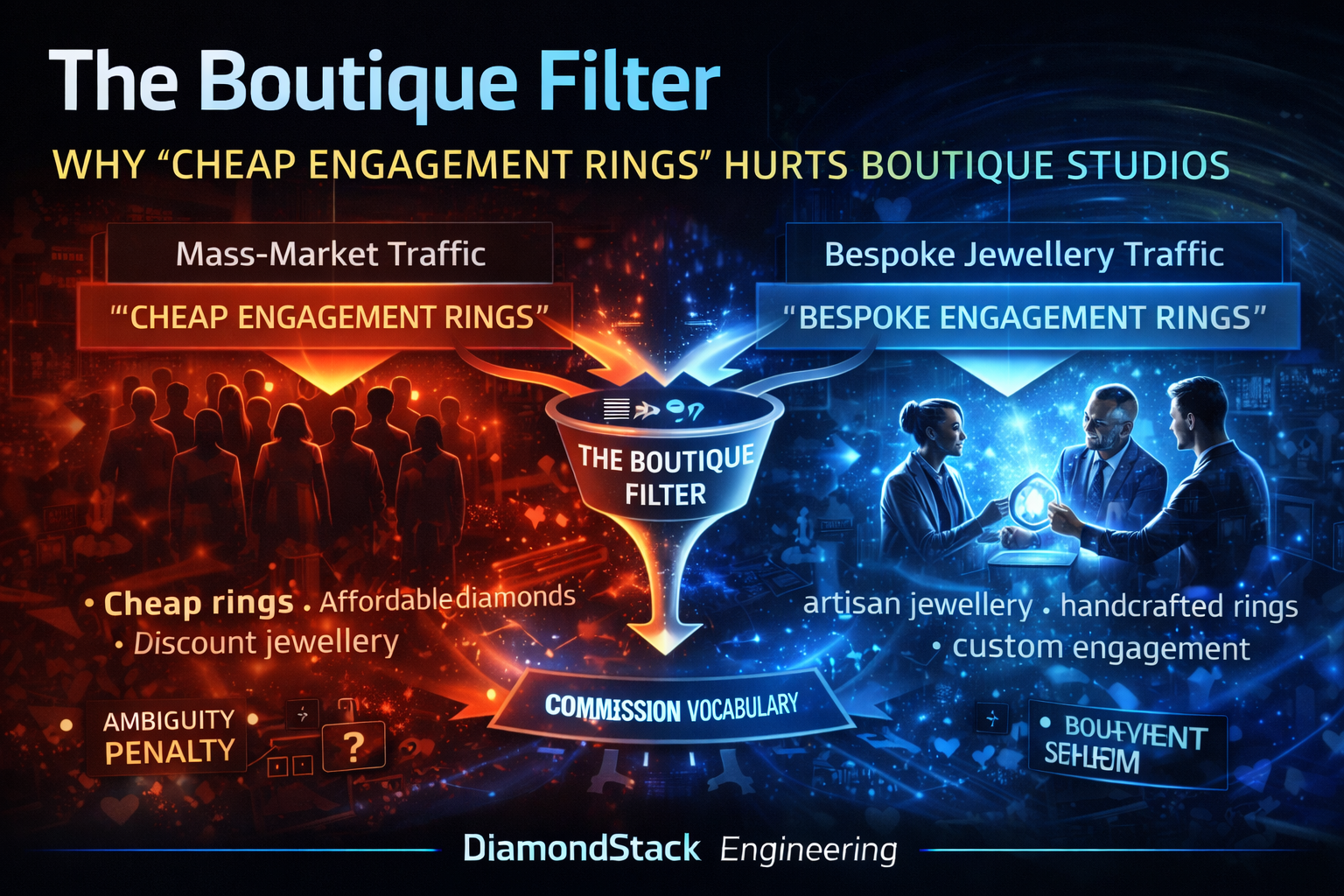
The Boutique Filter: Why Ranking for “Cheap Engagement Rings” Is Actively Harming Your Studio
Many jewellery retailers believe the objective of SEO is simple:
Rank for the biggest keywords.
Terms like:
- cheap engagement rings
- affordable engagement rings
- discount diamond rings
often receive tens of thousands of searches each month. On the surface, capturing that traffic appears to be a logical strategy.
More traffic should mean more customers.
But for boutique jewellery studios — particularly those specialising in bespoke engagement rings or artisan craftsmanship — ranking for these terms can actively damage the business.
This phenomenon occurs because search engines attempt to understand what kind of company a website represents.
When a boutique studio ranks for mass-market price queries, it sends a powerful but misleading signal:
“This brand competes on price.”
Over time, the search engine’s internal model of the business begins to shift away from luxury craftsmanship and toward commodity retail.
This misalignment triggers what the Coetzee Resonance Protocol (CRP) describes as the Ambiguity Penalty.
The solution is a deliberate strategy called The Boutique Filter — a method of intentionally removing mass-market search signals and replacing them with commission vocabulary that aligns with bespoke jewellery positioning.
The Traffic Illusion
The idea that “more traffic is always better” is one of the most persistent myths in digital marketing.
Traffic is only valuable when it matches the intent and economic reality of the business.
A boutique jewellery studio typically operates very differently from mass-market jewellery retailers.
Mass retailers depend on:
- large product catalogues
- price competition
- volume sales
Boutique studios operate on a completely different economic model.
They rely on:
- custom commissions
- personal design consultations
- high-value, low-volume transactions
For these businesses, attracting the wrong type of visitor can actually weaken the marketing system.
Someone searching for cheap engagement rings is rarely looking for:
- a bespoke designer
- a handcrafted ring
- a private diamond consultation
They are searching for the lowest possible price.
If that audience begins interacting with a boutique site, it creates behavioural signals that contradict the brand’s intended positioning.
The Mass-Market Trap
When a jewellery studio ranks for price-driven queries, several things begin to happen.
Visitors arriving from these searches often:
- bounce quickly when prices are higher than expected
- browse briefly without engaging
- abandon the site after seeing bespoke pricing structures
From the perspective of the search engine, this behaviour creates negative signals:
- low engagement
- short session duration
- poor conversion behaviour
These signals suggest that the website is not satisfying the query intent.
Search engines then face a classification problem.
If the website attracts price-sensitive traffic but does not behave like a price-driven retailer, the system struggles to categorise it properly.
This classification conflict is the root of the Ambiguity Penalty.
The Ambiguity Penalty
Search engines rely on patterns to understand what a website represents.
They analyse signals such as:
- page vocabulary
- internal linking structures
- user engagement behaviour
- topic clusters
When these signals align, the search engine can confidently classify the brand.
But when signals conflict, the classification becomes unstable.
For example, a boutique jewellery studio might publish content targeting:
- cheap engagement rings
- budget diamond rings
while simultaneously promoting services such as:
- bespoke engagement ring design
- private diamond sourcing
- handcrafted jewellery commissions
To a search engine, this combination creates confusion.
Is the business a discount jewellery retailer?
Or is it a high-end bespoke studio?
Because the signals conflict, the search engine weakens its confidence in both interpretations.
This is the Ambiguity Penalty.
Instead of ranking strongly for luxury queries, the site becomes diluted across multiple market segments.
Luxury Search Intent vs Commodity Search Intent
The difference between mass-market jewellery buyers and bespoke clients is not simply budget.
It is intent language.
Commodity buyers tend to search for:
- cheap engagement rings
- affordable diamond rings
- discount jewellery
Their decision process is primarily driven by price comparison.
Bespoke clients search very differently.
Their queries tend to include terms such as:
- custom engagement rings
- bespoke diamond ring designer
- handmade engagement rings
- artisan jewellery studio
These searches signal a completely different mindset.
The user is not comparing prices across catalogues.
They are searching for a designer or craftsperson.
This distinction is critical for search engines.
The language surrounding a site determines how it is classified within the search ecosystem.
Commission Vocabulary
The Boutique Filter works by replacing catalogue-oriented language with commission-oriented language.
This shift is subtle but powerful.
Instead of emphasising product inventory, the site emphasises design collaboration.
Examples of commission vocabulary include:
- bespoke engagement ring
- custom diamond design
- private consultation
- handcrafted jewellery
- artisan ring maker
These phrases communicate that the business operates within a creative commission model, not a price-driven catalogue model.
When this vocabulary appears consistently across:
- service pages
- blog content
- internal linking structures
search engines begin to understand the brand’s position in the jewellery market.
Implementing the Boutique Filter
Applying the Boutique Filter requires a deliberate restructuring of the site’s content strategy.
Step 1: Identify Mass-Market Pages
First, audit existing pages that target price-oriented search queries.
Examples include:
- cheap engagement rings
- affordable diamond rings
- discount jewellery
These pages often attract large traffic volumes but generate minimal revenue.
Step 2: De-Index Low-Intent Content
Instead of deleting these pages entirely, they can be removed from search indexes using:
- noindex directives
- canonical consolidation
- content restructuring
This reduces the site’s exposure to incompatible traffic.
Step 3: Replace Catalogue Language
Rewrite product and service descriptions using commission vocabulary.
Instead of emphasising price and availability, emphasise:
- craftsmanship
- design collaboration
- gemstone sourcing expertise
Step 4: Publish Commission-Focused Content
Content strategy should revolve around topics such as:
- how bespoke engagement rings are designed
- choosing diamonds for custom rings
- the design journey of a handcrafted engagement ring
These topics attract audiences seeking expert craftsmanship, not discount shopping.
Resonance Alignment in the Coetzee Resonance Protocol
Within the Coetzee Resonance Protocol, search visibility depends on resonance alignment.
Resonance occurs when three elements match:
- Brand positioning
- Search intent
- Content vocabulary
When a boutique studio attracts mass-market traffic, resonance breaks.
The search engine cannot determine the brand’s true identity.
The Boutique Filter restores resonance by ensuring that the audience, language, and brand positioning operate within the same semantic space.
Once this alignment occurs, search engines gain confidence in the brand classification.
The site begins to rank more strongly for:
- bespoke engagement rings
- custom diamond ring design
- artisan jewellery studios
These searches may have lower overall volume, but they carry far higher commercial intent.
The Strategic Advantage of Filtering Traffic
At first glance, removing high-volume keywords may seem counterintuitive.
However, boutique studios benefit from qualified demand, not mass traffic.
Filtering out incompatible search terms provides several advantages.
Stronger Brand Classification
Search engines gain a clearer understanding of the brand’s market position.
Higher Conversion Rates
Visitors arriving through commission-focused queries are more likely to engage with the studio.
Better Engagement Signals
Users spend more time exploring design processes and consultation options.
Increased Authority in the Luxury Segment
Over time, the site becomes recognised as a specialist in bespoke jewellery design.
These advantages outweigh the superficial appeal of mass traffic.
Conclusion
For boutique jewellery studios, SEO success is not measured by the number of visitors.
It is measured by alignment between the brand and the audience it attracts.
Ranking for terms like cheap engagement rings introduces traffic that conflicts with the economic and creative model of bespoke jewellery businesses.
This misalignment triggers the Ambiguity Penalty, weakening the brand’s ability to rank for the searches that actually generate commissions.
The Boutique Filter, as defined within the Coetzee Resonance Protocol, solves this problem by intentionally removing mass-market search signals and replacing them with commission vocabulary.
When a studio aligns its content with the language of craftsmanship and custom design, search engines gain a clear understanding of what the business represents.
And once that clarity exists, the right clients begin to find the studio.
Not because it ranks for the most traffic.
But because it resonates with the people searching for something truly bespoke.