
How to Automate Your Jewellery Business Without Losing the Personal Touch
How to Automate Your Jewellery Business Without Losing the Personal Touch
“I don’t want my business to feel robotic.”
This is one of the most common concerns jewellers have when the topic of automation comes up.
And it makes sense.
Jewellery is not just a product — it’s emotional, personal, and often tied to life’s most important moments. Engagements, anniversaries, milestones — these are not transactions you want to treat like a checkout process.
But here’s the reality:
The problem isn’t automation. The problem is how it’s used.
When done correctly, automation doesn’t remove the personal touch — it enhances it.
This article will show you how.
The Biggest Misconception About Automation
Most jewellers associate automation with:
- Generic messages
- Cold, impersonal systems
- Losing control over client relationships
This is a misunderstanding.
Automation is not about replacing people — it’s about removing friction.
It handles repetitive, time-consuming tasks so that you can focus on what actually matters:
- Client relationships
- Design and craftsmanship
- High-value conversations
When used properly, automation makes your business feel more responsive, more organised, and more professional — not less personal.
What Should NEVER Be Automated
Before discussing what to automate, it’s critical to define what should remain human.
1. Personal Consultations
This is where trust is built and vision is understood. No system can replace this.
2. Design Decisions
Custom jewellery requires creativity and collaboration. This must remain personal.
3. High-Value Client Conversations
When clients are making significant purchases, they expect real interaction.
Rule: If it involves emotion, trust, or decision-making — keep it human.
What SHOULD Be Automated (High-Impact Areas)
This is where automation creates the biggest advantage.
1. Lead Capture & Organisation
- Automatically capture enquiry details
- Store client information in a structured system
Impact: No lost leads, faster response times.
2. Follow-Ups & Reminders
- Automated follow-up sequences
- Reminders for pending quotes
Impact: More conversions without extra effort.
3. Quoting Processes
- Standardised pricing structures
- Faster quote generation
Impact: Reduced delays, improved client confidence.
4. Order Updates
- Automatic notifications for production progress
- Delivery updates
Impact: Clients feel informed and valued.
5. Internal Workflows
- Task assignments
- Production tracking
- Status updates
Impact: Smoother operations, fewer errors.
How Automation Improves Client Experience
When implemented correctly, automation doesn’t reduce quality — it improves it.
- Faster Responses: Clients don’t wait for replies
- Consistent Communication: No missed updates
- Professional Experience: Structured and reliable
- Less Friction: Easier for clients to move forward
Result: Clients feel taken care of — not ignored.
The Balance: Automation + Personalisation
The key to success is not choosing between automation and personalisation — it’s combining them.
Use Automation For:
- Speed
- Organisation
- Repetitive tasks
Use Human Interaction For:
- Emotional connection
- Trust-building
- Decision-making
This balance is what creates a premium client experience.
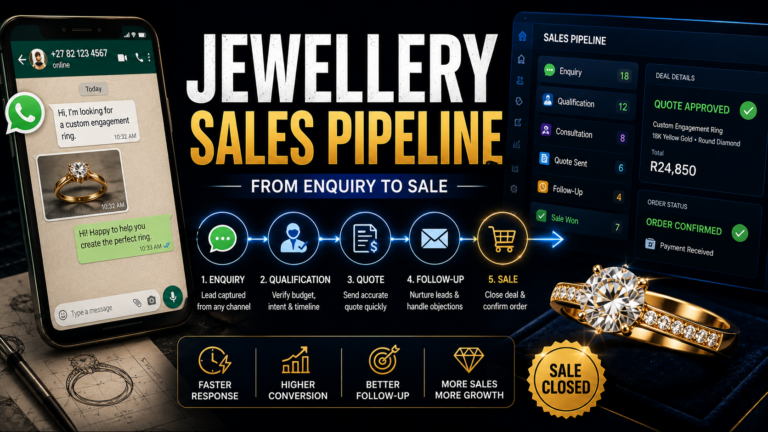
Real-World Example: Automated but Personal Client Journey
Scenario: A client enquires about a custom engagement ring.
- Step 1: Enquiry automatically captured and organised
- Step 2: Follow-up reminder ensures quick response
- Step 3: Personal consultation conducted (human)
- Step 4: Quote generated quickly using structured system
- Step 5: Automated updates keep client informed
- Step 6: Final delivery handled with personal interaction
Outcome: Faster process, better experience, stronger relationship.
Common Automation Mistakes
Over-Automation
Trying to automate everything leads to a robotic experience.
Generic Messaging
Clients can tell when communication lacks personalisation.
Poor Implementation
Automation without structure creates confusion.
Losing Human Touch
Forgetting where personal interaction is required.
How to Start Automating Your Jewellery Business
1. Identify Repetitive Tasks
What takes time but adds little value?
2. Start Small
Begin with lead capture and follow-ups.
3. Introduce Systems Gradually
Build your automation layer step by step.
4. Maintain Personalisation
Ensure communication still feels human.
Why Diamond Stack Enables Smart Automation
Most automation tools are generic. They don’t understand how jewellers operate.
Diamond Stack is designed differently:
- Built around jewellery workflows
- Balances automation with control
- Integrates sales, quoting, and operations
It doesn’t replace your personal touch — it strengthens it.
Key Takeaways
- Automation does not remove personal touch — it enhances it
- The right tasks should be automated, not everything
- Client experience improves with speed and consistency
- Balance between automation and human interaction is critical
Conclusion
The fear of automation is understandable — but misplaced.
The real risk is not automation. It’s inefficiency.
In a competitive market, clients expect fast responses, clear communication, and a seamless experience.
Without systems, delivering that consistently becomes impossible.
Automation, when done correctly, doesn’t make your business less personal — it makes it more professional, more responsive, and more scalable.
FAQ
Can you automate a jewellery business?
Yes, many operational tasks can be automated while maintaining personal client interactions.
Will automation make my business impersonal?
No, if implemented correctly, it enhances the client experience by improving speed and consistency.
What should not be automated?
Consultations, design decisions, and high-value client interactions should remain human.
How does automation improve sales?
By ensuring faster responses, better follow-ups, and fewer missed opportunities.
Where should I start with automation?
Begin with lead capture, follow-ups, and simple workflow automation.
Do small jewellers need automation?
Yes, even basic automation can significantly improve efficiency and growth.