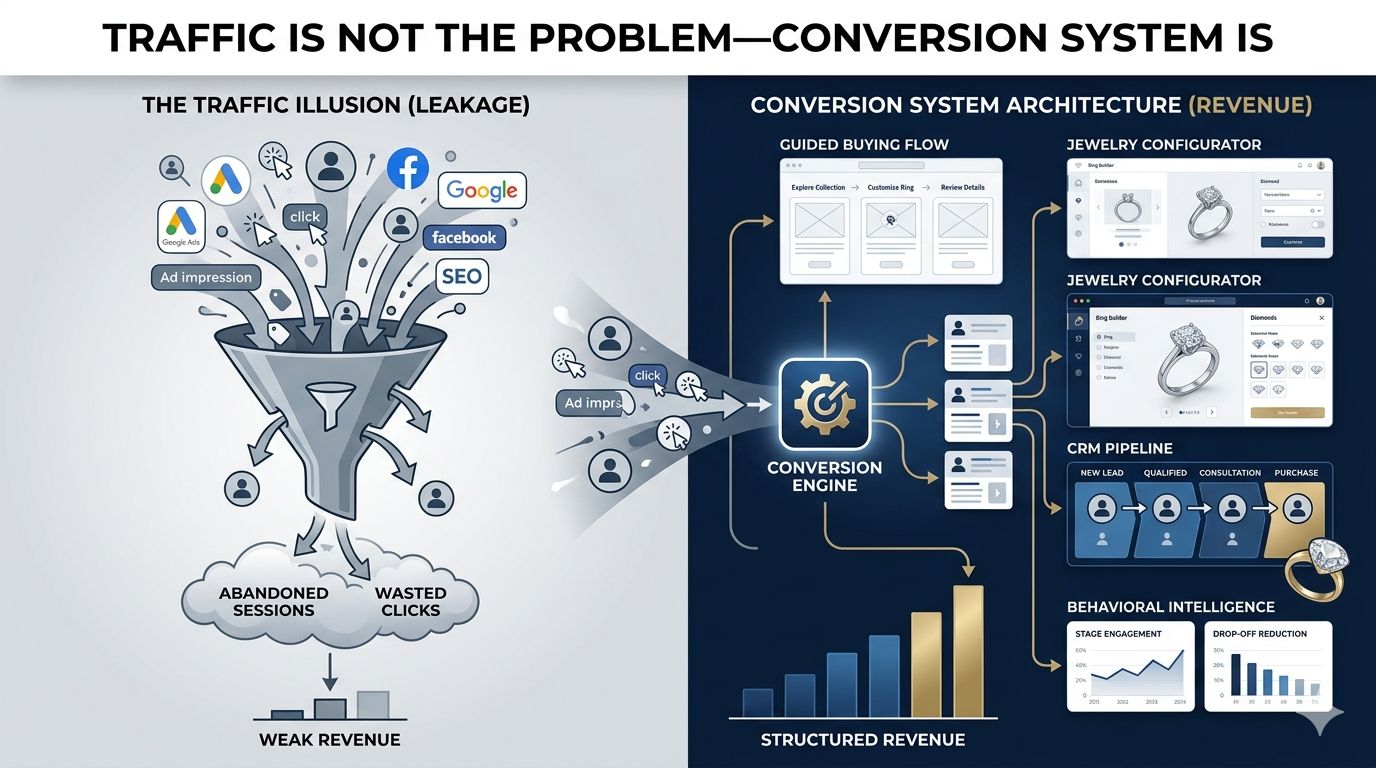
Why Jewellery Businesses Don’t Have a Traffic Problem—They Have a Conversion System Problem
Most jewellery businesses misdiagnose their growth problem.
When revenue is stagnant, the immediate assumption is almost always the same:
- “We need more traffic”
- “SEO isn’t working”
- “Ads aren’t converting because we need more reach”
- “Social media isn’t generating enough leads”
So the response follows a predictable pattern:
increase spend, increase reach, increase visibility.
But in most jewellery businesses, especially those operating in high-ticket categories like engagement rings and custom pieces, this diagnosis is structurally incorrect.
Because in reality:
most jewellery businesses already have enough traffic—they just don’t have a system that converts it efficiently
The problem is not demand.
The problem is conversion architecture.
The Myth: “We Just Need More Traffic”
Traffic is the easiest metric to chase because it is visible.
You can measure it daily:
- visitors
- impressions
- clicks
- sessions
So it becomes the default lever for growth.
But traffic is not a revenue system. It is only input.
And increasing input into a broken system does not fix output.
It amplifies inefficiency.
If your conversion system is weak, more traffic simply means:
- more confusion
- more wasted attention
- more unqualified enquiries
- more operational noise
Not more revenue.
Why Jewellery Traffic Already Has Intent
Unlike many eCommerce categories, jewellery traffic is rarely passive.
People are not casually browsing jewellery in the same way they browse clothing or gadgets.
They are usually driven by:
- engagement planning
- anniversaries
- gifting occasions
- emotional milestones
- aspirational research
This means:
jewellery traffic is already high-intent by default
But intent is not the same as readiness.
A user can be emotionally interested but still structurally unprepared to buy.
And that gap is where most revenue is lost.
Where Traffic Actually Breaks Down
If traffic is not the issue, the real question becomes:
where does intent fail to become conversion?
The answer is almost always systemic.
A. No guided decision flow
Most jewellery websites operate as open catalogues.
Users are expected to:
- browse categories
- compare products
- interpret pricing
- make a decision independently
But jewellery decisions are not simple comparisons.
They are multi-variable, emotional, and uncertain.
Without structured guidance:
- users get overwhelmed
- choices feel indistinguishable
- decision fatigue increases
And when uncertainty increases:
customers delay or abandon the decision entirely
B. Weak product understanding systems
Jewellery is not visually self-explanatory in digital environments.
Customers need clarity on:
- diamond quality differences
- setting implications
- pricing logic
- customization options
- perceived value
But most websites present products as static images with limited explanation.
So users are forced to interpret value themselves.
That creates friction.
And friction reduces conversion.
C. No behavioural tracking or intent detection
Most jewellery businesses cannot answer questions like:
- Which users are repeatedly viewing the same product?
- Which users are engaging with configurators?
- Where do users hesitate or drop off?
- Which price ranges are being explored most?
Without this visibility:
intent exists, but remains invisible to the business
And invisible intent cannot be prioritised or nurtured.
D. No CRM integration or structured pipeline
In many jewellery businesses, customer data lives in fragments:
- WhatsApp chats
- emails
- spreadsheets
- basic enquiry forms
There is no unified conversion pipeline.
So leads are treated equally regardless of:
- intent level
- budget
- readiness
- engagement depth
This leads to a critical inefficiency:
high-value buyers are not systematically prioritised
E. Lack of trust reinforcement systems
Trust is not a single element in jewellery sales.
It is a continuous requirement.
At each stage, customers need reassurance:
- Is this real value?
- Is this quality consistent?
- Am I making the right decision?
- Can I trust this seller?
Most websites only provide trust signals at the surface level:
- reviews
- certifications
- branding
But trust must be reinforced throughout the journey—not just at entry.
Without this reinforcement:
uncertainty dominates the decision process
And uncertainty stops conversion.
The Hidden Truth: Most Jewellery Websites Are Not Conversion Systems
A critical misunderstanding exists in jewellery eCommerce:
Most businesses believe they have a “sales funnel”.
But in reality, they have a catalogue with contact options.
There is no structured conversion system guiding users from:
- interest → understanding → confidence → decision
Instead, users are left to self-navigate a complex emotional and financial decision.
And that rarely ends in consistent conversion.
Because:
browsing is not the same as decision-making
What a Real Conversion System Looks Like
A high-performing jewellery eCommerce system is not a website.
It is a layered architecture designed around decision behaviour.
1. Conversion architecture layer
This defines how users move through decisions:
- guided buying journeys
- structured product pathways
- reduced cognitive load navigation
Instead of browsing freely, users are guided intentionally.
2. Product configuration layer
This enables real interaction with the product:
- ring builders
- diamond selection systems
- real-time visualisation
- dynamic pricing updates
This reduces imagination dependency and increases certainty.
3. Behavioural intelligence layer
This captures intent signals:
- repeated product views
- configuration behaviour
- engagement depth
- hesitation patterns
It transforms passive traffic into structured intelligence.
4. CRM and sales pipeline layer
This ensures no intent is lost:
- lead scoring
- structured follow-up flows
- prioritised sales engagement
- pipeline visibility
It converts behaviour into action.
5. Marketing input layer
Marketing is only responsible for one thing:
feeding the system with traffic
But it does not determine conversion.
The system does.
Why More Traffic Makes Weak Systems Worse
This is the part most businesses miss.
If your conversion system is weak, increasing traffic does not improve performance.
It creates compounding inefficiency:
- more low-quality leads enter the system
- sales teams become overloaded
- response quality decreases
- high-intent leads get delayed or ignored
- conversion rates decline further
To compensate, businesses increase marketing spend again.
Which creates a loop:
more traffic → lower efficiency → more spend → weaker ROI
At scale, this becomes structurally expensive.
Signs You Have a Conversion Problem (Not a Traffic Problem)
Most jewellery businesses already have the symptoms:
- traffic is stable or growing, but revenue is not
- enquiries are inconsistent in quality
- many users browse but do not enquire
- WhatsApp becomes the primary sales channel
- sales depend heavily on manual follow-up
- customers delay decisions despite strong interest
- conversion rate does not improve with more traffic
These are not marketing problems.
They are system design problems.
What Improving Conversion Actually Requires
Fixing conversion is not about “optimising ads” or “improving landing pages”.
It requires system-level changes.
A. Guided buying systems
Customers need structured pathways:
- budget-first journeys
- style-based narrowing
- intent-based flows
This reduces cognitive load and decision friction.
B. Decision-support configurators
Instead of static browsing, users must interact with products:
- ring builders
- diamond comparison tools
- live visual feedback
This turns uncertainty into clarity.
C. CRM-driven prioritisation
Not all leads are equal.
A proper system identifies:
- high-intent users
- mid-consideration users
- low-intent browsers
And treats them differently.
D. Behavioural tracking systems
To improve conversion, you must understand behaviour:
- where users hesitate
- what they compare
- what they abandon
- what they revisit
Without this, optimisation is guesswork.
E. Trust reinforcement architecture
Trust must be embedded across the journey:
- not just on product pages
- not just at checkout
- but throughout decision stages
Clarity reduces friction.
And friction determines conversion.
Strategic Insight: Traffic Is Fuel, Not a System
Traffic does not create revenue.
It only creates opportunity.
The system determines what happens next.
A useful way to understand this:
- traffic = fuel
- conversion system = engine
- architecture = performance design
You can add more fuel (traffic), but if the engine is inefficient:
performance does not improve—it deteriorates
Conclusion
Most jewellery businesses are not struggling because they lack traffic.
They are struggling because they lack conversion systems capable of processing intent effectively.
This leads to a fundamental imbalance:
- strong interest
- weak conversion structure
- inconsistent revenue outcomes
The solution is not more marketing.
It is better system design.
Because in jewellery eCommerce:
traffic brings opportunity, but conversion systems determine revenue
And until that distinction is understood, businesses will continue to scale input instead of output.