Scaling Frameworks Without Diluting Logic — How to Avoid the ‘Degradation of Standards’ Problem
Erwee Coetzee
Diamond Stack
Cape Town, South Africa
Your Stone Selection Framework was perfect when Mthembu was the only one applying it. He’d watched you for two years. He understood not just the rules, but the reasoning behind the rules. When he faced an edge case, he could ask himself: “What would the founder do?” and arrive at the right answer.
Then you hired three new sourcing team members.
You trained them on the framework. They read the documentation. You did a 90-minute session explaining the logic. They seemed to understand.
Now, three months in, you’re noticing: the quality has slipped. Stones selected by the new team don’t have the same presence that Mthembu’s selections do. Customers comment on it. Repeat purchases are down.
You’re angry at the new team. You’re wondering if the framework is actually clear enough. You’re blaming externalisation for not working.
You’re wrong about all three things.
The Ostensive vs. Performative Gap
Martha Feldman and Brian Pentland (2003) studied how organisations maintain routines as they scale. They made a critical distinction: ostensive vs. performative.
Ostensive: What a routine is supposed to be (the documented version, the ideal)
Performative: How people actually do it (the lived version, the practical)
Your Stone Selection Framework’s ostensive version says: “Weigh collector psychology at 35%, presence at 40%, seasonal fit at 15%, market position at 10%.”
Mthembu’s performative version—how he actually applies it—is different. He weights presence higher when working with new collectors because he’s learned (through 18 months of feedback) that unknown collectors are risk-averse and presence reduces perceived risk. He weights seasonal fit differently depending on whether it’s early or late season. He adapts the weightings based on market momentum he’s sensing.
Mthembu’s performative version is better than the ostensive version because it’s been refined through experience. But it’s also invisible to the new hires.
Your new sourcing team members read the ostensive version and apply it literally. Presence at 40%. Seasonal fit at 15%. No adaptation. They’re following the framework. But they’re not getting the same results as Mthembu because they’re missing the tacit knowledge that’s built into his performative version.
Why This Isn’t Framework Failure—It’s Knowledge Asset Degradation
Dorothy Leonard-Barton (1992) studied how organisations lose knowledge assets as they scale. Her finding: the same knowledge that’s an asset in one context becomes a liability in another if it’s not transferred properly.
Your Stone Selection Framework is a knowledge asset. Mthembu embodies it. The framework itself (the ostensive version) is documented. But the knowledge that makes the framework work—the tacit, experiential understanding of how to apply it—lives in Mthembu’s judgment, not on a page.
When you hire new people, you transfer the ostensive version. They learn the rules. But they don’t get the refined performative version that Mthembu has developed through 18 months of calibration.
So they apply the framework rigidly. And the quality slips. Not because the framework is bad. But because the tacit knowledge—the performative refinement—hasn’t been transferred.
Worse: if your new hires apply the framework rigidly and it produces lower-quality results, they start to distrust the framework. “The weights don’t match the market.” They begin adapting it on their own, creating local variants. Now instead of having Mthembu’s refined performative version, you have four different interpretations of the framework.
That’s degradation.
The Solution: Make the Performative Visible
Here’s what you do, starting this week:
Step 1: Document Mthembu’s Performative Version
Sit with him for three sessions (similar to the framework articulation from Posts 4–6, but this time focused on practice refinement):
Session 1 (2 hours): “Show me your 20 best selections from the last six months. For each one, walk me through your thinking. What did you weight? Why? What did you notice about the market?”
As Mthembu talks, you’re documenting the actual weightings he used. You’ll probably find he’s using different weights than the documented framework suggests. That’s good. That’s the refinement you need to capture.
Session 2 (2 hours): “Show me your 10 hardest decisions. The edge cases. How did you apply the framework when it wasn’t obvious?”
This is where the tacit knowledge really lives—in how he adapts the framework under uncertainty.
Session 3 (2 hours): “Now let’s codify this. What rules of thumb have you developed? What do you notice about seasonal shifts? About collector psychology? About market momentum?”
You’re extracting the performative version and making it explicit.
Step 2: Create Two Tiers of Documentation
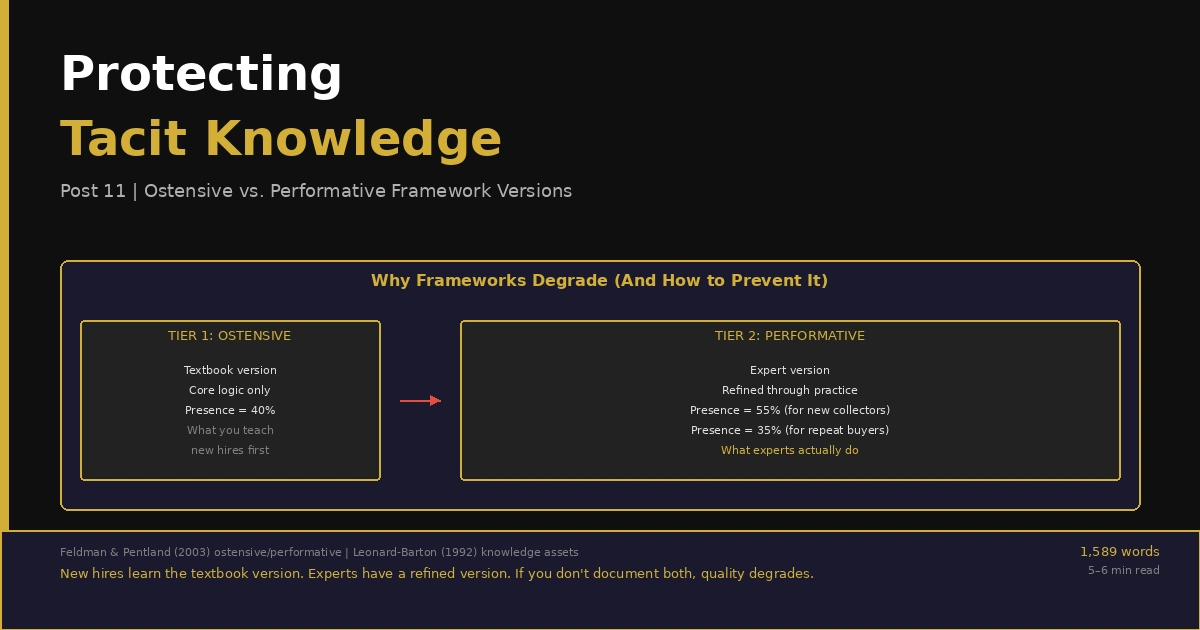
Tier 1 (Ostensive): “Here’s the framework: the core logic and weightings”
Tier 2 (Performative): “Here’s how an expert applies it: the refined rules of thumb, the edge case logic, the seasonal adaptations”
New hires learn Tier 1 first. But they’re told: “You’re reading the textbook version. The expert version is Tier 2. Your job over the next three months is to move from textbook to expert by observing how Mthembu applies it.”
Step 3: Create a “Refinement Review” Process
Every six months, you and Mthembu review his performative version. Ask:
“What rules of thumb have changed since last review? What’s the market teaching us? Should the Tier 2 documentation be updated?”
This keeps the performative version from calcifying. It evolves as Mthembu learns.
And it prevents the new hires from being trained on outdated tacit knowledge.
Why New Hires Actually Need Two Versions
This seems like extra work. Why not just train on Tier 2 (the refined version) from the start?
Because Tier 2 only makes sense once you understand Tier 1. The refinements are deviations from the core logic. If you don’t understand the core logic, the refinements seem arbitrary.
New hire learning arc:
Weeks 1–4: Learn Tier 1 (core framework, core logic)
Weeks 5–8: Observe Mthembu applying Tier 2 (watching the expert)
Weeks 9–12: Apply framework with Mthembu’s feedback (developing judgment)
Months 4–6: Independent application with quarterly calibration
Now the new hire isn’t just following the textbook. They’re internalising the refined performative version through observation and feedback.
Why This Matters for Post 12
Posts 9–10 solved consistency and decision-making at the 20-person scale. But if your frameworks are degrading as they spread, consistency is an illusion. You look consistent on paper but you’re diverging in practice.
Post 11 (this one) solves the degradation problem: make the performative version visible so new hires learn from the refined version, not the textbook version.
Post 12 will show you how to keep frameworks from becoming stale. Because here’s the risk: Mthembu’s refined performative version was perfect for 2024. But it’s 2026. The market has shifted. His rules of thumb are now constraints.
How do you know when a framework needs refreshing? Post 12 shows you the signals and the process.
Your Reflection for This Week
Look at your frameworks. Which ones have been diluted as they’ve spread?
Which expert (like Mthembu) has developed a refined performative version that new hires don’t know about? Which framework needs a Tier 2 (expert performance) documentation layer?
Start there. That’s your highest-leverage documentation project.
Research & References
Feldman, M. S., & Pentland, B. T. (2003). Reconceptualizing organizational routines as a source of flexibility and change. Administrative Science Quarterly, 48(1), 94–118.
The definitive work on ostensive (how a routine is supposed to be) vs. performative (how it’s actually done) versions. Shows why frameworks degrade as they scale and how to maintain coherence.
Leonard-Barton, D. (1992). Wellsprings of knowledge: Building and sustaining the sources of innovation. Harvard Business School Press.
On knowledge assets and how they become liabilities if not transferred properly. Explains why tacit knowledge (like Mthembu’s performative version) is essential to protect and transfer.
Argote, L., McEvily, B., & Reagans, R. (2003). Managing knowledge in organisations: An integrative framework and review of emerging themes. Management Science, 49(4), 571–582.
On knowledge transfer in organisations. Shows why documentation alone isn’t sufficient; tacit knowledge must be transferred through observation and feedback.
Winter, S. G. (2013). Habit, deliberation, and action: Strengthening the foundations of behavioural economics. Journal of Institutional Economics, 9(03), 315–328.
On how routines embody tacit knowledge and why that knowledge is difficult to codify. Relevant to understanding why frameworks need both ostensive and performative versions.