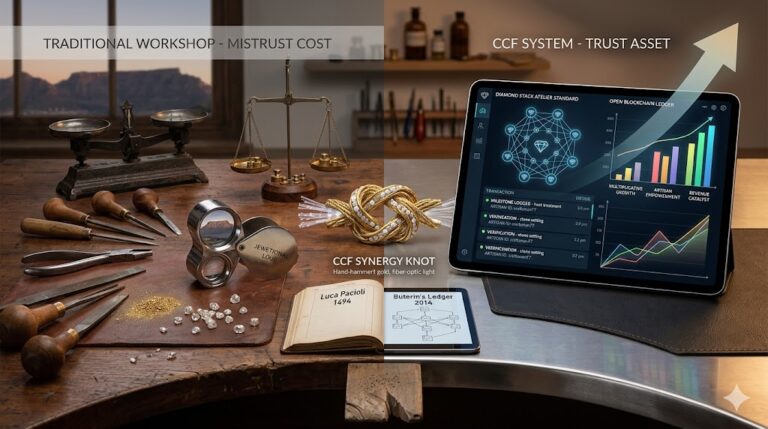

The Legacy Engine: How De-Risking Transforms Bespoke Jewellery Studios into Intergenerational Wealth Machines
In the luxury jewellery world, bespoke ateliers have long been romanticized as intimate sanctuaries of craft—places where a single founder’s vision turns raw gems into heirlooms. Yet beneath this allure lies a harsh economic reality: most studios operate as fragile, high-risk entities that depreciate rather than appreciate over time. Economic swings, rising material costs, geopolitical disruptions to supply chains, and intensifying demands for ethical sourcing amplify hidden vulnerabilities. Buyers—whether private clients, collectors, or potential acquirers—apply steep “doubt premiums,” discounting value because provenance is unverifiable, operations depend on individuals, and intangibles like brand trust remain unquantified.
The De-Risking Protocol, powered by Diamond Stack’s layered architecture (Atelier Ledger, Heritage Graph, and automated signals), flips this script. It doesn’t merely mitigate risks; it engineers studios into legacy engines—self-sustaining, antifragile systems that generate compounding intergenerational wealth. By converting opacity into verifiable truth and volatility into stability, the protocol elevates enterprise value far beyond traditional artisan models, turning what was once a personal passion project into a durable family or institutional asset.
Consider economic volatility, a persistent threat in 2026. Gold prices fluctuate wildly, gem markets react to inflation and tariffs, and bespoke clients delay commissions during uncertainty. Traditional studios absorb these shocks through founder heroics—personal loans, delayed payments, or rushed compromises that erode margins and quality. Buyers sense this fragility, applying risk discounts that can shave 30–50% off perceived worth in acquisitions or valuations. Diamond Stack counters this by embedding resilience at the core. The Atelier Ledger captures forensic, timestamped production data—macro photos of settings, precise metrics on tolerances, and real-time cost tracking—creating an auditable operational history. This data proves cost controls and quality consistency, even under stress. When markets tighten, a Diamond Stack-enabled studio demonstrates antifragility: it doesn’t just survive downturns; its documented efficiency attracts premium clients seeking reliability, while acquirers pay higher multiples for a business that withstands shocks without founder intervention.
Counterfeiting compounds these risks, eroding trust across luxury. The global counterfeit jewellery trade drains billions annually, with buyers wary of untraceable pieces losing resale value. Traditional certificates are easily forged, and “silent” heirlooms—those without documented origins—trade at discounts or remain unsold. Here, the Heritage Graph shines as a tamper-proof digital passport. By minting immutable records from mine to wearer (leveraging integrations like Nivoda for verifiable sourcing), it creates a blockchain-backed provenance chain that survives generations. This isn’t narrative marketing; it’s verifiable evidence that neutralizes fraud risk. A piece with a full Heritage Graph commands resale premiums because its authenticity is machine-readable and third-party verifiable. For the studio, this translates to higher client lifetime value—repeat commissions for traceable family pieces—and elevated brand equity, as your atelier becomes synonymous with unbreakable truth in a market plagued by doubt.
Sustainability and ESG pressures add another layer. Consumers, especially younger generations entering luxury, demand proof of ethical origins amid climate scrutiny and regulatory shifts toward traceability mandates. Greenwashing invites backlash, while opaque chains expose studios to reputational hits or supply disruptions. Diamond Stack’s automated signals provide the antidote: real-time ethical data flows (conflict-free certifications, low-impact sourcing via API links) embedded in every transaction. This transparency isn’t compliance burden—it’s a valuation accelerator. Studios aligned with ESG realities position themselves in the growing “conscious luxury” segment, where traceable pieces fetch premiums and attract institutional buyers. The protocol turns potential ESG vulnerabilities into competitive moats, boosting multiples by quantifying goodwill as liquid, inheritable equity.
Perhaps most transformative is the protocol’s role in generational wealth transfer. Estate planning for high-value jewellery collections often falters: heirs dispute valuations without provenance, tax authorities challenge undocumented goodwill, and forced sales occur at depressed prices during liquidity crunches. A 1924 family ring, beautiful but silent about its journey, loses narrative power across generations. The Heritage Graph changes this by creating a perpetual digital ledger—capturing resize histories, ownership transfers, and ethical markers—that survives the founder. This documented equity minimizes tax exposure (through substantiated stepped-up basis claims), reduces family conflicts, and preserves appreciating value. The studio itself becomes inheritable: its ledger-tracked operations, client signals, and provenance database form a proprietary asset base that successors or buyers can price accurately, avoiding the classic “key-person collapse.”
In essence, the De-Risking Protocol redefines the bespoke atelier from a craft-dependent venture to a legacy engine. Traditional models trap value in intangibles—reputation, relationships, intuition—that evaporate on exit. Diamond Stack externalizes and quantifies these into hard assets: immutable data layers that compound over time. Volatility becomes opportunity (proven resilience wins clients), counterfeiting becomes differentiation (unforgeable truth commands premiums), ESG becomes advantage (ethical signals attract conscious capital), and succession becomes continuity (verifiable equity endures transfers).
The result is mathematical valuation uplift. Risk discounts evaporate as asymmetry dissolves; multiples rise as the business resembles a database of verified luxury assets rather than a fragile workshop. Founders gain freedom—stepping back without guilt, knowing systems self-audit—while building wealth that outlives them. In a world of uncertainty, the protocol doesn’t just de-risk; it engineers antifragile growth, where stress (market shifts, scrutiny, generational change) strengthens the enterprise.
For Cape Town’s bespoke community and beyond, this isn’t incremental improvement—it’s a paradigm shift. The future belongs to ateliers that turn vulnerability into verifiable, compounding valuation. Diamond Stack makes that future operational today.