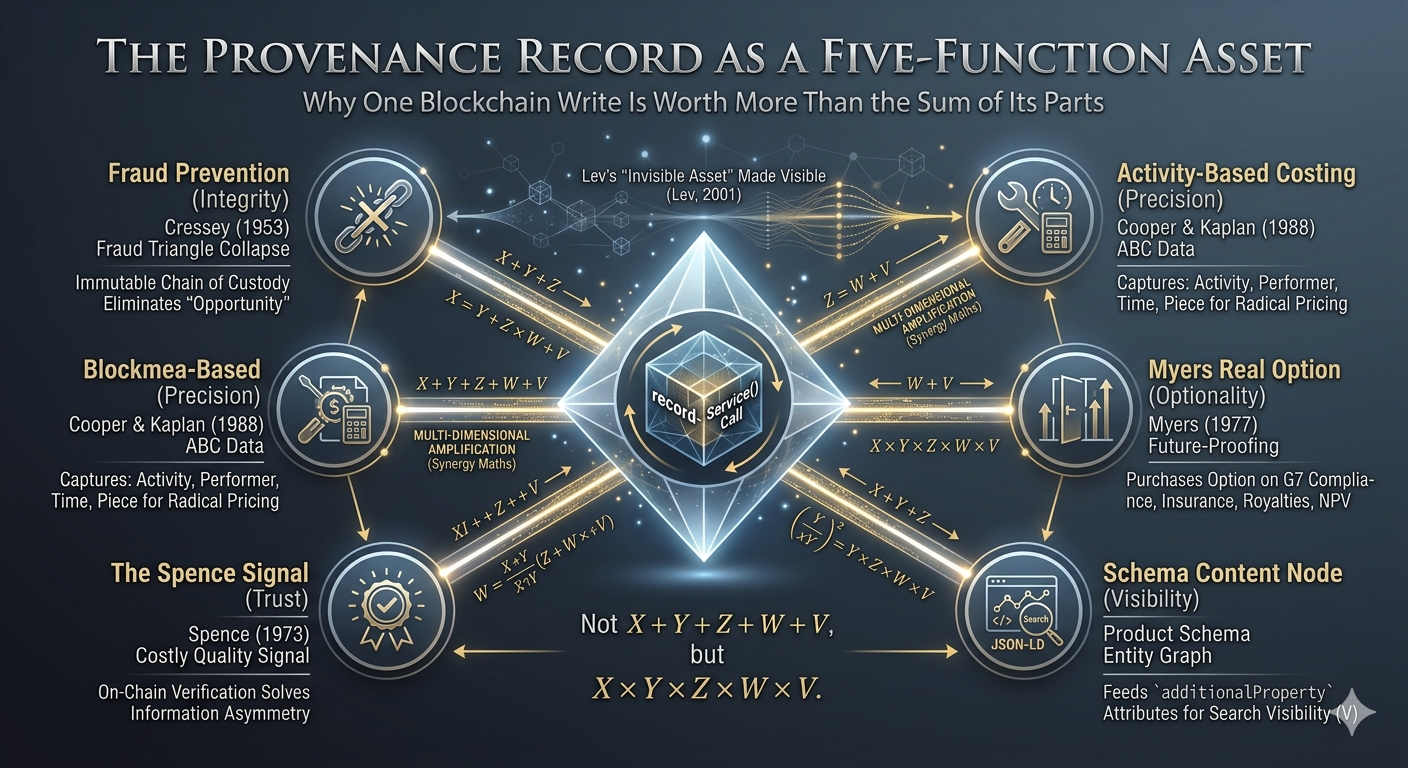
In the current luxury gemstone market, most blockchain implementations are merely “digital theatre”—static electronic replicas of the same paper certificates that have been vulnerable to forgery for decades. The Algorithmic Atelier identifies a fundamental shift: a single recordService() call on a decentralized ledger is not a solitary act of documentation. Instead, it is a high-velocity event that simultaneously activates value across five distinct economic and operational domains.
As Baruch Lev (2001) argues in Intangibles, certain invisible assets can drive disproportionate financial performance. The provenance record is that “invisible asset” made operational.
The Five Simultaneous Functions of a Single Record
When an artisan logs a service—whether it is a cut, a polish, or a repair—the single data entry performs five distinct roles:
Fraud Prevention (The Collapse of Cressey’s Triangle): By creating an immutable, timestamped chain of custody, the system eliminates the “Opportunity” arm of Cressey’s (1953) Fraud Triangle. If the record cannot be altered, the window for illicit substitution or origin-spoofing is permanently closed.
Activity-Based Costing (ABC Data): Following Cooper & Kaplan (1988), every record serves as a granular data point. It captures the activity, the performer, the time, and the specific piece. This transforms “overhead” into precise, traceable costs, allowing for radical pricing accuracy.
The Spence Quality Signal: In a market plagued by information asymmetry, an on-chain record acts as a “costly signal” (Spence, 1973). Because it requires a verifiable operational act to produce, it is a genuine signal of quality that a “lemon” producer cannot credibly mimic.
The Myers Real Option: Each entry is a strategic investment in future outcomes (Myers, 1977). It purchases the “option” for future G7 compliance, higher insurance appraisals, and secondary market royalties that would be impossible without a verified history.
Schema Content Node: On a technical level, the record populates the additionalProperty attributes of the Product Schema. This feeds the global entity graph, ensuring that the diamond’s unique “digital twin” is indexed and visible to search algorithms, driving organic traffic (V).
The Synergy Mathematics:
Traditional analysis treats these benefits as additive (
). The Algorithmic Atelier framework argues they are multiplicative.
The synergy is realized through the Informativeness Principle (Holmström, 1979). When an artisan knows their work is recorded on-chain, it creates a psychological and operational “feedback loop”:
Empowerment (Artisan)
Better Data (ABC)
Higher Pricing (Signal)
Improved GMROI (Accounting)
Further Infrastructure Investment (Flywheel).
The Synergy Matrix
Function
Economic Theory
Operational Impact
Integrity
Cressey (1953)
Eradicates the “opportunity” for fraud.
Precision
Cooper & Kaplan (1988)
Turns artisanal time into hard financial data.
Trust
Spence (1973)
Communicates value to a skeptical buyer.
Optionality
Myers (1977)
Secures future compliance and resale value.
Visibility
Schema.org / SEO
Ensures the asset exists in the global digital graph.
Conclusion: The Frontier of Intangible Assets
While Lev (2001) documented how intangibles affect performance, the CCF (Core Competency Framework) provides the first model for simultaneous activation in a micro-enterprise context. By moving beyond “digital theatre” and into multi-functional data records, the Algorithmic Atelier proves that a single blockchain write is worth significantly more than the sum of its parts.
References
Cressey, D. R. (1953). Other People’s Money: A Study in the Social Psychology of Embezzlement.
Cooper, R., & Kaplan, R. S. (1988). Measure Costs Right: Make the Right Decisions. Harvard Business Review.
Holmström, B. (1979). Moral Hazard and Observability. The Bell Journal of Economics.
Lev, B. (2001). Intangibles: Management, Measurement, and Reporting.
Myers, S. C. (1977). Determinants of Corporate Borrowing. Journal of Financial Economics.
Spence, M. (1973). Job Market Signaling. The Quarterly Journal of Economics.
The traditional jewellery retail model—buying wholesale, applying a standard markup, and letting inventory sit in a glass display case—is structurally broken. In the 2026 South African landscape, this “buy and hold” strategy is a fast track to insolvency, particularly within the hollowed-out middle market (R15,000 to R40,000). Caught between severe Rand (ZAR) volatility, persistent inflation,…
An engagement ring is not a standard eCommerce product. It is an emotional purchase.A status purchase.A trust-sensitive purchase.Often one of the most financially significant online transactions a customer will make before buying property or a vehicle. Yet most engagement ring product pages are engineered like ordinary retail pages. Beautiful imagery alone is not enough. Many…
Why Do Beautiful Luxury Brands Quietly Lose? Why do some luxury brands with beautiful websites, premium products, and decades of reputation quietly lose market share while technically inferior competitors dominate visibility, trust, and conversions? It is a question many luxury executives avoid asking. The answer is uncomfortable. The market rarely rewards beauty alone. Luxury retailers…
When you are selling luxury jewelry, you aren’t just selling a physical object. You’re selling a milestone, a legacy, and—for the buyer—a significant financial commitment. The problem is that 90% of e-commerce templates are built for “impulse buys.” They are engineered to sell sneakers, gadgets, and fast fashion. But nobody buys a R200,000 GIA-certified diamond…
Erwee CoetzeeDiamond StackCape Town, South Africa You’ve made it 18 months. Your Daily Provenance Log is automatic. Three frameworks are in rotation: stone selection, design direction, pricing. Your first team member—let’s call him Mthembu—is making 80% of decisions independently. You check in quarterly. The system works. But now you have 20 people. Not one team…