
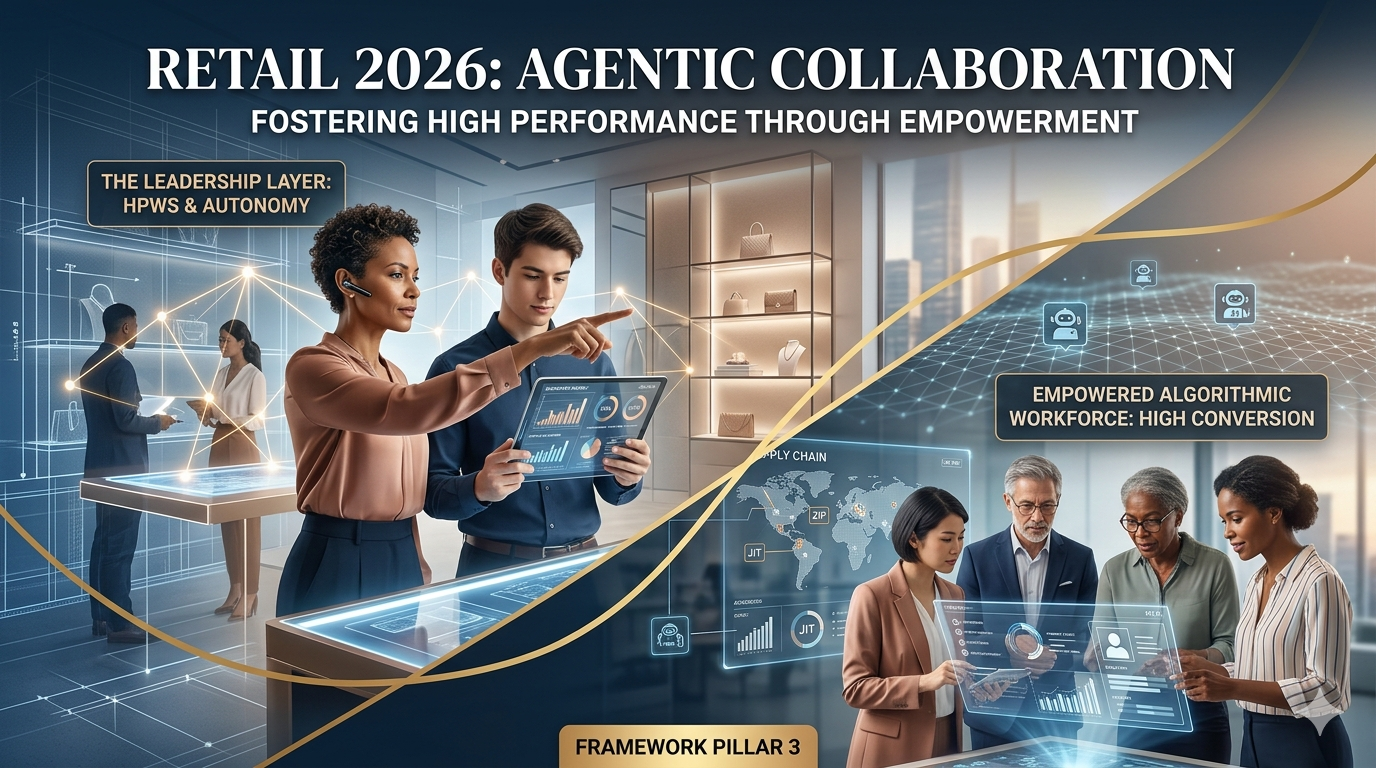
The Leadership Layer—Engineering the “Empowered Algorithmic Workforce”
The final pillar of the Core Competency Framework (CCF) is not technological, but cultural. While the “Algorithmic Atelier” and “ZIP Solution” provide the infrastructure, they remain inert without a Leadership Layer capable of operationalizing them. Turning a traditional sales team into an Empowered Algorithmic Workforce requires moving beyond conventional management toward High-Performance Work Systems (HPWS) that prioritize decision-making power and job autonomy.
1. From Transactional to Transformational Leadership
Traditional retail leadership often relies on close supervision and specific instructions. In 2026, the retail industry is navigating a profound technological transformation that demands transformational leadership—a style that directly impacts knowledge-sharing and organizational performance.
- Servant Leadership: Modern luxury leaders must put their team’s needs first, emphasizing personal growth and empowerment over mere results.
- Participative Decision-Making: Empowered workforces thrive when leaders delegate authority, encouraging employees to contribute to decisions before they are finalized.
2. The “Empowerment” Protocol
The CCF’s leadership strategy is grounded in psychological empowerment, which has been documented to significantly influence sales performance and customer satisfaction.
- Information Transparency: Sharing business information and career progression pathways is essential to fostering a sense of belonging and “upliftment”.
- The AMO Framework: High-performance is treated as a function of three variables: Ability (skills), Motivation (engagement), and Opportunity (the power to act).
- Digital Literacy: Leaders must complement traditional capabilities with enhanced competencies in innovation and digital literacy to navigate the era of agentic AI.
3. The 2026 Competitive Edge: Agentic Collaboration
By 2026, technology is shifting from aiding humans to acting on their behalf via agentic AI. An empowered workforce in this era uses AI “copilots” to provide instant, expert-level advice to clients, turning physical stores into high-tech “experience hubs”.
- Outcome-Driven Sales: Employees are trained to move away from “selling a product” to “managing a relationship” and delivering specific outcomes.
- Human-Machine Synergy: 2026 is defined by people who work with AI agents replacing those who do not.
The Final Synergy: Closing the Loop
The CCF’s untested hypothesis is now complete. When Leadership Empowerment (increased conversion) meets the Economics of Provenance (price premiums) and Accounting Efficiency (reduced capital risk via ZIP), the business achieves a structural improvement in GMROI that traditional models cannot replicate.
| Pillar | Action | Multiplier Effect |
|---|---|---|
| Leadership | Empowerment & HPWS | Higher conversion through expert authority. |
| Economics | Blockchain Provenance | Commands a “trust premium” on every sale. |
| Accounting | ZIP / JIT Inventory | Eliminates the capital “cash trap” entirely. |
References
- Lor, W., & Hassan, S. (2017). The Influence of Empowerment on Sales Performance.
- Majnoor & Vinayagam (2024). Integrated approaches to leadership development.
- McKinsey (2025). The State of Fashion 2026: When the rules change.
- Santoso et al. (2022). Transformational team development in retail.